
Reviewed · LUXOR WEST BANK TOURS
Tour to The East & West Bank of the Nile
Luxor’s greatest strength is also its biggest challenge: the ancient monuments are spread across both sides of the Nile. This private tour solves that problem in one long day, taking you from the Valley of the Kings and Hatshepsut’s Temple on the West Bank to Karnak and Luxor Temple on the East Bank.
I like the door-to-door private transport, especially if you are coming from a hotel or cruise ship, and I like that the price includes entrance fees, lunch, water, and a private Egyptologist. The drawback is simple: five major sites in about eight hours makes for a full day, with plenty of walking, heat, and a lot of information to absorb.
Key points to know before booking
- Five major Luxor sights in one day: Visit the Valley of the Kings, Hatshepsut’s Temple, Colossi of Memnon, Karnak, and Luxor Temple.
- Private rather than shared: Only your own group takes part, so the guide can adjust explanations and pacing.
- Tickets and lunch included: The $169 price covers the listed entrance fees, a meal at a good-quality restaurant, bottled water, transfers, and taxes.
- Strong guide element: Past guide assignments connected with this operator include Hany Refaat, Hany Taha, Marwa Ali, El-Tayeb, Hamy, Mansour, and Abdalla.
- Built for cruise and hotel guests: Pickup and return are included, with direct transport in a private air-conditioned vehicle.
- Plan for a demanding day: The scheduled visits alone add up to more than six hours, before driving and lunch.
Why this private Luxor route works
Luxor is not one compact archaeological park. The Nile divides the ancient city into two very different sightseeing areas, and each bank deserves time.
The West Bank is tied to death, burial, and the afterlife. The Valley of the Kings holds royal tombs cut into barren rock, while Hatshepsut’s Temple rises against the cliffs at Deir el-Bahari. The Colossi of Memnon give you a quick roadside stop before the route crosses back toward the old religious center on the East Bank.
The East Bank feels more like the ceremonial and public side of ancient Thebes. Karnak is immense and sprawling, while Luxor Temple sits right in the modern city. Seeing both in one day gives you a useful picture of how ancient Egypt functioned, rather than treating each monument as an isolated ruin.
A private guide matters here. Hieroglyphs, royal succession, temple rituals, and burial customs can blur together after a few hours. A good Egyptologist can explain the main ideas, answer your questions, and then give you quiet time to look around on your own.
A few other Luxor days to weigh up
- Hurghada: Luxor Valley of the Kings & Tutankhamun Tomb Trip
★ 4.7 · 13,208 reviews - Luxor: Valley of the Kings and Hatshepsut Temple Day Tour
★ 4.4 · 1,404 reviews - Hurghada: Luxor Tour with Valley of Kings, Karnak & Tut Tomb
★ 4.6 · 1,082 reviews
Valley of the Kings: two hours among royal tombs
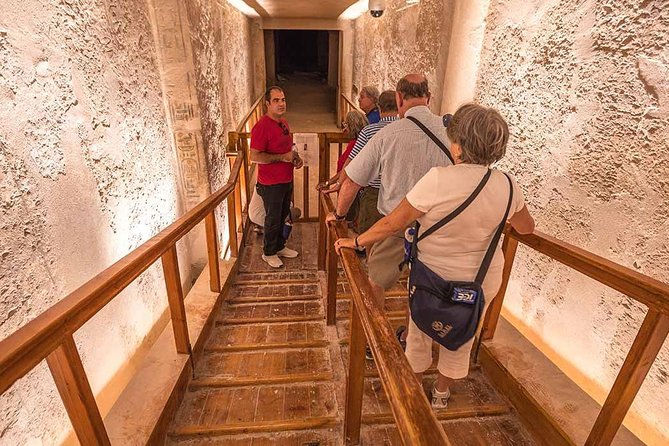
The first major stop is the Valley of the Kings, a dry gorge on Luxor’s West Bank. At ground level, it can look almost plain: red and beige rock, hard sun, and dusty paths. The real spectacle is below the surface, where 63 known tombs were cut into the hills over roughly 500 years.
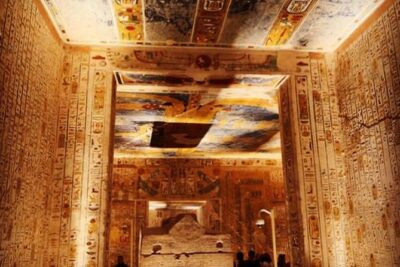
The valley served as a royal burial ground during the New Kingdom, from about the 16th to the 11th century BC. Pharaohs were placed in decorated chambers rather than the large pyramids associated with earlier periods. The tombs were designed to carry the dead ruler through the afterlife, so their walls are covered with painted texts, figures, and religious scenes.
The two-hour allocation is sensible because the site is not just one tomb. Your admission is included, but the standard ticket does not necessarily mean every special tomb is covered. Tutankhamun’s tomb, for example, is an important part of the valley’s modern fame, yet special tomb access can involve separate arrangements. Ask your guide what your ticket covers before entering.
Howard Carter’s 1922 discovery of Tutankhamun’s tomb made this valley famous around the world. Most of the pharaoh’s treasures are now associated with museum collections, but the story helps explain why the site draws such attention.
Inside the tombs, the experience is close and visual. You will see narrow passages, chambers, painted surfaces, and ancient symbols at eye level. Some tombs are easier to appreciate with a guide who can point out what matters, since the scale and repeated imagery can otherwise become confusing.
Expect heat and uneven walking. Wear sensible shoes, carry the bottled water provided, and save some energy for Karnak later. The valley is the most physically demanding stop for some people, even though much of the visit is not a long hike.
Hatshepsut’s Temple and the cliffs at Deir el-Bahari
From the valley, the tour continues to the Temple of Hatshepsut, with about an hour at the site. The temple’s setting is the star attraction: broad terraces and long lines rise toward pale limestone cliffs.
Hatshepsut ruled during Egypt’s New Kingdom after the deaths of her father, Tuthmose I, and her half-brother and husband, Tuthmose II. She took the title of pharaoh and used temple art and royal symbols to present her authority.
Your guide can help you read the temple as political messaging, not just architecture. Reliefs and statues show how Hatshepsut wanted her reign understood, while the design links the man-made terraces to the mountain wall behind them.
One hour is enough for a focused visit, but it will not let you linger over every detail. The open terraces offer little shade, so this is another place where sun protection and water matter. The reward is one of Luxor’s most memorable views, especially when you look back across the temple toward the dry West Bank.
Colossi of Memnon: a quick stop with a long story
The Colossi of Memnon takes about 15 minutes. That sounds brief, and it is, but the stop works as a pause between the larger West Bank sites.
The two seated statues portray Pharaoh Amenhotep III and once guarded the entrance to his mortuary temple. Each statue is described as about 60 feet tall, and smaller figures of the pharaoh’s wife and mother appear near his legs.
The name Colossi of Memnon comes from a later legend linked to the northern statue. After an earthquake, the damaged figure was said to make a mysterious sound at sunrise. The phenomenon helped give the statues their famous name, though the original Egyptian identity of the figures is Amenhotep III.
You will have time for photographs and a brief explanation, not a full exploration. Treat this as a useful orientation stop, since the missing mortuary temple makes the surviving statues feel like fragments of a much larger complex.
Same base, a completely different day out:
- Luxor Day Trip from Hurghada Small Group & Tutankhamun Tomb
★ 4.8 · 5,366 reviews - Hot Air Balloon Ride in Luxor Egypt with Transfers Included
★ 5.0 · 4,319 reviews - Luxor: Shared Full-Day Tour to Luxor West and East Banks
★ 4.5 · 1,812 reviews - Luxor: Hot Air Balloon Ride over Luxor Relics
★ 4.8 · 1,681 reviews
Lunch gives the day a needed reset
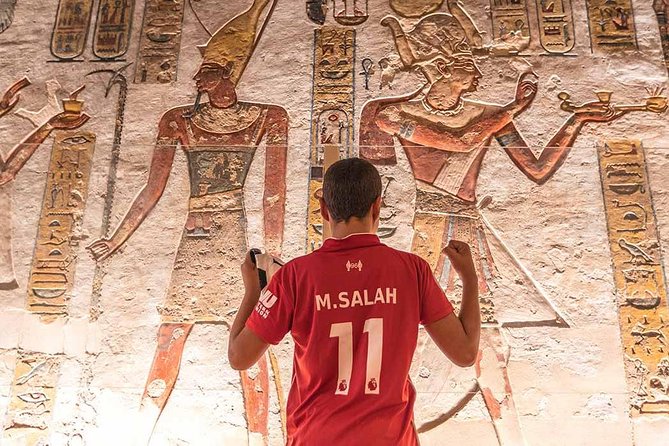
Lunch at a good-quality restaurant is included, along with bottled water in the vehicle. The exact restaurant and menu are not specified, so you should view this as a practical included meal rather than a promised culinary highlight.
That distinction matters on a tight sightseeing day. You do not have to spend time choosing a restaurant or settling a separate bill, and a sit-down meal gives you a chance to rest before the East Bank monuments.
The tour price also includes service charges and taxes. Tipping is not included, so keep that separate if you choose to tip the guide or driver.
Karnak: Egypt’s monumental religious center
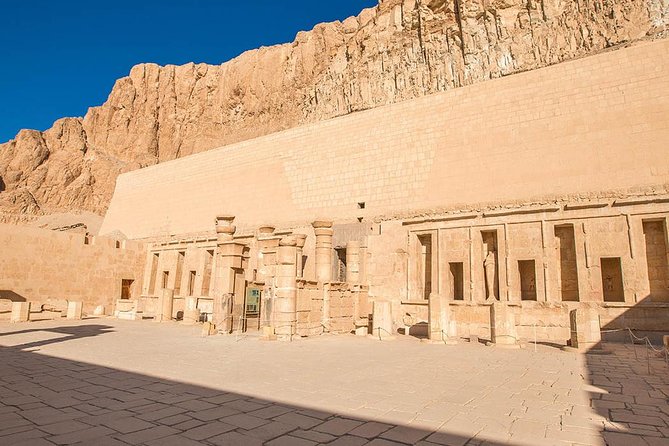
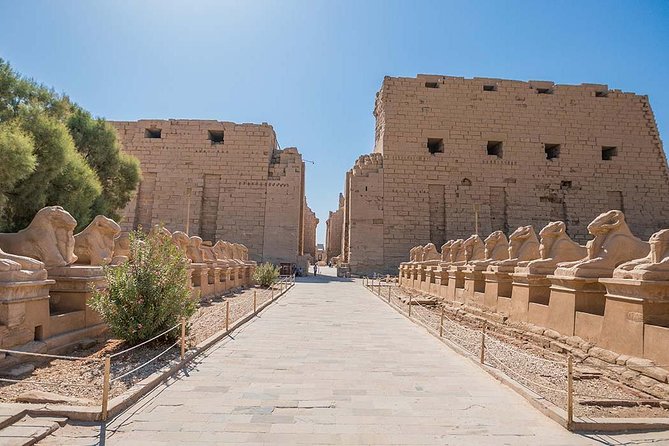
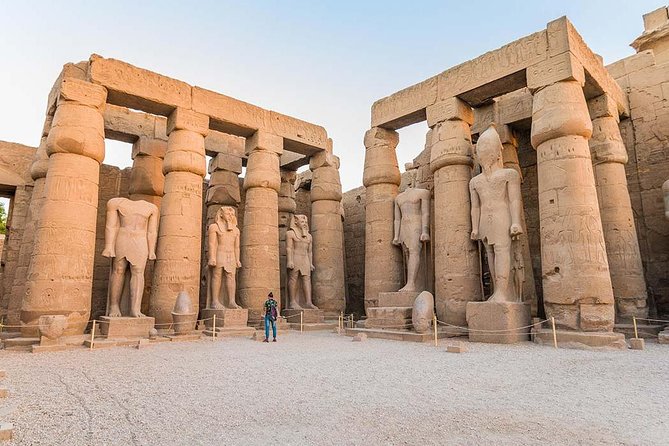
Karnak receives about two hours, and this is the stop that most benefits from a guide who can impose some order on the site. The complex grew over about 1,500 years, with successive pharaohs adding temples, pylons, sanctuaries, columns, statues, and inscriptions.
Karnak was the religious heart of ancient Thebes during the New Kingdom. It was not merely a place for worship. It also served as a treasury, administrative center, and royal complex, which helps explain its size.
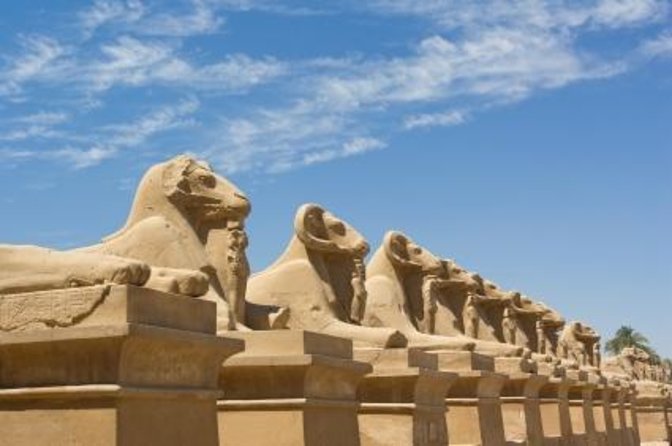
The famous approach includes the avenue of ram-headed sphinxes. The route once connected Karnak with Luxor Temple, stretching for roughly three miles, though you will not walk the whole ancient avenue on this tour.
Inside Karnak, the Great Hypostyle Hall is the visual heavyweight. Its forest of huge columns carries carved and painted decoration, and the scale makes it difficult to take in from a single viewpoint. This is where a guide can explain which rulers added which parts and why the complex feels like several temples joined together.
Two hours allows a meaningful visit, but Karnak can easily occupy half a day by itself. If you like architectural details, ask your Egyptologist to pause at the areas that interest you most. If you are tiring, stay focused on the major courtyards, columns, and sacred spaces rather than trying to see every corner.
Luxor Temple: ancient stone beside modern life
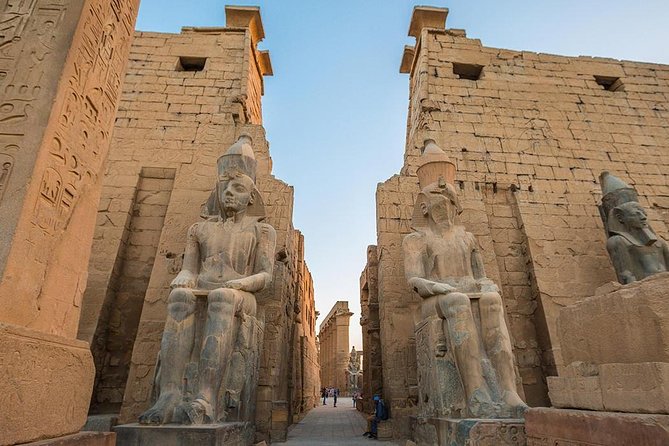
The final major stop is Luxor Temple, with about an hour inside the modern city of Luxor. Its location creates a striking contrast. Ancient stone and carved reliefs sit beside present-day streets, while the Nile flows nearby.
Unlike Karnak, Luxor Temple feels more compact and direct. Large statues, pylons, columns, and relief carvings remain in good condition, making it easier to understand the basic shape of the monument during a shorter visit.
The temple was part of ancient Thebes, the capital associated with Egypt’s New Kingdom. Its ceremonial role was tied to kingship and religious festivals, and its relationship with Karnak is reflected in the avenue of sphinxes that once joined the two sites.
If your timing brings you to Luxor Temple later in the day, lighting can add another layer to the visit. One of the supplied experiences describes arriving late in the afternoon and seeing the final temple well lit, though exact light conditions depend on the day and schedule.
An hour is enough to see the major features and hear the main explanation. You will not have unlimited time for photography or a slow study of every relief, so decide in advance whether you care more about the big architectural view or small carved details.
The guide can make or break the day
The tour promises a private English-speaking Egyptologist, but a specific guide is not guaranteed at booking. Names associated with past Memphis Tours assignments include Hany Refaat, Hany Taha, Marwa Ali, El-Tayeb, Hamy, Mansour, and Abdalla.
Several of these guides have been praised for explaining tombs, temple art, hieroglyphs, and the Nile in clear detail. Hany Refaat, in particular, is described as a guide who could explain hieroglyphs and adapt the amount of information to the group. Marwa Ali is noted for a friendly, highly informed approach, while El-Tayeb is associated with a relaxed style and time for questions.
Those names are useful context, not a promise. Your actual guide may be someone else, and the quality of the day will depend partly on how well the guide matches your interests.
Tell the Egyptologist what you want early. You may prefer a broad story of pharaohs and religion, or you may want more time on art, architecture, archaeology, or royal personalities. In a private vehicle and private group, you have more room to ask for that adjustment than you would on a large coach tour.
Transport, pace, and the real value of $169
At $169 per person, this is not the cheapest way to see Luxor. It is a package price for a private eight-hour day, not just a guide and a few monument tickets.
The price includes pickup and return from your Luxor hotel, or direct service from your ship, private air-conditioned transfers, an Egyptologist, entrance fees to the listed sites, lunch, bottled water, taxes, and service charges. Once those costs are separated, the value becomes easier to judge.
For a couple or small group, the private format can be worthwhile. You avoid waiting for a large group, and you can ask questions without competing for the guide’s attention. Group discounts may also affect the per-person cost, though the exact discount is not stated.
The tradeoff is the fixed route. You are paying for access to the main sights, not a slow, specialized archaeological day. The itinerary gives roughly two hours to the Valley of the Kings, one hour at Hatshepsut’s Temple, 15 minutes at the Colossi, two hours at Karnak, and one hour at Luxor Temple, with driving and lunch fitted into the eight-hour total.
That is efficient, but not leisurely. You should book it if your time in Luxor is limited and you want the major sites handled in one day. If you have several days in the city, separate visits may let you spend longer at Karnak or add other places not covered here.
Who should book this tour
This is a good fit for first-time visitors who want the essential monuments without sorting out transport between the two banks. It also suits cruise passengers who need a planned route and return transfer, as well as families or couples who prefer a private guide.
It works especially well if you want historical explanation rather than simply being dropped at the gates. The combination of tombs, temples, statues, lunch, and private transport gives you a clear first look at Luxor.
I would be more cautious if you dislike hot outdoor sites, long sightseeing days, or set schedules. The tour does not include tipping, extras, or anything outside the listed plan, and five major stops leave limited room for detours.
Free cancellation is available if you cancel at least 24 hours before the start time. Changes made later are not accepted, and poor weather can lead to a different date or a full refund.
Should you book the East and West Bank tour?
Book it if you want Luxor’s essential sights in one organized day, with tickets, lunch, transport, and a private Egyptologist already arranged. The strongest reasons are the private format and the chance to shape the guide’s explanations around your group.
Skip it, or choose a slower plan, if you have plenty of time and want to study each temple at length. For most first visits, though, this is a practical way to cover both banks without wasting precious hours on transport and planning.
FAQ
How long is the East and West Bank tour?
The tour lasts approximately eight hours. The planned visits total about six hours and 15 minutes, with the remaining time used for transport and lunch.
Is this a private tour?
Yes. Only your group participates, and the tour includes a private English-speaking Egyptologist.
Where does pickup take place?
Pickup is offered from your hotel in Luxor or directly from your ship. Return transportation is included.
What sites are included?
The tour visits the Valley of the Kings, Temple of Hatshepsut at Deir el-Bahari, Colossi of Memnon, Temple of Karnak, and Luxor Temple.
Are entrance fees included?
Yes. Entrance fees to all the listed sites are included in the tour price.
Is lunch included?
Yes. Lunch at a good-quality restaurant is included. The specific restaurant and menu are not stated.
Is bottled water provided?
Yes. Bottled water is provided aboard the private air-conditioned vehicle.
Is tipping included?
No. Tipping is not included, and any personal extras are also excluded.
Can most people take part?
The tour information states that most people can participate. The route includes walking at major archaeological sites, including outdoor areas and tomb entrances.
Can I cancel for a refund?
You can cancel for a full refund if you do so at least 24 hours before the experience start time. Cancellations or changes made less than 24 hours before the start are not accepted for a refund.
New on the Luxor list
- Private Tour Nile Felucca Ride at Sunset in Luxor★ 5.0 · 26 reviews
- Full-Day East and West Luxor Private Tour★ 4.5 · 26 reviews
- Marsa Alam: Snorkeling with Sea Turtles Marsa Mubarak★ 4.9 · 26 reviews
- Day Trip to Edfu & Kom Ombo temples from Luxor and drop off in Aswan or Luxor★ 5.0 · 26 reviews
- Private Full day East and West Bank, Luxor★ 5.0 · 26 reviews
- Luxor Day Tour: Kings Valley & Karnak & Luxor & Hatshepsut Temple★ 5.0 · 26 reviews
- Luxury Hot Air Balloon Experience in Luxor with Pick-up★ 5.0 · 27 reviews
- Full-Day Luxor Tour – Discover the East and West Banks of the Nile★ 5.0 · 27 reviews
Luxor West Bank Tours, compared.
Luxor Valley of the Kings & Tutankhamun Tomb Trip
Read our review →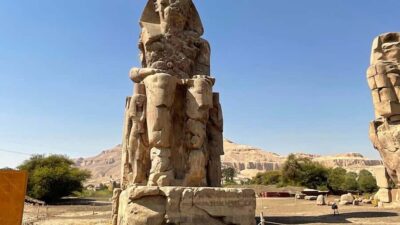
Valley of the Kings and Hatshepsut Temple Day Tour
Read our review →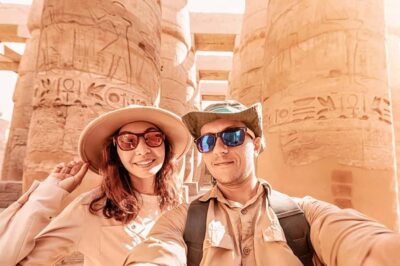
Luxor Tour with Valley of Kings, Karnak & Tut Tomb
Read our review →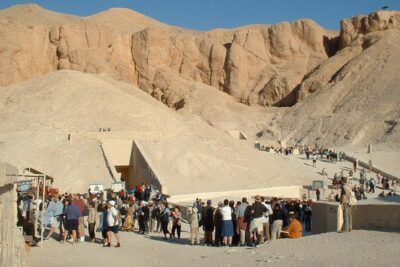
Valley of Kings, Hatchepsut Temple ,Karnak & Luxor-DayTour
Read our review →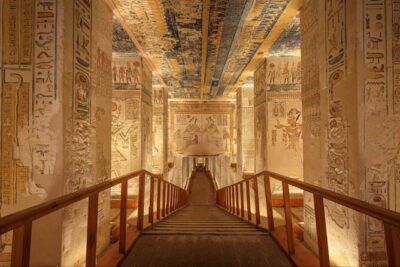
Full Day Tour of Luxor West Bank Temples and Tombs (Private)
Read our review →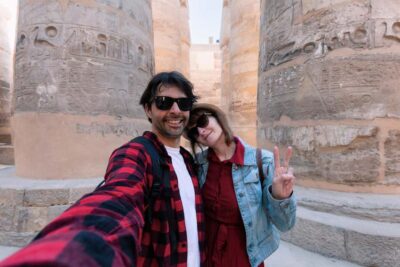
Small Group Excursion to Luxor Valley of the Kings from Hurghada
Read our review →
Valley of Kings Hatshepsut & Karnak Luxor Day Trip
Read our review →Browse the lists this tour appears in