
Reviewed · LUXOR WEST BANK TOURS
Private King Tut’s Tomb, Valley of the Kings & Queens, Hatshepsut
Standing before Tutankhamun’s mummy in the young king’s original tomb is the emotional centerpiece here. You also get a broad West Bank sweep: the Valley of the Kings, Hatshepsut’s temple, the Valley of the Queens, and the Colossi of Memnon, all with private transport from your hotel.
I like the private format, which lets you spend more time on the tombs that interest you most. I also like the chance to see premium sites such as Tutankhamun’s tomb and, when open, Queen Nefertari’s tomb, rather than settling for only the standard royal chambers.
The main catch is the price structure: $55 covers the guide and transport, but entrance tickets are extra. Those special tombs can add a noticeable amount, and Nefertari’s tomb may close without warning for conservation work.
Key points to know before booking
- Tutankhamun’s mummy remains in his own tomb: You can see the young pharaoh’s preserved body inside KV62.
- This is a private West Bank day: Your party travels alone with an Egyptologist guide and driver.
- Premium tomb tickets cost extra: Budget separately for Tutankhamun and any special tombs such as Nefertari.
- The tour covers several royal burial sites: Ramses III, Ramses IV, Merneptah, Ramses IX, Queen Titi, and others may be part of the route.
- Guides are a major part of the experience: Hassan, Ragab, Abdul, and Roshdy are among the guides associated with particularly strong tours.
- The schedule is packed: At about five hours and ten minutes, expect an efficient visit rather than a slow archaeological study.
Why Tutankhamun’s tomb is the big moment
Tutankhamun ruled Egypt as a child, taking the throne at about ten years old and dying at nineteen. His fame comes from the nearly intact tomb discovered by Howard Carter in 1922, not from a long or especially powerful reign.
Inside the tomb, you can see his royal mummy still resting in the burial chamber. That is unusual in Egypt, where many royal remains were moved or separated from their original burials. The chamber is small, but the personal connection is powerful: you are looking at the actual body of the pharaoh whose gold funerary mask became one of the world’s best-known archaeological images.
The visit lasts about 20 minutes. That is enough to see the mummy and the painted burial room, but not enough for a leisurely study of every detail. I would treat this as a focused historical encounter, not a large tomb filled with objects. Most of Tutankhamun’s famous treasures are in Cairo, while the tomb itself offers the setting, decoration, and mummy.
The ticket is not included. Check the current cost before booking, because this is one of the add-on charges that can change the final price of the tour.
A few other Luxor days to weigh up
- Hurghada: Luxor Valley of the Kings & Tutankhamun Tomb Trip
★ 4.7 · 13,208 reviews - Luxor: Valley of the Kings and Hatshepsut Temple Day Tour
★ 4.4 · 1,404 reviews - Hurghada: Luxor Tour with Valley of Kings, Karnak & Tut Tomb
★ 4.6 · 1,082 reviews
Reading the walls in Ramses III’s tomb
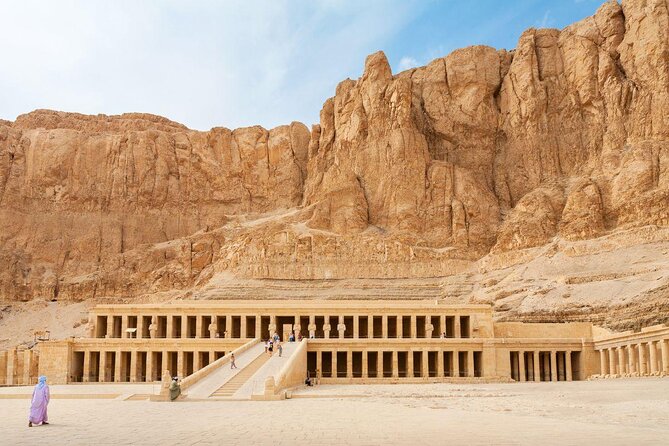
The Tomb of Ramses III, also called KV11, gives you a fine introduction to New Kingdom funerary art. The walls include scenes from the Litany of Ra and the Book of Gates, along with images of the king meeting the gods.
Near the entrance, side chambers contain unusual secular scenes, including foreign tributes and carefully drawn Aegean figures. These details help you see the tomb as more than a burial room. It is also a statement about Egypt’s place in the ancient world.
Allow about 25 minutes here. The guide can explain the religious symbols and point out details you might miss on your own. Still, there is an important practical point: guides may remain outside the tombs rather than entering with you, because of rules intended to limit carbon monoxide inside the chambers. A good guide should brief you first, then explain the decoration before or after you go in.
Hatshepsut’s temple beneath the cliffs
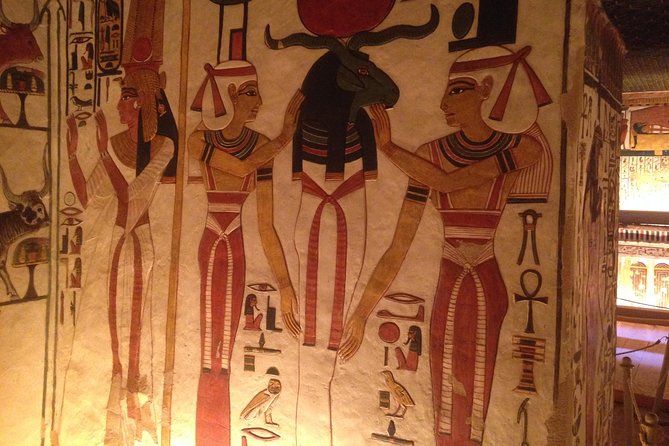
The Temple of Hatshepsut at Deir el-Bahari changes the rhythm of the morning. After the enclosed tombs, you step into a broad architectural setting beneath the Theban Mountain, with terraces and long colonnades rising against the cliffs.
Hatshepsut was Egypt’s only woman to rule as pharaoh. She presented herself in the traditional royal form, often using the symbols and imagery associated with male kings. Her reign brought peace, prosperity, and major building work, and this temple is her most famous monument.
The reliefs describe her divine birth and royal achievements. Your guide can make sense of the political message behind the scenes, which matters here because Hatshepsut’s story is not simply about a remarkable woman gaining power. It is also about how an Egyptian ruler used religion, art, and architecture to make her authority feel legitimate.
The visit is scheduled for about an hour, making it one of the least rushed stops. Wear practical shoes and expect sun exposure. The site is open and spacious, so the heat can feel stronger than it does inside the tombs.
Merneptah and the engineering of a royal tomb
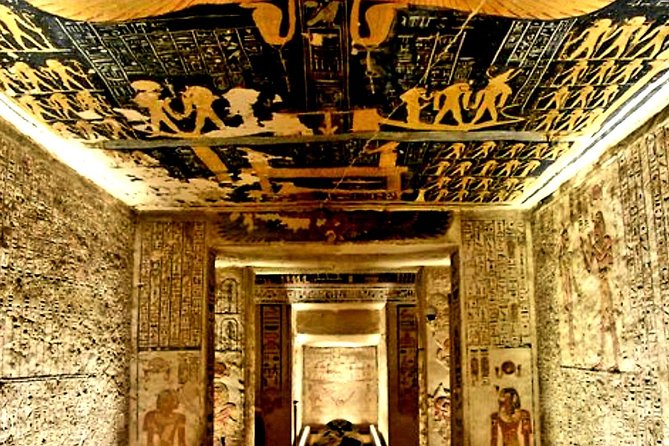
Merneptah was the son of Ramses II and Queen Isis-Nofret. His tomb, KV8, is a useful contrast to the smaller and more familiar chambers elsewhere in the valley.
The tomb connects royal burial with the god Ptah, the creator deity associated with Memphis and with craftsmen and architects. Images and religious references helped guide and protect the dead on the journey west into the afterlife.
You have about 25 minutes here. The importance of this stop is less about a single famous image and more about seeing how royal tomb design developed. The guide can help you compare its layout, religious texts, and burial arrangements with the tombs of Ramses III and Ramses IV.
Again, the ticket is extra. Since several tombs are offered during the day, ask your guide which entrances are covered by the basic Valley of the Kings ticket and which require a special payment.
Same base, a completely different day out:
- Luxor Day Trip from Hurghada Small Group & Tutankhamun Tomb
★ 4.8 · 5,366 reviews - Hot Air Balloon Ride in Luxor Egypt with Transfers Included
★ 5.0 · 4,319 reviews - Luxor: Shared Full-Day Tour to Luxor West and East Banks
★ 4.5 · 1,812 reviews - Luxor: Hot Air Balloon Ride over Luxor Relics
★ 4.8 · 1,681 reviews
The colorful chamber of Ramses IV
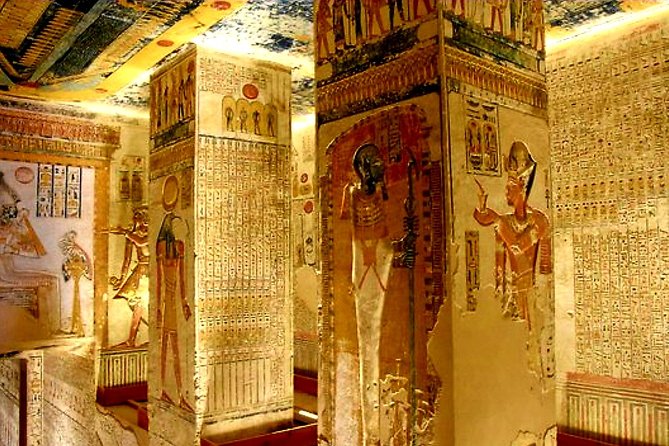
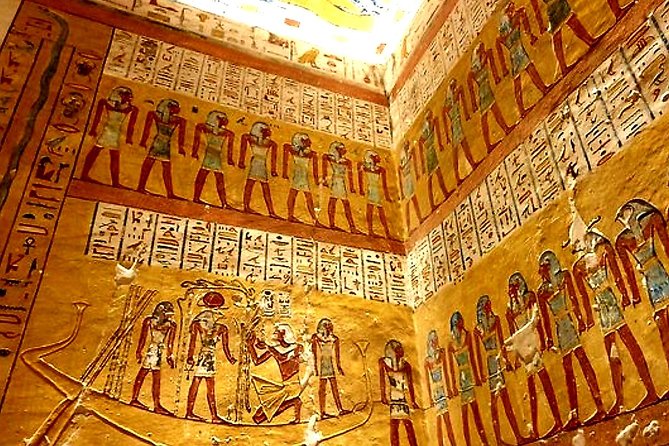
KV2, the Tomb of Ramses IV, is one of the strongest artistic stops on the route. Its walls carry scenes from several funerary books, including the Litany of Ra, Book of the Dead, Book of Caverns, Book of the Heavens, Book of Amduat, and Book of the Night.
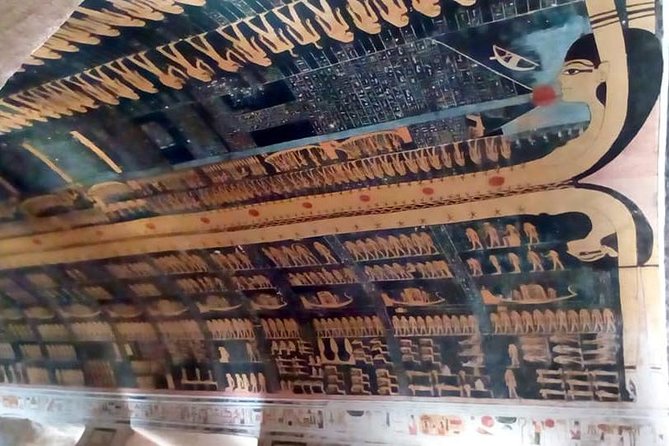
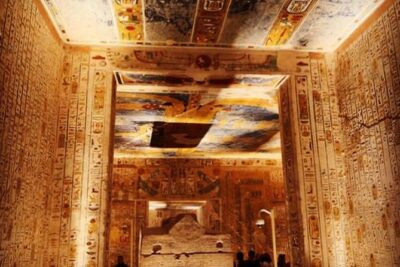
The burial chamber is especially striking for its blue and white decoration. Above you, the goddess Nut stretches across the ceiling, representing the sun’s passage through the heavens and its return at dawn. The large rose-colored granite sarcophagus gives the room a strong visual anchor.
You are scheduled to spend about 25 minutes here. That is enough to appreciate the main scenes, but the sheer number of texts can overwhelm you without explanation. This is where an Egyptologist guide earns the cost of the private tour, especially if the guide can connect the pictures to the larger idea of death, rebirth, and the king’s journey through the night.
If you enjoy painted tombs, you may want to tell your guide that this is a priority. A private tour makes that sort of adjustment easier than a fixed group schedule.
The Valley of the Kings, with several royal chambers
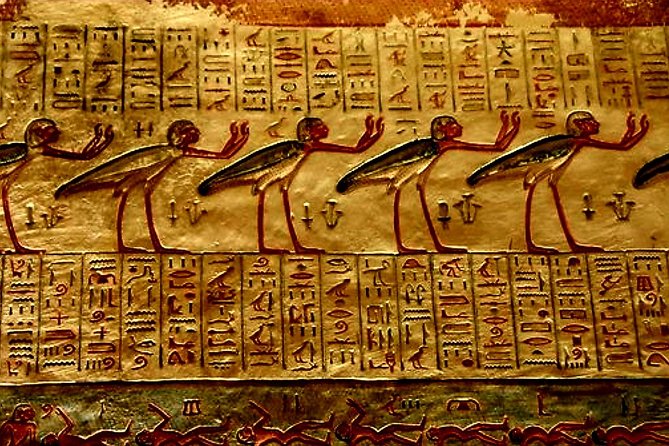
The Valley of the Kings is not one single monument. It is a spread of tomb entrances cut into dry hills, with winding paths and steep slopes between them. The real pleasure comes from moving from one chamber to the next and noticing how each king used similar religious ideas in different ways.
The route describes visits connected with Ramses, Horemheb, Merneptah, and Tutankhamun. Separate itinerary details also identify Ramses III, Ramses IV, and Ramses IX, so the exact selection can vary according to opening conditions, ticket rules, and your guide’s plan.
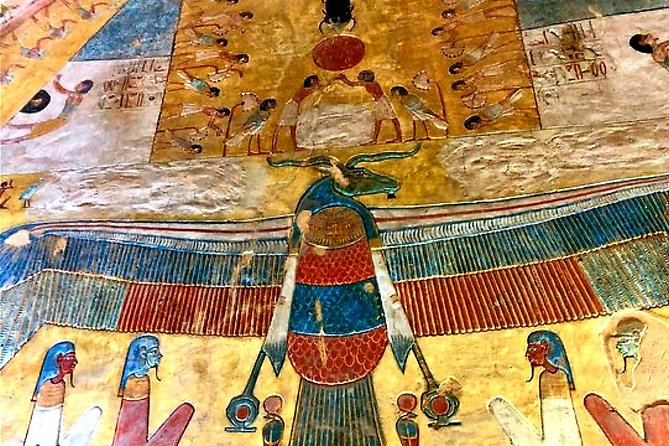
Ramses IX’s tomb is known for its colorful decoration and a ceiling showing Nut across the sky. The image of the goddess swallowing and giving birth to the sun turns the ceiling into a picture of daily rebirth. It is the sort of detail you might walk past without a guide’s explanation.
The Valley of the Kings portion is listed as about two hours, though the full itinerary includes overlapping tomb entries. Do not read every listed stop as a separate, guaranteed two-hour block. The practical expectation is a carefully chosen group of tombs within the overall five-hour-ten-minute tour.
Bring water, protect yourself from the sun, and expect walking on uneven ground. The air inside the chambers may feel cooler, but the approach between tombs can be hot. Photography rules and conservation limits can also change, so follow the instructions given at each entrance.
The Valley of the Queens and Queen Titi
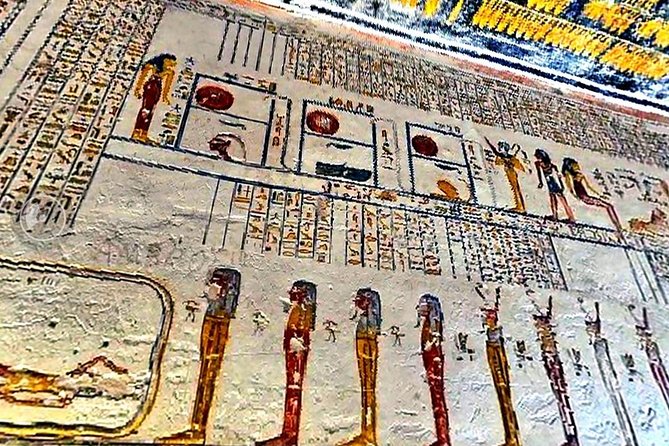
The Valley of the Queens was used for queens, princes, princesses, and other members of the royal family. Ancient Egyptians called the area Ta-Set-Neferu, a name translated as the Place of Beauty or the Place of the Royal Children.
The Tomb of Queen Titi is a small royal burial site with an uncertain identity. That mystery gives the visit a different tone from Tutankhamun’s tomb, whose owner is firmly known and globally famous. Queen Titi’s chamber invites questions about how much remains unknown about the royal family.
The listed visit to the tomb and valley is brief, about ten minutes for each. That makes this part more of a targeted stop than a long exploration. The title of the experience specifically highlights Queen Nefertari, and several descriptions refer to her tomb as a major feature, but the detailed stop list names Queen Titi instead. Confirm before paying which Valley of the Queens tomb is open and included in your planned route.
Nefertari’s tomb is often treated as a premium visit because of its delicate wall paintings and limited access. The color and detail are a major reason people consider the extra ticket worthwhile. Yet conservation work can close it suddenly, even after it was open the day before. If seeing Nefertari is your main reason for booking, ask about current access and the operator’s policy if the tomb is closed.
A quick stop at the Colossi of Memnon
The Colossi of Memnon are two huge stone statues, each more than 18 meters tall. They once guarded the entrance to the mortuary temple of Amenhotep III, a complex now mostly lost.
The statues also connect several generations of Egyptian rulers. Amenhotep III was the father of Akhenaten and grandfather of Tutankhamun, so the stop gives you a useful family link between the monuments you have seen.
You spend about 15 minutes here, and admission is free. That is enough for photographs and a short explanation. I appreciate this quick stop because it breaks up the tomb visits without adding another paid entrance or a long indoor visit.
Do not expect a complete temple complex. The statues are the surviving attraction, while much of the original site has disappeared. Their scale is still impressive, especially when you stand close and look up at the carved stone figures.
How the private format affects the day
Pickup and drop-off are offered at centrally located Luxor hotels. You travel in a modern, air-conditioned vehicle with your own guide and driver, which is valuable on the West Bank where the sites are spread out.
The tour begins at 8:00 am and lasts about five hours and ten minutes. That start gives you a useful morning window, though the summer sun can still be intense by late morning. The schedule is full, so this is better for someone who wants to cover many key sites in one outing than for someone who prefers to spend half a day in one tomb.
Private touring also lets you ask for more explanation, request a slower pace, or focus on a favorite pharaoh. Several guides connected with this experience, including Hassan, Ragab, Abdul, and Roshdy, are described as strong storytellers with formal Egyptology backgrounds. Guide quality can vary, so I would request a guide with strong English and ask whether you can express preferences for the tombs you most want to study.
There is one point to clarify before the day begins. A guide may not enter every tomb with you because of conservation and air-quality rules. That does not automatically mean poor service. The useful arrangement is for the guide to explain the chamber outside, then meet you afterward to discuss what you saw.
Is $55 good value?
At $55 per person, the base price is attractive for a private half-day outing with hotel transport and a licensed Egyptologist guide. You avoid joining a large group, and the air-conditioned vehicle matters after several walks in the sun.
The real cost is higher because entrance tickets are excluded. Tutankhamun’s tomb and Nefertari’s tomb require special attention to ticket prices, and other tombs may have their own entry rules. One useful way to judge the value is to compare the final total, not the advertised starting price, with what you would pay for transport and a guide separately.
I would not book this expecting an all-inclusive ticket package. I would book it for the private planning, transport, and access to a wide selection of West Bank sites. If your budget is tight, ask for the complete ticket estimate before confirming.
A hot-air balloon ride may also be available before the tour, but it is an optional extra rather than part of the stated package. Do not assume it is included in the $55.
Who should book this Luxor tour?
I would choose this experience if you have one morning for the West Bank and want the major royal tomb areas handled in one organized route. It suits first-time visitors who want historical context, families who value private transport, and anyone who prefers to ask questions without a large group around them.
It is also a good fit for archaeology fans who care more about tomb decoration than shopping or long meals. You can ask to focus on Ramses IV, Ramses IX, Tutankhamun, or another open chamber.
I would hesitate if you dislike a fast schedule or want every site guaranteed. The route includes many stops, ticket access can change, and Nefertari’s tomb may close for conservation. I would also be cautious about assuming lunch is included. A buffet lunch appears in one account of a tour day, but it is not listed among the stated inclusions, so confirm that directly.
Free cancellation is available if you cancel at least 24 hours before the local start time. Changes or cancellations inside that window are not accepted for a refund.
Final verdict: book it for access and flexibility
I recommend this tour for a focused, private look at Luxor’s West Bank, especially if Tutankhamun’s mummy and the premium tombs are high on your list. The guide, transport, and private format make the $55 starting price fair, provided you budget for admission separately.
Before booking, confirm the current ticket total, the exact Valley of the Queens tombs open that day, and whether Nefertari can be visited. If those details line up, this is a strong way to see the royal burial grounds without wasting time arranging transport between far-flung sites.
FAQ
What time does the tour start?
The tour starts at 8:00 am.
How long does the experience last?
The advertised duration is approximately five hours and ten minutes.
Is hotel pickup included?
Yes. Pickup and drop-off are offered at centrally located hotels in Luxor.
Are entrance tickets included in the price?
No. Entrance tickets are excluded from the $55 per-person price.
Can I see Tutankhamun’s mummy?
Yes. The tour includes a visit to Tutankhamun’s tomb, where his royal mummy remains in the original tomb. The admission ticket is extra.
Is Queen Nefertari’s tomb guaranteed to be open?
No. Conservation closures can occur without warning. Confirm current access before booking, especially if Nefertari’s tomb is your main priority.
Is this a private tour?
Yes. Only your own party participates, with a licensed Egyptologist guide and round-trip transport in an air-conditioned vehicle.
New on the Luxor list
- Full-Day East and West Luxor Private Tour★ 4.5 · 26 reviews
- Marsa Alam: Snorkeling with Sea Turtles Marsa Mubarak★ 4.9 · 26 reviews
- Private Full day East and West Bank, Luxor★ 5.0 · 26 reviews
- Day Trip to Edfu & Kom Ombo temples from Luxor and drop off in Aswan or Luxor★ 5.0 · 26 reviews
- Luxor Day Tour: Kings Valley & Karnak & Luxor & Hatshepsut Temple★ 5.0 · 26 reviews
- Luxury Hot Air Balloon Experience in Luxor with Pick-up★ 5.0 · 27 reviews
- Full-Day Luxor Tour – Discover the East and West Banks of the Nile★ 5.0 · 27 reviews
- 5 Days 4 Nights Nile Cruise Tour★ 5.0 · 27 reviews
Luxor West Bank Tours, compared.
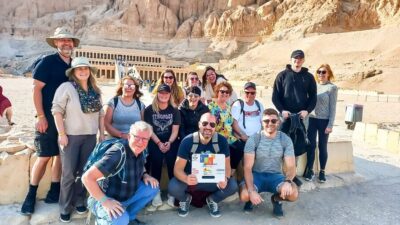
Luxor Valley of the Kings & Tutankhamun Tomb Trip
Read our review →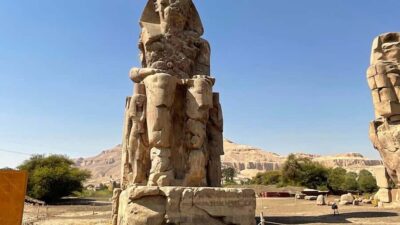
Valley of the Kings and Hatshepsut Temple Day Tour
Read our review →
Luxor Tour with Valley of Kings, Karnak & Tut Tomb
Read our review →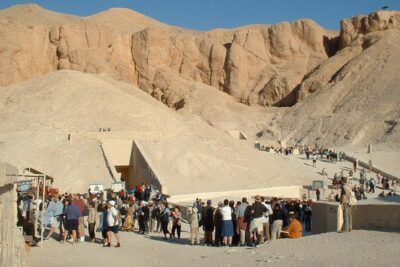
Valley of Kings, Hatchepsut Temple ,Karnak & Luxor-DayTour
Read our review →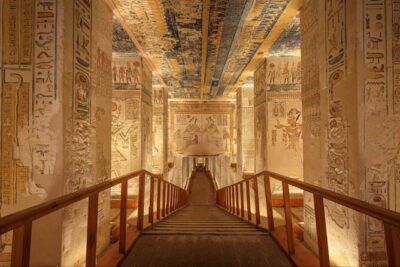
Full Day Tour of Luxor West Bank Temples and Tombs (Private)
Read our review →
Small Group Excursion to Luxor Valley of the Kings from Hurghada
Read our review →
Valley of Kings Hatshepsut & Karnak Luxor Day Trip
Read our review →Browse the lists this tour appears in