
Reviewed · LUXOR WEST BANK TOURS
Private Tour: Luxor East Bank, Karnak and Luxor Temples
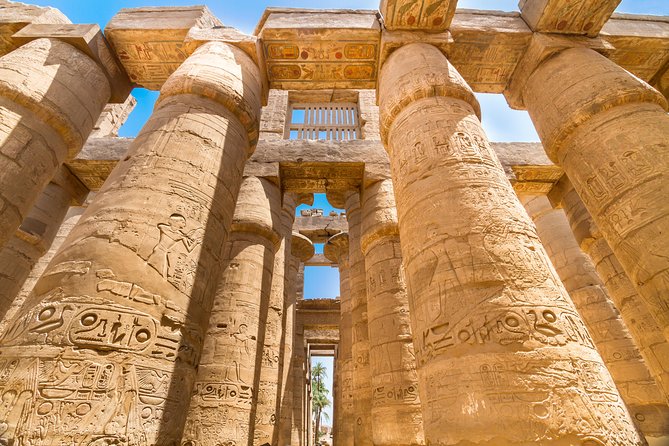
Karnak is the main event here: a vast temple complex where every court, column, and carved wall points to a different pharaoh. You walk through the Avenue of Sphinxes, enter the Great Court, and then face the 134 giant columns of the Hypostyle Hall. It is the sort of place that makes you stop talking for a moment.
I like the private format, since you can ask questions, pause for photographs, and spend more time on the parts that catch your eye. I also like having an Egyptologist explain details that are easy to miss, from the purpose of the pylons to the meaning of the carved scenes. The main consideration is time: the tour lasts about 3 hours and 30 minutes, although the description also calls it a four-hour visit, so Karnak may feel rushed if you want to see every corner.
Key points at a glance
- Karnak’s 134-column Hypostyle Hall is the visual high point, with columns rising like a stone forest.
- The Avenue of Sphinxes links the two temple areas in the story of ancient Luxor.
- A private Egyptologist guide lets you ask questions and adjust attention toward the details you care about.
- Luxor Temple adds a different mood, with Ramses II statues, papyrus columns, and an Alexander the Great chapel.
- Hotel or river-port pickup and air-conditioned private transport make this easy to fit into a Luxor stay.
- The $107.88 price is strongest for couples or small groups who value personal guiding and a simple door-to-door plan.
Why Karnak deserves the first half of your afternoon
Luxor occupies the site of ancient Thebes, once Egypt’s royal capital. Karnak was not built in one burst by one ruler. More than 30 pharaohs added courtyards, halls, pylons, shrines, and monuments over many centuries.
That long building process gives the complex its special character. You do not simply see one finished temple. You move through layers of royal ambition, with each ruler trying to add something larger, taller, or more impressive than what came before.
Your driver collects you from a central Luxor hotel or the Luxor river port in an air-conditioned minivan. The 1:00 pm start works well if you have spent the morning elsewhere or arrived by Nile cruise, though the afternoon sun can still be strong. Bring water, a hat, and shoes suited to uneven ground.
The first approach is along the Avenue of Sphinxes. This ceremonial route once connected Karnak and Luxor Temple for roughly two kilometers. The restored section gives you a sense of how processions once moved toward the sacred precinct, although the surviving avenue is only part of the original route.
At the entrance, your guide explains the huge pylons, the monumental gateways that announce the temple before you even enter. These are not quiet doors. They were statements of power, built to make worshippers feel small and to frame the world of the gods beyond.
A few other Luxor days to weigh up
- Hurghada: Luxor Valley of the Kings & Tutankhamun Tomb Trip
★ 4.7 · 13,208 reviews - Luxor: Valley of the Kings and Hatshepsut Temple Day Tour
★ 4.4 · 1,404 reviews - Hurghada: Luxor Tour with Valley of Kings, Karnak & Tut Tomb
★ 4.6 · 1,082 reviews
Inside Karnak, each court tells a different story
Karnak rewards a guide because the site can feel confusing on your own. There are many walls and columns, but the layout makes more sense when someone explains how the complex grew over time.
You pass through the Great Court and continue toward the Great Hypostyle Hall. This is the place most people remember. Its 134 columns fill the space, with the tallest rising high above you. The central columns are especially massive, and the scale is hard to judge until you stand beneath them.
Your Egyptologist can explain how ancient builders raised and positioned these immense stone elements. The exact methods remain a subject of study, but the basic result is clear: the engineering was extraordinary. Look closely at the carvings, since reliefs and inscriptions cover the surfaces and record religious scenes, royal victories, and offerings.
Karnak is also a place to slow down. A private guide can give you the main explanation, then allow free time to look around. This matters because the site is not best understood in one long stream of facts. You need a few minutes to take in the columns, walls, open courtyards, and changing light.
At the sacred lake, you see another part of temple life. The water was used in religious practices, including purification connected with offerings. It also gives you a visual pause after the dense columns and stone walls.
The supplied schedule assigns about one hour to Karnak. That is enough for the major route, but not enough for every monument in this enormous complex. If you are passionate about ancient Egyptian architecture or photography, ask your guide at the start how the time will be divided.
Luxor Temple offers a more compact visit
The drive to Luxor Temple is short, and the change in scale is noticeable. Karnak is sprawling and layered. Luxor Temple is more compact, with a strong central axis and impressive features close together.
The temple was built around 1,400 BC and later changed by rulers including Tutankhamun, Ramses II, and Alexander the Great. That mixture is part of its appeal. You are not looking at one frozen moment in Egyptian history. You are seeing a place that continued to matter as new rulers added their own names and images.
Two colossal statues of Ramses II guard the entrance. Their size gives you an immediate sense of the ruler’s public image. Nearby, one of the original pair of obelisks remains in place. Its companion now stands at Paris’s Place de la Concorde, a fact your guide can use to explain how major Egyptian monuments ended up far from the Nile.
Inside, look for the papyrus-shaped columns, carved walls, courts, and inner rooms. Your guide helps you read the hieroglyphic scenes rather than treating them as decoration. That translation turns the temple into a set of messages about kingship, worship, and divine order.
One especially unusual feature is the chapel associated with Alexander the Great. Alexander rebuilt the room in his own name, adding another chapter to a temple that had already seen centuries of change. You might also notice architectural oddities and later alterations, which make Luxor Temple feel less polished and uniform than a modern reconstruction.
The schedule allows about one hour here. That is a sensible amount of time for the principal courts and sanctuaries, but you should not expect a slow, scholarly examination of every inscription. The private arrangement helps, since your guide can spend more time on a question that interests you instead of following a fixed group script.
What the private guide changes
The strongest reason to choose this tour is not the vehicle. You can arrange transport to the temples in several ways. The real value is having one Egyptologist with you from entrance to exit.
A well-prepared guide gives the ruins a sequence. At Karnak, that means showing how the complex expanded and why the deeper sections can take you further back in time. At Luxor Temple, it means pointing out the work of different rulers and explaining how Alexander wrote himself into the building’s story.
The guides connected with this experience include Adel, Bassem, Hisam, Michael, Yolanda, and Abdul. Assignments can change, so you should not book on the assumption that one particular person will lead your visit. Still, the accounts associated with these guides highlight a useful pattern: strong guides add humor, answer questions clearly, and bring personal enthusiasm to the subject.
Adel is described as quick, friendly, and full of stories. Bassem is praised for explaining the temples in detail. Yolanda and her driver Tony are noted for an energetic presentation and courteous service. Abdul is described as punctual and able to answer questions, though one account found him tired on a later outing. These details point to the usual reality of private touring: the guide can make a very good visit exceptional, but the exact experience depends partly on the person assigned that day.
You also have more control than in a large group. If you want extra time with the Hypostyle Hall, ask. If you have had enough of dates and dynasties, request a quieter walk and photographs. The private setup is particularly useful for couples, families, and small groups with different interests.
Same base, a completely different day out:
- Luxor Day Trip from Hurghada Small Group & Tutankhamun Tomb
★ 4.8 · 5,366 reviews - Hot Air Balloon Ride in Luxor Egypt with Transfers Included
★ 5.0 · 4,319 reviews - Luxor: Shared Full-Day Tour to Luxor West and East Banks
★ 4.5 · 1,812 reviews - Luxor: Hot Air Balloon Ride over Luxor Relics
★ 4.8 · 1,681 reviews
Is $107.88 per person good value?
At $107.88 per person, this is not the cheapest way to see Karnak and Luxor Temple. Its value depends on what the price covers for your group.
You receive hotel or river-port pickup, private air-conditioned transport, admission to both temple sites, and an Egyptologist guide. You also avoid the usual effort of arranging separate transport and finding explanations at each entrance. For two people, the total cost is more noticeable, but the private attention can justify it if you want comfort and questions answered as you go.
For a larger private group, the price may feel more reasonable, especially with group discounts available. Food and drinks are not included, but this is a half-day sightseeing trip rather than a meal-based outing, so that omission is easy to plan around.
There is an extra charge of 1,000 Egyptian pounds for languages other than English. Check the language and final price carefully before booking. English guiding is included in the stated pricing, while French and other language requests may carry the supplement.
The tour is booked, on average, 102 days ahead. That does not guarantee it will sell out on your dates, but it suggests you should arrange it early if you have a fixed Nile cruise schedule or a short stay in Luxor.
Timing, comfort, and practical details
The stated start time is 1:00 pm. Pickup is offered from a central Luxor hotel or the Luxor river port, followed by private minivan transport between the sites. The vehicle is air-conditioned, an important comfort in Luxor.
The experience is listed as approximately 3 hours and 30 minutes, while the main description refers to four hours. Treat it as a compact half-day outing. The planned temple visits total about two hours, leaving the rest for pickup, driving, explanations, and movement between the sites.
You should wear practical shoes. The temples involve walking across broad courts and ancient surfaces, and you will spend plenty of time standing while looking up at columns and carved walls. Carry water, since food and drinks are not included.
Most people can participate, according to the provided information. If you have a particular mobility concern, ask the provider before booking, since the available details do not describe specific step-free routes or vehicle arrangements.
Confirmation is provided when you book, and changes or cancellation are free up to 24 hours before the local start time. Within 24 hours, the payment is not refundable, and late changes are not accepted.
Who will get the most from this tour?
This suits you if you want to see Luxor’s two essential East Bank temples without organizing taxis, tickets, and a guide separately. It is also a good choice for a first visit, since the sites are much easier to understand with someone explaining the rulers, religious purpose, and later additions.
History fans will appreciate the chance to ask about individual pharaohs, construction methods, inscriptions, and the movement from Karnak to Luxor Temple. Photographers will like the ability to pause, although the short schedule means you should tell your guide early if photographs are a priority.
The tour is less suitable if you want an entire day at Karnak alone. One hour there covers the famous route, but this is a highlights visit. You may also prefer independent sightseeing if you already have strong background knowledge and want to set your own pace from start to finish.
For a family or small private party, the format is practical. You can keep explanations focused, take breaks when needed, and avoid waiting for a large group. For solo visitors, the cost per person may be harder to justify unless the convenience and guide matter a great deal.
Should you book the Karnak and Luxor Temple tour?
Book it if you want the two major East Bank temples handled in one private afternoon, with transport and an Egyptologist included. The best parts are the towering Hypostyle Hall, the Avenue of Sphinxes, and the chance to examine Luxor Temple’s Ramses statues, obelisk, papyrus columns, and Alexander chapel with context.
Before paying, confirm the exact duration, pickup point, guide language, and any language supplement. If you want a relaxed archaeological study rather than a highlights tour, look for a longer private visit. Otherwise, this is a well-focused way to get your bearings in ancient Thebes and see the monuments that make Luxor essential.
FAQ
Where does the tour start?
Pickup is offered from a central Luxor hotel or the Luxor river port.
What time does the tour begin?
The stated start time is 1:00 pm.
How long does the tour last?
The experience is listed as approximately 3 hours and 30 minutes, while the main description refers to four hours.
Which temples are included?
The tour visits the Temples of Karnak and Luxor Temple on Luxor’s East Bank.
Is transportation included?
Yes. Private transportation in an air-conditioned minivan, along with hotel pickup and drop-off, is included.
Is an Egyptologist guide included?
Yes. A qualified Egyptologist guide is included. English is included in the stated pricing, while a supplement of 1,000 Egyptian pounds applies to languages other than English.
Can I cancel for a full refund?
Yes, if you cancel at least 24 hours before the experience’s local start time. Cancellations or changes made less than 24 hours in advance are not accepted for a refund.
New on the Luxor list
- Full-Day East and West Luxor Private Tour★ 4.5 · 26 reviews
- Marsa Alam: Snorkeling with Sea Turtles Marsa Mubarak★ 4.9 · 26 reviews
- Day Trip to Edfu & Kom Ombo temples from Luxor and drop off in Aswan or Luxor★ 5.0 · 26 reviews
- Private Full day East and West Bank, Luxor★ 5.0 · 26 reviews
- Luxor Day Tour: Kings Valley & Karnak & Luxor & Hatshepsut Temple★ 5.0 · 26 reviews
- Luxury Hot Air Balloon Experience in Luxor with Pick-up★ 5.0 · 27 reviews
- Full-Day Luxor Tour – Discover the East and West Banks of the Nile★ 5.0 · 27 reviews
- 5 Days 4 Nights Nile Cruise Tour★ 5.0 · 27 reviews
Luxor West Bank Tours, compared.
Luxor Valley of the Kings & Tutankhamun Tomb Trip
Read our review →
Valley of the Kings and Hatshepsut Temple Day Tour
Read our review →
Luxor Tour with Valley of Kings, Karnak & Tut Tomb
Read our review →
Valley of Kings, Hatchepsut Temple ,Karnak & Luxor-DayTour
Read our review →
Full Day Tour of Luxor West Bank Temples and Tombs (Private)
Read our review →
Small Group Excursion to Luxor Valley of the Kings from Hurghada
Read our review →
Valley of Kings Hatshepsut & Karnak Luxor Day Trip
Read our review →Browse the lists this tour appears in