
Reviewed · LUXOR WEST BANK TOURS
Private Guided Tour to Valley of the Kings
The painted burial chambers of the Valley of the Kings are the reason to come to Luxor. You walk down into the mountain, past walls covered with gods, ritual texts, and scenes meant to guide a pharaoh into the next world. Ramses III, Merenptah, and Ramses IV offer some of the most rewarding interiors.
I like the private guide and car, since you can ask questions, adjust the pace, and avoid being tied to a large group. I also like the early four-hour format, which gives you a focused morning instead of a tiring full-day outing. The catch is that entrance tickets are not included, and the exact tomb lineup and current fees need confirming before you go.
Key points to know before booking
- Three tombs are the core experience: The tour centers on a selection such as Ramses III, Merenptah, Ramses IV, or Horemheb.
- A private Egyptologist changes the visit: Guides including Hassan, Khalid, Hamdy, Ameen, and Abdul have been praised for clear explanations and personal attention.
- Tutankhamun costs extra: His tomb and mummy require a separate ticket, listed as 450 EGP in the tour details.
- Hotel and harbor pickup are included: You travel across the Nile in an air-conditioned private vehicle.
- The morning start matters: Pickup is scheduled for 8:00 a.m., before the West Bank becomes more crowded and hot.
- The price is only part of the budget: The tour costs $50 per person, but the standard entrance fee of 750 EGP and optional tomb charges are separate.
Why the Valley of the Kings feels different
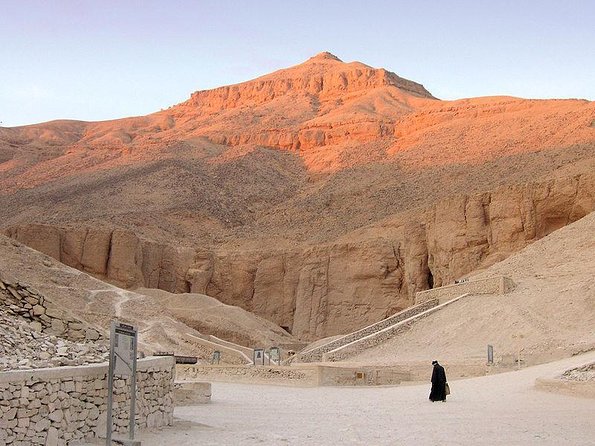
The Valley of the Kings is not a collection of freestanding monuments. It is a burial ground cut into the dry hills on Luxor’s West Bank, where pharaohs of the New Kingdom were placed in underground tombs.
That setting shapes the experience. You leave the open Nile plain and enter a bare mountain valley. Then you walk through narrow corridors into chambers where the decoration still carries color and detail after thousands of years. The contrast is striking: plain rock outside, carefully planned royal symbolism inside.
A private Egyptologist helps you read what you are seeing. Without guidance, it is easy to notice only the colors and hieroglyphs. With an explanation, the walls become a sequence of religious texts, gods, stars, boats, and images of the king meeting divine figures.
The tour lasts about four hours, including transport and visits. That is enough time for a useful introduction, but not enough to inspect every open tomb at leisure. I would treat it as a focused visit to three main tombs, with extra options only if time and tickets allow.
A few other Luxor days to weigh up
- Hurghada: Luxor Valley of the Kings & Tutankhamun Tomb Trip
★ 4.7 · 13,208 reviews - Luxor: Valley of the Kings and Hatshepsut Temple Day Tour
★ 4.4 · 1,404 reviews - Hurghada: Luxor Tour with Valley of Kings, Karnak & Tut Tomb
★ 4.6 · 1,082 reviews
A smooth start from Luxor at 8:00 a.m.
Pickup is offered from a central Luxor hotel or the harbor. The private, air-conditioned vehicle matters more than it may sound. The West Bank sites are spread out, and having your own car means you are not waiting for a large group to board, shop, or catch up.
The short drive also gives your guide time to explain the plan. This is where a private tour can be more useful than a standard group outing. You can tell the guide if you care most about painted ceilings, pharaohs, architecture, or photography, then spend your limited time accordingly.
Several guides are named in the feedback connected with this experience. Hassan is praised for punctuality, strong English, cultural advice, and flexibility when plans changed. Khalid is described as friendly and clear, while Hamdy is noted for explaining the tombs in detail, including Tutankhamun’s story. Ameen and Abdul are also praised for calm, informative guiding.
That said, one very poor report describes a short-tempered guide. I would not ignore that criticism. Guide quality is central to a private tour, so confirm the pickup details and guide assignment before setting out.
Tomb of Ramses III, a colorful first stop
Ramses III’s tomb is numbered KV 11. Its corridors contain painted sunken reliefs connected with texts such as the Litany of Ra and the Book of Gates. You will also see the pharaoh presented before the gods.
What makes this tomb especially interesting are the small side rooms near the entrance. They show secular subjects rather than only religious scenes, including foreign tribute, imported pottery from the Aegean, boats, royal equipment, and blind harpists. The harpist images gave the tomb one of its alternative names, the Tomb of the Harpers.
The listed stop is brief, about 10 minutes, but the broader Valley visit allows more time underground. Be ready for a walk and some steps. The tombs are manageable for many people, but the corridors can be long, enclosed, and steep in places.
This is a good tomb for seeing how royal decoration was not limited to abstract symbols. Your guide can point out where ordinary objects and foreign peoples appear in the design, giving you a better sense of the pharaoh’s world.
Merenptah’s tomb and the scale of the corridors
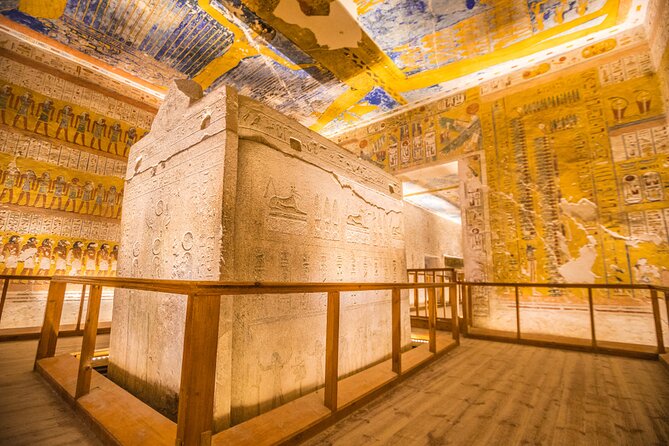
Tomb 8 belonged to Merenptah, the son of Ramses II and Queen Isis-Nofret. It was discovered by Howard Carter in 1903.
Its design differs from earlier royal tombs. The side rooms are fewer, while the corridors and chambers become noticeably taller. The tomb also reflects changes in the royal burial plan, making it useful for comparing architectural choices rather than simply admiring decoration.
The information supplied for this stop also refers to Ptah, the creator god associated with Memphis, and to divine protection for the dead on their journey west. This is exactly the sort of detail that is easy to miss when walking alone. A guide can connect the names of the gods with the scenes on the walls.
The scheduled stop is about 10 minutes, but allow more time if this is one of your selected tombs. Merenptah is a strong choice for anyone interested in structure, scale, and the way tomb designs changed over time.
Same base, a completely different day out:
- Luxor Day Trip from Hurghada Small Group & Tutankhamun Tomb
★ 4.8 · 5,366 reviews - Hot Air Balloon Ride in Luxor Egypt with Transfers Included
★ 5.0 · 4,319 reviews - Luxor: Shared Full-Day Tour to Luxor West and East Banks
★ 4.5 · 1,812 reviews - Luxor: Hot Air Balloon Ride over Luxor Relics
★ 4.8 · 1,681 reviews
Ramses IV and its remarkable ceiling
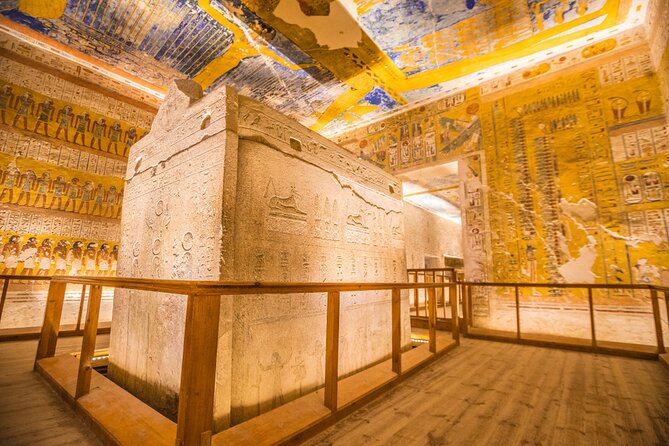
Ramses IV’s tomb, KV 2, is often singled out as one of the most impressive choices on this route. Its walls contain scenes from several major religious works, including the Litany of Ra, the Book of the Dead, the Book of Caverns, the Book of the Heavens, the Book of Amduat, and the Book of the Night.
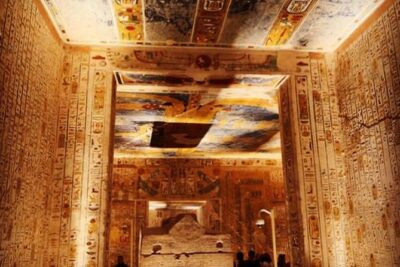
The blue and white decoration in the burial chamber is especially memorable. A rose-colored granite sarcophagus remains in the chamber, and the ceiling shows the goddess Nut swallowing the sun before it travels through her body and is born again.
This is a tomb where looking up matters. Do not spend the whole visit staring at the side walls. The ceiling carries a large part of the story, and your guide should explain how the image fits the ancient Egyptian idea of death and renewal.
One practical point: the itinerary names several possible tombs, and the number of stops is not perfectly consistent. The tour is advertised around three tombs, but some descriptions mention four, including Ramses, Horemheb, and Merenptah. Ask your guide which tombs are open and included on your morning.
Horemheb and other possible tomb choices
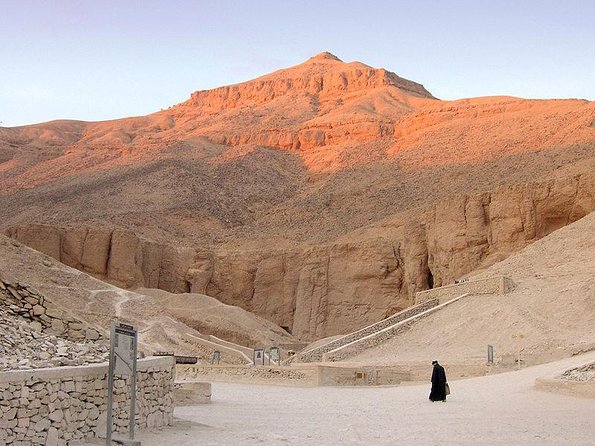
Horemheb is also listed among the possible royal tombs. The supplied information does not give a detailed description of its interior, so I would ask your guide what is currently open and how it compares with the other options.
Some details also refer to the tomb of Ramses IX, whose decoration includes a ceiling with the goddess Nut and a large sarcophagus. The names in the itinerary are not presented in a fully consistent order, so do not assume every named tomb is guaranteed.
That uncertainty is not unusual at an archaeological site where access can change. Still, it is worth clarifying at the start. If you have a priority, such as Ramses III, Ramses IV, or Merenptah, say so before tickets are purchased.
The private format helps here. A guide can explain the available choices and adjust the visit instead of simply following a fixed line of people.
Tutankhamun’s tomb is optional, and not the best value for everyone
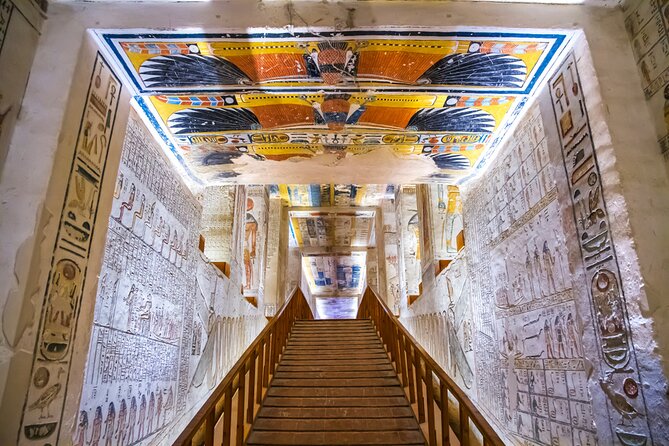
Tutankhamun is the most famous name in the Valley, but fame does not automatically make his tomb the strongest artistic choice.
The young king came to the throne at about 10 years old and died at about 19. His royal mummy remains in the tomb, and the tour gives you the option to see it face to face. The additional entrance fee is listed as 450 EGP in the supplied tour details.
One important warning: the pricing information is not fully consistent. The general entrance fee is listed as 750 EGP per person, while one response refers to a different Tutankhamun price. Confirm the current amount locally or with the operator before the tour begins.
I would pay the extra charge if seeing Tutankhamun’s mummy is a personal priority. If you care more about wall decoration and large painted chambers, Ramses IV may offer more for your money. The optional ticket can also push the total cost well above the advertised $50 tour price.
What the private format is really worth
At $50 per person, this is not the cheapest way to reach the Valley of the Kings. It can still be good value if you are sharing the private vehicle with others and want an Egyptologist to explain the site rather than simply drive you there.
The strongest value comes from three things:
- You do not share the tour with another booking group.
- Hotel or harbor pickup and drop-off are included.
- You can ask for explanations, adjust the pace, and request a different tomb choice when possible.
The private setup also saves mental energy. Luxor’s major sites can involve heat, transport, and ticket decisions. Having a guide organize the morning lets you focus on the tombs.
The price does not include the entrance fees. The stated standard cost is 750 EGP per person, and Tutankhamun is extra. Optional hot-air ballooning may also be available before the tour, but it is not part of the included four-hour visit.
Crowds, heat, and how to use the morning well
The 8:00 a.m. start is a sensible choice. The Valley can become crowded, and one report specifically suggests starting with it because waiting and congestion may increase later.
A private guide may help you move more efficiently through ticket lines and between tombs, but no guide can guarantee an empty site. The Valley is one of Luxor’s main sights, so expect other groups, especially around the most popular tombs.
I would keep the morning focused. Choose the three included tombs carefully rather than trying to collect every possible entrance. If you add Tutankhamun, allow for the extra ticket and the time needed to reach it.
The tour includes an air-conditioned car, which provides a welcome break between stops. Wear footwear suited to walking and be prepared for underground corridors. The supplied information says most people can participate, but it does not promise specific accessibility arrangements, so anyone with mobility concerns should ask before booking.
Colossi of Memnon and the wider West Bank
The itinerary includes a 10-minute stop at the Colossi of Memnon. These huge seated statues are a quick photo and orientation stop, not a long guided visit.
Other locations are also named, including the Temple of Merenptah, the Ramesseum, the Temple of Seti I, the Valley of the Nobles, and Howard Carter’s house. They are not all described as guaranteed stops within the four-hour core tour.
This matters because the Valley alone can use most of the morning. If you want to add the Ramesseum or another West Bank site, ask at the beginning how much time remains and if an extra charge applies. The private vehicle gives you more flexibility, but the schedule still has limits.
One useful advantage is the possibility of returning to a cruise boat on time. A guide can adjust the route and save travel time, which is especially important if your ship has a fixed sailing schedule.
Who should book this Luxor tour?
I would recommend this experience to first-time visitors who want context, a private vehicle, and a half-day plan. It also suits families, since one guide can adjust explanations and pace for children. One account specifically praises the guide’s work with children aged seven and eleven.
It is a good choice for solo visitors who do not want to arrange West Bank transport alone. It also fits cruise passengers who need a compact tour with pickup and return to the harbor.
You may prefer a different arrangement if you want a slow archaeological study, a guaranteed list of every named tomb, or a full day covering several temples. Four hours goes quickly, especially if you add Tutankhamun and photo stops.
The experience is also only as good as the individual guide. Hassan, Khalid, Hamdy, Ameen, and Abdul receive especially warm praise for punctuality, flexibility, humor, and clear explanations. The isolated complaint about poor conduct is a reminder to confirm who will lead your tour.
Should you book it?
Book this private Valley of the Kings tour if you value personal guiding, hotel pickup, and a well-contained morning. Ramses III, Merenptah, and Ramses IV give you a strong set of tombs, and the private format lets you ask questions that a large group often cannot accommodate.
Before paying, confirm the exact tombs, the current 750 EGP entrance fee, and the separate Tutankhamun charge. If you do that, the $50 price can make sense for a convenient and focused introduction to Luxor’s West Bank. If you want every possible site, plan more time.
FAQ
How long does the tour last?
The tour lasts approximately four hours.
What time does the tour start?
Pickup is scheduled for 8:00 a.m.
Is hotel pickup included?
Yes. Pickup and drop-off are included from a central Luxor hotel or the harbor.
Is transport included?
Yes. Transport is provided in a private, air-conditioned vehicle.
Is the tour private?
Yes. Only your own group participates.
Is an Egyptologist guide included?
Yes. A qualified Egyptologist guide is included.
How many tombs will I visit?
The tour is built around visiting three royal tombs, although some descriptions mention four possible tombs. Confirm the exact selection with your guide.
Are entrance tickets included?
No. The stated entrance fee is 750 EGP per person.
Can I visit Tutankhamun’s tomb?
Yes, but it is optional and requires a separate ticket. The supplied details list the fee as 450 EGP.
Can I cancel for a full refund?
Yes, if you cancel at least 24 hours before the start time. Cancellations or changes made less than 24 hours before the tour are not accepted for a refund.
New on the Luxor list
- Full-Day East and West Luxor Private Tour★ 4.5 · 26 reviews
- Marsa Alam: Snorkeling with Sea Turtles Marsa Mubarak★ 4.9 · 26 reviews
- Day Trip to Edfu & Kom Ombo temples from Luxor and drop off in Aswan or Luxor★ 5.0 · 26 reviews
- Private Full day East and West Bank, Luxor★ 5.0 · 26 reviews
- Luxor Day Tour: Kings Valley & Karnak & Luxor & Hatshepsut Temple★ 5.0 · 26 reviews
- Luxury Hot Air Balloon Experience in Luxor with Pick-up★ 5.0 · 27 reviews
- Full-Day Luxor Tour – Discover the East and West Banks of the Nile★ 5.0 · 27 reviews
- 5 Days 4 Nights Nile Cruise Tour★ 5.0 · 27 reviews
Luxor West Bank Tours, compared.
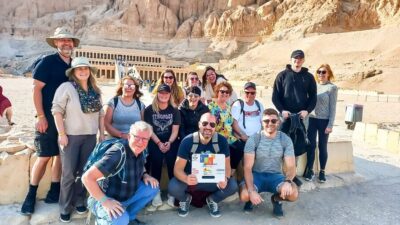
Luxor Valley of the Kings & Tutankhamun Tomb Trip
Read our review →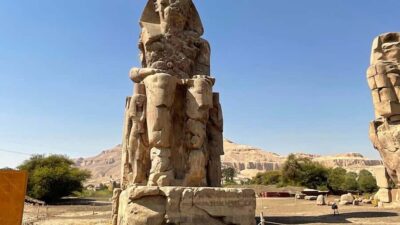
Valley of the Kings and Hatshepsut Temple Day Tour
Read our review →
Luxor Tour with Valley of Kings, Karnak & Tut Tomb
Read our review →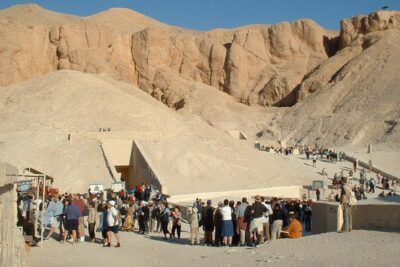
Valley of Kings, Hatchepsut Temple ,Karnak & Luxor-DayTour
Read our review →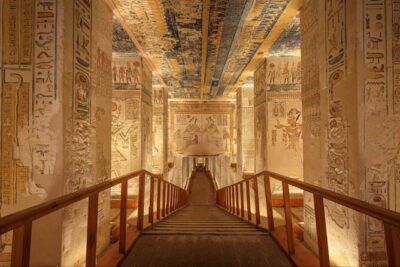
Full Day Tour of Luxor West Bank Temples and Tombs (Private)
Read our review →
Small Group Excursion to Luxor Valley of the Kings from Hurghada
Read our review →
Valley of Kings Hatshepsut & Karnak Luxor Day Trip
Read our review →Browse the lists this tour appears in