
Reviewed · ABU SIMBEL TOURS
Private Tour: Abu Simbel by Minibus from Aswan
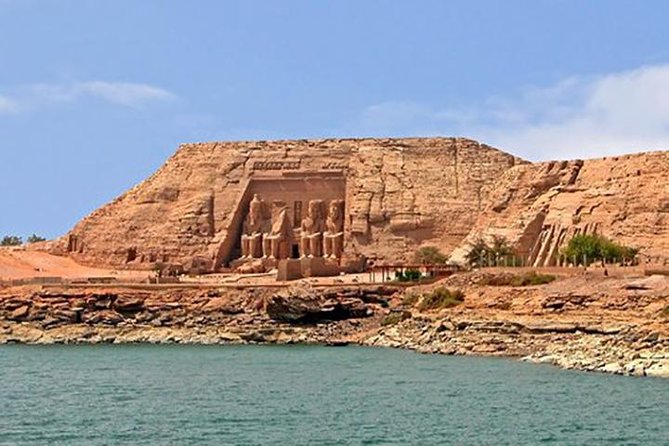
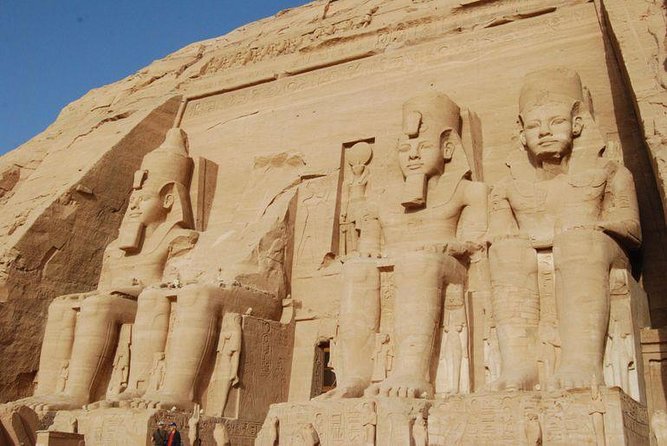
Abu Simbel is one of those places where the journey is part of the bargain. After about three hours across the desert from Aswan, you come face to face with four huge statues of Ramses II cut into the cliff above Lake Nasser. I like the private minibus and the chance to set a departure time that fits your day. I also like having a guide explain the temples before you enter, since guides cannot go inside with you. The catch is simple: you spend roughly six hours on the road for about two hours at the site.
I especially like the human story behind the monuments. These temples were taken apart and rebuilt piece by piece in 1968 when the Aswan High Dam threatened to flood them. The main drawback is that the quality of the guide service can vary. Some guides, including Michael and Mark on different departures, have provided strong explanations and fluent English, while other assignments have been far less useful.
Key points to know before booking
- Three hours each way: The drive from Aswan crosses open desert and can feel long, especially if your time inside the temples is shortened by convoy delays.
- Two major temples in one stop: You visit the Great Temple of Ramses II and the smaller Temple of Hathor, both carved in the 13th century BC.
- Private transport and attention: Only your group takes part, with pickup and return to an Aswan hotel or port in an air-conditioned minibus.
- Your guide stops at the entrance: Guides cannot accompany you inside, but a good guide will explain the interiors before you go in.
- Departure time matters: Early departures can help you reach Abu Simbel before the busiest period, while later departures may let you sleep longer.
- The relocation story adds meaning: If time allows, the visitor center explains how the temples were moved above the rising waters of Lake Nasser.
Why Abu Simbel is worth the long road from Aswan
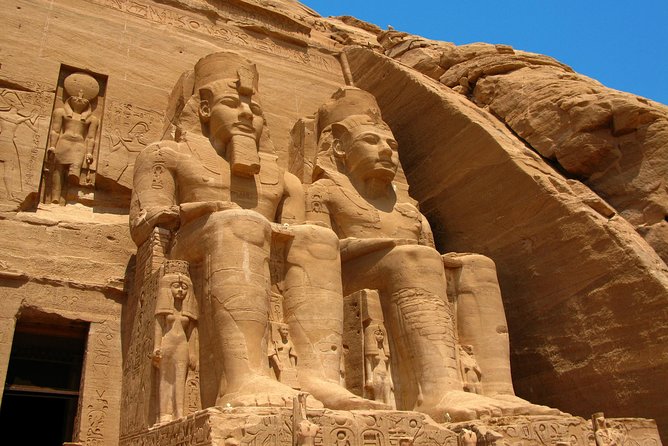
The first sight of Abu Simbel is the payoff. The Great Temple is fronted by four seated figures of Ramses II, each towering over the entrance. Beside it sits the smaller Temple of Hathor, dedicated to Hathor and linked closely to Nefertari, Ramses II’s favored wife.
These are not modest ruins scattered across a wide archaeological field. They are compact, dramatic monuments that confront you at once. The scale is hard to grasp until you stand near the feet of the statues and look up at the carved faces.
The setting beside Lake Nasser adds to the effect. The temples were originally cut into the cliff in southern Nubia, but the construction of the Aswan High Dam changed the future of the whole area. An international UNESCO effort moved the temples to higher ground in 1968. The stonework was cut apart, numbered, moved, and reassembled so carefully that you may have trouble spotting the joins.
That relocation is a major reason to choose a guided visit. Without some context, you see giant statues and painted chambers. With an explanation, you understand that the whole site is both an ancient monument and a modern engineering project.
A few other Aswan days to weigh up
- 4-Days Nile Cruise From Aswan To Luxor including Abu Simbel and Hot Air Balloon
★ 5.0 · 3,142 reviews - From Aswan: Abu Simbel Temple Day Trip with Hotel Pickup
★ 4.4 · 2,807 reviews - 4-Day 3-Night Nile Cruise from Aswan to Luxor&Abu Simbel+Balloon
★ 5.0 · 2,023 reviews
A three-hour desert drive from Aswan
The tour begins with pickup at your Aswan hotel or port. You select a departure time when booking, although road and convoy rules may affect the exact schedule. Some departures have begun around 3:45 or 4 a.m., while other groups have left later in the morning or even late at night.
An early start has clear advantages. You reach Abu Simbel before the heat becomes severe and have a better chance of avoiding the thickest crowds. The tradeoff is obvious: you lose sleep, and a 4 a.m. departure can make the return journey tiring.
A later start may suit you if you have no afternoon plans and would rather sleep longer. One late-morning departure left Aswan around 8:45 a.m., allowing a more relaxed start. A late-night departure has also been used by some groups, bringing the benefit of cooler conditions and a quieter temple visit, though this depends on the transport schedule and your tolerance for an unusual day.
The road takes about three hours each way. You pass through desert, with occasional camels visible along the route, but there is no changing scenery to distract you for long. Bring water. A small travel pillow can also make the ride more comfortable, especially if you choose the early convoy.
The drive may take place with a convoy of other tour vehicles. This arrangement is connected to road safety and tourist police instructions, not simply to the tour company’s preference. Convoy delays can happen, and they may reduce your time at Abu Simbel. On one particularly delayed trip, the group had only about an hour and 15 minutes at the temples.
That is the main logistical weakness. A private tour gives you a private vehicle and guide, but it does not always give you full control over the road schedule.
What the private minibus adds
The private format is useful if you are traveling as a couple, family, or small group and want pickup at your own hotel or boat. You do not share the temple visit with a large organized group, and the guide can focus on your questions during the approach and walk to the entrances.
The vehicle is described as an air-conditioned minibus, and several departures have included a cooler or ice box. That matters on a long desert road, especially in hot weather. Still, vehicle comfort may vary. Some people have found the minibus comfortable, while others have described a small van with limited space and open windows.
The private setup also has a value question. At $231.42 per person, this is not a budget excursion. The price makes more sense if two or more people share the private arrangements, if you are arriving by boat and need dependable port pickup, or if having an Egyptologist guide and a pre-arranged vehicle removes stress.
If you are alone, the cost is harder to defend. A hotel-arranged car or another local option may be cheaper, though the quality of the vehicle, driver, and guide may be less certain. You are paying for convenience, private service, and advance arrangements rather than simply for admission to Abu Simbel.
Meeting the temples at the entrance
The temples are reached by a short walk from the minibus. Your guide explains the site during this approach, pointing out the history of the two buildings and describing their rescue from the rising waters of Lake Nasser.
This is where guide quality matters most. A strong guide will use photographs or illustrations to show you what to notice inside. Mark has been described as energetic, well educated in Egyptology, and good company. Michael has also led a departure in fluent English, explaining the background before the group entered. Those are the sort of guides who make the long ride feel worthwhile.
Other guide assignments have been less satisfying, with short explanations and weak answers to basic questions. Since your guide cannot enter the temples, a short or vague briefing leaves you to make sense of the interiors alone. When you confirm the tour, it is sensible to ask how long the guide plans to spend explaining the chambers and reliefs before you go inside.
The outdoor explanation can also be poorly timed. In summer, standing in direct sun for 20 minutes is uncomfortable. If your guide has detailed information to share, you may prefer to hear some of it in the vehicle or in a shaded area before walking to the entrance.
Same base, a completely different day out:
- 4-Day 3-Night Nile Cruise from Aswan to Luxor including Abu Simbel, Air Balloon
★ 4.5 · 612 reviews - From Aswan: 3-Day Cruise to Luxor with Hot Air Balloon
★ 4.3 · 598 reviews - From Aswan: 4-Day Nile Cruise from Aswan to Luxor with Guide
★ 4.1 · 593 reviews - 4-Days Nile Cruise From Aswan To Luxor including Abu Simbel and Hot Air Balloon
★ 4.5 · 509 reviews
Inside the Great Temple of Ramses II
The Great Temple is the larger and more imposing of the two. Its exterior is dominated by the seated statues of Ramses II, while the interior leads you through halls lined with enormous figures, pillars, and painted scenes.
Inside, look for the battle imagery and the repeated presentation of the pharaoh as a powerful ruler. The scale continues indoors, with colossal statues arranged along the halls. Your guide should explain the basic layout before you enter, then give you enough time to move at your own pace.
The free time is important because the guide cannot accompany you past the entrance. You can pause for details, study the murals, and take in the changing feel of the chambers without being hurried by a group leader. The concern is that the exact amount of time may feel short. Several departures have allowed only about an hour at the entire complex, leaving little room to linger in both temples.
If you want photographs, take them quickly and respectfully where permitted. The exterior gives you the classic view of the four statues, but the interior is where the monument feels most powerful. Painted scenes and towering stone figures survive in a setting that feels far more intimate than the enormous façade suggests.
The smaller Temple of Hathor and Nefertari
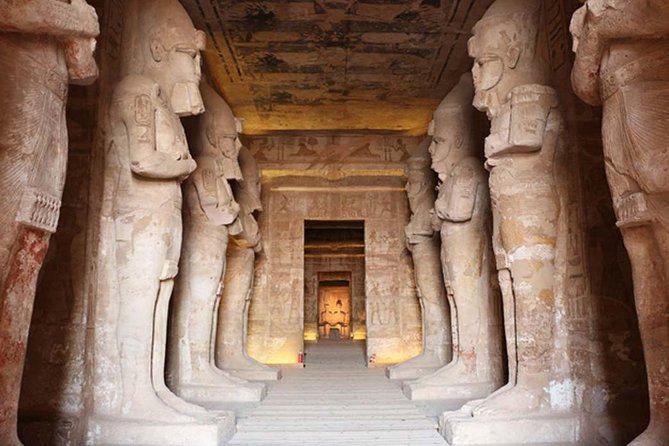
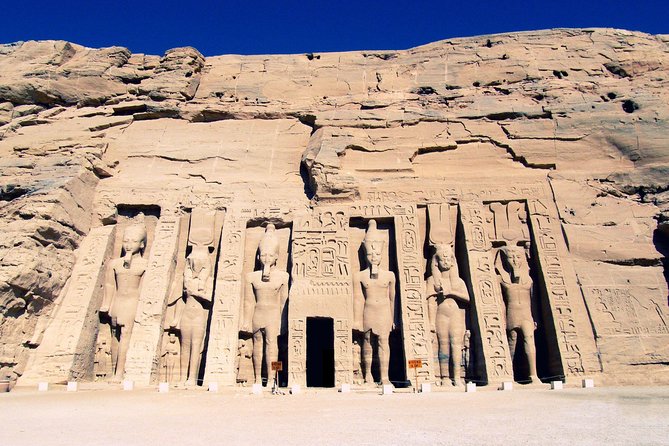
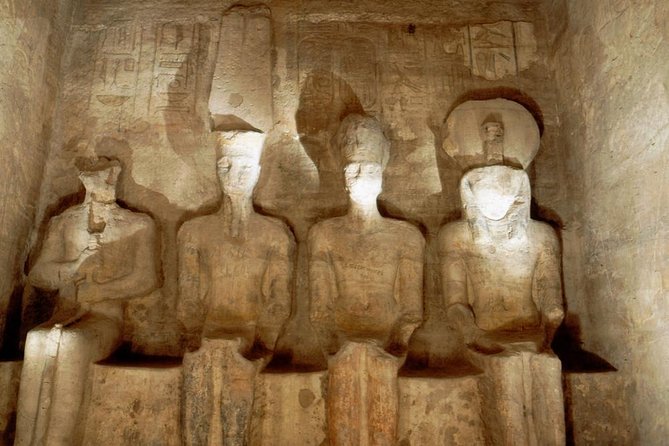
Do not treat the smaller temple as an optional extra. The Temple of Hathor has a different mood and purpose, with Hathor and Nefertari represented in its carvings and murals.
The building is smaller than the Great Temple, but that makes the interior easier to read. Pillars and wall scenes focus on Hathor, the goddess associated with the temple, and Nefertari, Ramses II’s wife. The paired temples also make a point about royal power and family representation.
Your guide should outline the difference between the two temples before you enter. Then use your free time to compare the scale, decoration, and subjects for yourself. Since you cannot take the guide inside, it helps to remember a few points from the briefing or ask for a quick plan of what to see first.
The smaller temple is easy to rush past after the Great Temple. Resist that temptation. If the site schedule is tight, make sure your guide tells you how much time remains before you enter, so you can divide it sensibly between the two buildings.
The relocation project at the visitor center
If the convoy schedule leaves enough time, you may visit the small visitor center near the temples. It documents the 1968 rescue project, when the two buildings were dismantled and reconstructed above the future flood level.
This stop is not the main reason to make the journey, but it explains the modern story that makes Abu Simbel even more remarkable. The temples were not merely moved as freestanding blocks. The cliff face and temple structures were cut into sections and rebuilt in a new position.
Time is the limiting factor. The visitor center may be skipped if the convoy arrives late or if your group needs to begin the return to Aswan. I would treat it as a worthwhile bonus, not a guaranteed part of the day.
The same applies to unscheduled shopping stops. Some departures have included a proposed papyrus factory visit, while other groups have avoided it. If you want every possible minute at Abu Simbel, make your preference clear and ask whether any shopping stop is planned.
Timing, heat, and the convoy problem
Your choice of departure time shapes the whole experience. An early convoy can mean fewer people and cooler temperatures, but you must wake before dawn and may spend part of the return drive tired. A later departure offers more sleep and may work better if your Aswan schedule is open, but it can bring more heat and crowds.
The site itself may occupy only two hours in the official plan, and real time can be shorter if the convoy is delayed. That is a lot of driving for a compressed visit. If you want a slow archaeological experience, this day trip may frustrate you.
Still, the monuments are too important to judge only by road time. Abu Simbel is one of Egypt’s strongest visual experiences, and the first view of the façade can justify the effort. I would book it with realistic expectations: this is a long transport day built around one exceptional stop.
The return drive may continue after sunset. Make sure you have water and a light layer for the air-conditioned vehicle. Driver quality can vary as well. Some drivers have been praised for punctuality and professionalism, while others have driven too aggressively or used poor judgment after dark. The private format gives you a direct point of contact, so speak up if you need a slower or more comfortable journey.
Who gets the best value from this tour
I would consider this tour a strong fit if you have only one day in Aswan and want Abu Simbel arranged in advance. It is also useful if you are arriving by Nile cruise boat and want pickup at the port, or if you prefer not to negotiate a vehicle and guide separately.
It suits people who value privacy and personal attention more than the lowest price. Families and small groups can spread the cost across several people, making the $231.42 per-person rate easier to accept.
I would think twice if you are traveling alone on a tight budget. The temples themselves are the same destination reached by cheaper arrangements, and the six-hour road trip can feel disproportionate if you are given only a short time on site.
I would also be cautious if your main goal is detailed Egyptology inside the chambers. The guide cannot accompany you indoors, so the quality of the pre-entry explanation is crucial. Ask about the guide’s language skills and planned briefing before you commit.
Practical details that matter
Pickup and drop-off are offered at Aswan hotels and the Aswan port. The activity is private, so only your group participates. Confirmation is provided at booking, and passport name, number, expiry date, and country are required for every participant.
Most people can take part, but the experience includes a short walk from the vehicle and a long ride in each direction. Consider your comfort with heat, early starts, and extended time seated before booking.
The cancellation rule is fairly useful: you can cancel for a full refund up to 24 hours before the local start time. Changes or cancellations inside that 24-hour window are not accepted for a refund.
Should you book this Abu Simbel day trip?
Book it if Abu Simbel is high on your Egypt list and you want private transport, hotel or port pickup, and an Egyptologist to set the scene before you enter. The Great Temple and Temple of Hathor are worth the road, and the 1968 relocation gives the visit an unusual modern chapter.
Do not book it expecting a leisurely day. The route takes about three hours each way, convoy rules can interfere with timing, and the guide stays outside the temples. For the best chance of a calm visit, discuss departure options before booking, carry water, and ask how much time will be protected for both interiors.
At $231.42 per person, the tour earns its price through convenience and privacy, not through a long stay at the site. If those benefits fit your plans, this is a practical way to reach one of southern Egypt’s great monuments. If price matters most, compare local options in Aswan before paying.
FAQ
How long does the Abu Simbel tour take?
The experience lasts about eight hours, including approximately three hours of driving from Aswan to Abu Simbel and three hours back.
What temples will I visit?
You will visit the Great Temple of Ramses II and the smaller Temple of Hathor, both built in the 13th century BC.
Can the guide enter the temples with me?
No. Because of the number of people at Abu Simbel, guides are not permitted inside either temple. Your guide explains the interiors before you enter, and you then explore independently.
Is transportation included?
Yes. Private transportation by air-conditioned minibus is included, with pickup and drop-off at Aswan hotels and the Aswan port.
Is this a private activity?
Yes. Only your group participates in the tour.
Will I visit the visitor center?
You may visit the nearby visitor center if time allows. It explains how the temples were relocated in 1968 to protect them from flooding caused by the Aswan High Dam.
What information is required when booking?
You must provide each participant’s passport name, passport number, expiry date, and country.
New on the Aswan list
- 4-Day-3 Night Nile Cruise Aswan & Luxor + Abu Simbel, Air Balloon★ 5.0 · 26 reviews
- 4-Days Nile Cruise sails Aswan to Luxor &Abu Simbel. Air Balloon★ 5.0 · 26 reviews
- Abusimbel Aswan to Luxor 4 days Nile cruise★ 5.0 · 27 reviews
- 4-Day 3-Night Nile Cruise from Aswan to Luxor – Luxury Tour★ 4.5 · 27 reviews
- Tour to Abu Simbel Temple with a small group and a Professional tour guide★ 4.5 · 27 reviews
- 4 Days 3 Nights from Aswan to Luxor Nile cruise+Abu simbel temple★ 5.0 · 27 reviews
- 4 Days Nile Cruise from Aswan to Luxor★ 5.0 · 28 reviews
- Nile Cruise 4 Days 3 Nights from Aswan to Luxor★ 4.5 · 29 reviews
Abu Simbel Tours, compared.
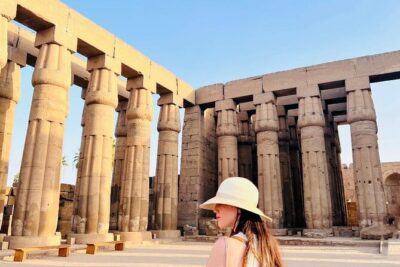
4-Days Nile Cruise From Aswan To Luxor including Abu Simbel and Hot Air Balloon
Read our review →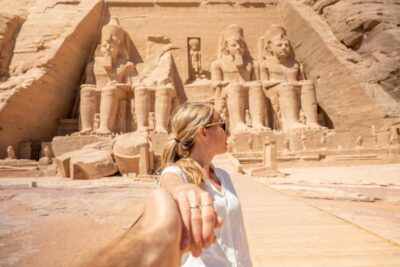
4-Day 3-Night Nile Cruise from Aswan to Luxor including Abu Simbel, Air Balloon
Read our review →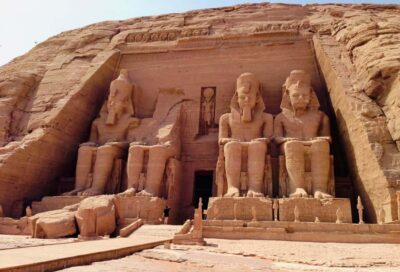
Abu Simbel Temple Private Guided Day Trip with Lunch
Read our review →4-Days Nile Cruise From Aswan To Luxor including Abu Simbel and Hot Air Balloon
Read our review →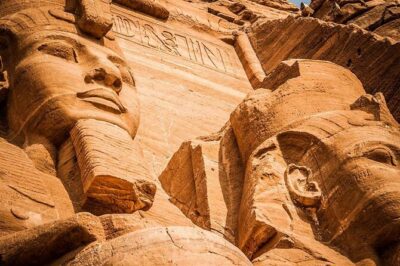
Private Day Tour to Abu Simbel Temples from Aswan
Read our review →4 Days Nile Cruise from Aswan to Luxor including Abu Simbel and Hot Air Balloon
Read our review →
Browse the lists this tour appears in