
Reviewed · ASWAN TOURS
Abusimble Day Tour from Aswan
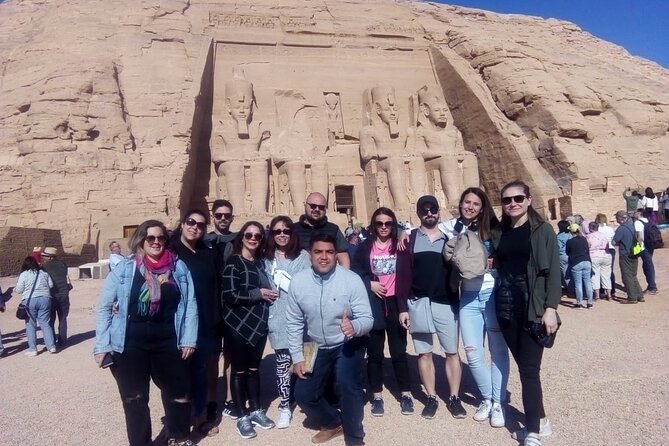
The reason to make this punishingly early start is simple: Abu Simbel’s colossal Ramses II statues are among Egypt’s most memorable sights. This $35.29 shared trip gets you there from Aswan without arranging a separate car, and the price includes hotel pickup, air-conditioned transport, and a local Egyptologist in Abu Simbel.
I especially like the reliable early departures and the chance to finish back in Aswan around early afternoon. The guide, sometimes named Ahmed, gives a useful introduction before allowing you to explore alone. The catch is limited time at the temples, often 90 minutes to two hours after six or more hours on the road.
Key points to know before booking
- Pickup usually begins around 4 a.m., with some pickups reported as early as 3:45 a.m.
- The drive takes about three hours each way, covering roughly 275 to 295 kilometers south of Aswan.
- You visit both major temples, Ramses II’s temple and the smaller temple of Queen Nefertari.
- Site time can range from about 90 minutes to two hours, depending on traffic, pickup delays, and the group schedule.
- Entry tickets are extra, and a breakfast box is not supplied, so bring food and water.
- The shared vehicle holds up to 15 people, making this a low-cost option but not the roomiest one.
Why Abu Simbel is worth the long road from Aswan
Abu Simbel is not a casual side trip. It sits far south of Aswan, close to the Sudanese border, and the journey takes roughly three hours in each direction. Still, the temples reward the effort in a way few Egyptian monuments can.
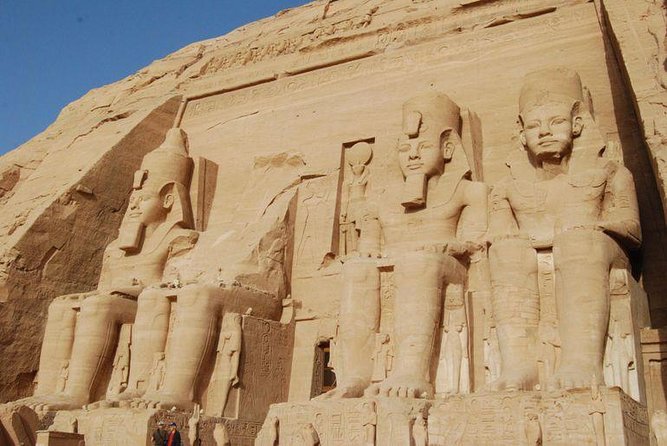
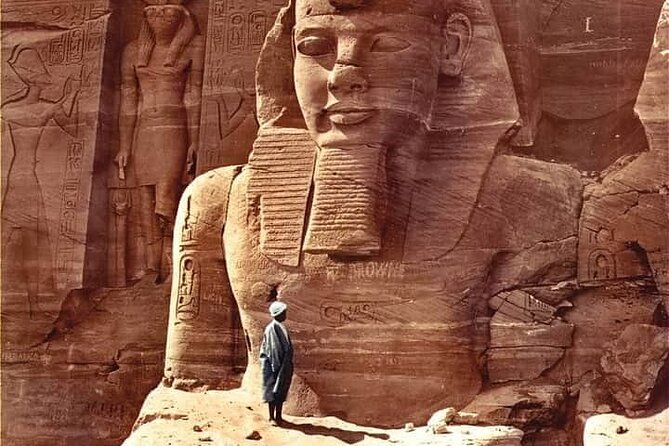
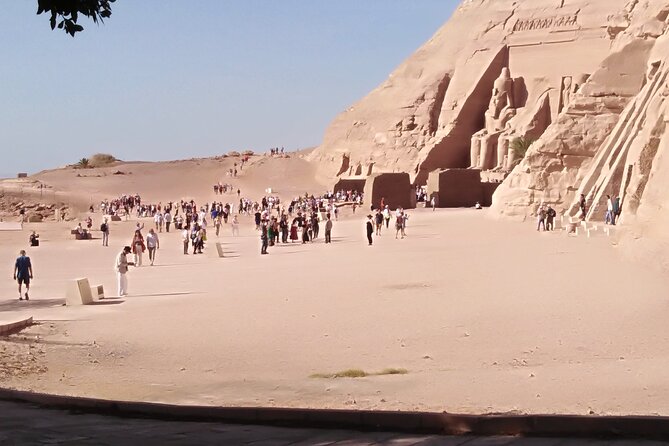
The main temple was built for Ramses II. Four huge seated statues of the king guard the entrance, carved into the sandstone cliff. Even before you enter, the scale is startling. The figures are not subtle, and they were never meant to be. Ramses wanted power made visible.
Beside it is the temple of Queen Nefertari, dedicated to the goddess Hathor. It is smaller, but do not treat it as an afterthought. The façade includes statues of Nefertari and Ramses at similar scale, an unusual sign of respect in a royal monument.
The temples were moved in the 20th century when the Aswan High Dam created Lake Nasser. That fact adds another layer to the visit. What you see is an ancient site reconstructed in a new location, preserved so you can still walk through the carved halls and see the painted reliefs.
You do not need to be an Egypt specialist to appreciate Abu Simbel. The scale works immediately. The interior scenes, royal figures, and surviving colors give you plenty to examine even if your guide’s explanation is brief.
A few other Aswan days to weigh up
- 4-Days Nile Cruise From Aswan To Luxor including Abu Simbel and Hot Air Balloon
★ 5.0 · 3,142 reviews - From Aswan: Abu Simbel Temple Day Trip with Hotel Pickup
★ 4.4 · 2,807 reviews - 4-Day 3-Night Nile Cruise from Aswan to Luxor&Abu Simbel+Balloon
★ 5.0 · 2,023 reviews
The 4 a.m. departure and the road south
The day begins before sunrise. Pickup is usually scheduled around 4 a.m., though exact times vary by accommodation and route. One vehicle has been reported arriving at 3:45 a.m., so keep your phone nearby and confirm the meeting time the evening before.
The early start is not an accident. A shared vehicle must collect people from different hotels, and the group needs to reach Abu Simbel within its planned window. Some departures arrive around 8:45 a.m., while the return to Aswan is often between 1 and 2 p.m.
The vehicle is air-conditioned, and the trip includes stops when needed for a toilet break, tea, or coffee. Some journeys have included a security checkpoint or an unexpected delay. These stops can add time, and communication may be limited if the driver speaks little English.
I would bring a small breakfast, water, tissues, and something warm for the first part of the ride. The tour description says you should have a breakfast box, but it does not include one. Your Aswan hotel may be able to prepare food, though that is not guaranteed by the tour itself.
The road distance is variously given as 275, 290, or 295 kilometers. The practical point is the same: this is about six hours of driving in total. You should book it because you want Abu Simbel, not because you enjoy leisurely transport.
Arriving at the Abu Simbel Temple Complex
At Abu Simbel, your local guide meets or assists the group near the entrance area. The usual arrangement is a short explanation outside the temples, followed by free time to enter and look around on your own.
This matters because guides are generally not permitted to give a full running commentary inside the temples. The Egyptologist may explain the main features of both monuments for roughly 10 to 20 minutes, then direct you toward the entrances and agree on a meeting time.
Some people find this format ideal. You get the basic story, then freedom to study the reliefs without having to stay beside a guide. Others expect a longer guided visit and feel shortchanged, especially if they have paid an additional local guide or if the introduction is rushed.
Ask clearly where and when to meet before you walk away. A few people have become confused about the return point or assumed the guide would accompany them inside. The guide may not enter with you, and the driver is not the person providing the archaeological explanation.
Ramses II’s temple and its giant façade
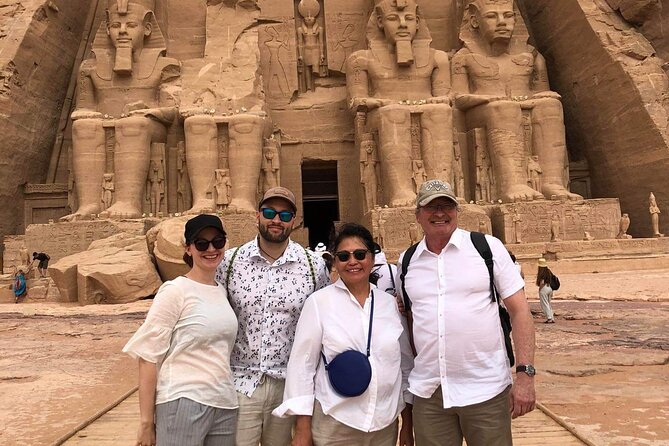
Start with Ramses II’s temple if the guide begins there. The four seated statues on the façade are the first major sight, and you need a little time simply to take in their size. The entrance sits between the central figures, leading into a sequence of halls and chambers.
Inside, look for the carved scenes showing Ramses in royal and religious settings. The temple’s design turns the king into the center of the world, with repeated images reinforcing his authority. Your guide can point out the main figures and themes, but the free time is valuable for noticing details at your own pace.
Do not spend every minute taking photos outside. The interior gives you a better sense of the temple as a working sacred space, not just a monumental façade. If the site is crowded, move steadily through the first hall, then pause in the side chambers where you may have more room to look upward and along the walls.
The amount of time here depends on your total site window. With two hours, you can see both temples at a reasonable pace. With only 90 minutes, you need to resist long photo sessions at the entrance.
Same base, a completely different day out:
- 4-Day 3-Night Nile Cruise from Aswan to Luxor including Abu Simbel, Air Balloon
★ 4.5 · 612 reviews - From Aswan: 3-Day Cruise to Luxor with Hot Air Balloon
★ 4.3 · 598 reviews - From Aswan: 4-Day Nile Cruise from Aswan to Luxor with Guide
★ 4.1 · 593 reviews - 4-Days Nile Cruise From Aswan To Luxor including Abu Simbel and Hot Air Balloon
★ 4.5 · 509 reviews
Queen Nefertari’s temple
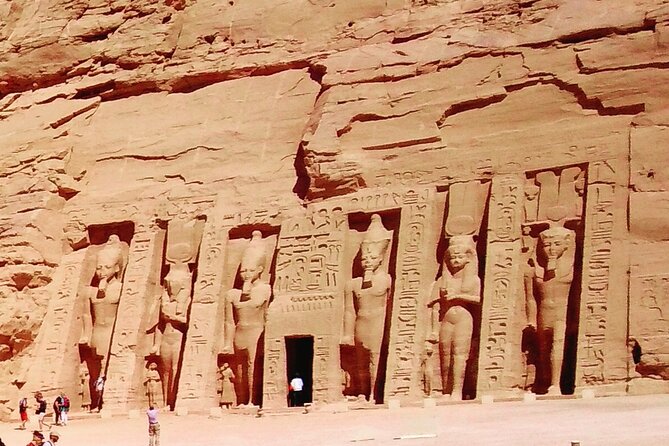
Queen Nefertari’s temple is next door, making the two-site visit efficient. Its façade is smaller than Ramses II’s, but its royal imagery is no less important.
The temple honors Hathor, a goddess linked with motherhood, music, and protection. Nefertari appears in a prominent role, and the paired royal statues outside help explain why this monument deserves equal attention during a short visit.
Inside, pay attention to the painted reliefs. Surviving color makes the rooms feel more immediate than bare stone alone. The chambers are smaller and can feel easier to appreciate quickly, but do not mistake smaller for less significant.
If you have only 90 minutes, allow time for both temples rather than spending the whole visit at Ramses II’s façade. A sensible split is to see the main exterior and interior rooms of the larger temple first, then give Nefertari’s temple a focused visit.
What the guide adds, and what the guide may not do
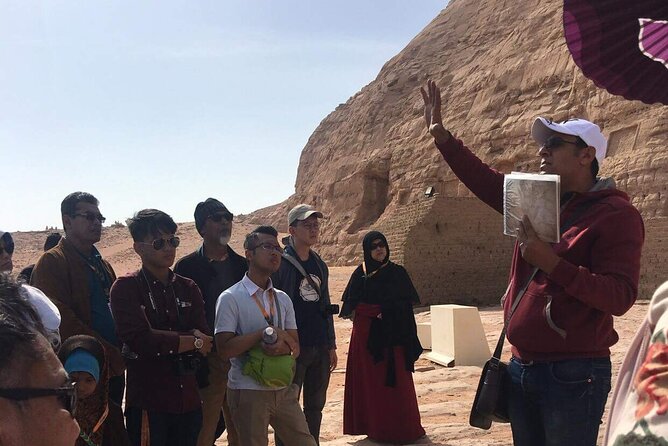
The tour includes a licensed Egyptologist in Abu Simbel, with language arranged as required. In practice, the guide’s role is usually to gather the group, explain the main points outside, help with orientation, and set the return time.
Guides such as Ahmed have been praised for clear explanations, but the quality can vary. Some introductions have felt too short, especially to people expecting a full tour. The guide may also leave you to explore once the main explanation is complete.
I suggest preparing before you leave Aswan. Read a short account of Ramses II, Nefertari, Hathor, and the relocation of the temples. That way, even a brief introduction gives you useful context, and your time inside is not dependent on a long lecture.
The guide is also not the driver. If you have a question about the temples, ask the Egyptologist when the group gathers. If you need a restroom stop, vehicle information, or a change in drop-off, speak with the driver or tour representative early.
Transport, group size, and comfort
This is a shared tour with a maximum of 15 people. Depending on the group, you may ride in a smaller vehicle or a bus. The vehicle is air-conditioned, but comfort reports vary, especially during the return in hot weather.
A full vehicle keeps the price low, but it also means waiting for pickups and keeping to a fixed schedule. One late hotel pickup can reduce the time available at the temples. The operator has stated that the schedule is constrained by the long road, speed limits, security procedures, and the need to return the whole group.
The drivers are often described as punctual, safe, and efficient. That is one of the strongest reasons to choose this option instead of arranging a more expensive private car. Still, do not expect a talkative driver or a scenic tour with many stops. The purpose is to get you south and back safely.
If you stay on Elephantine Island, confirm pickup instructions carefully. You may be asked to reach a mainland meeting point or a pier, and a boat transfer may cost extra. That arrangement can be awkward before dawn, particularly if your accommodation is some distance from the jetty.
Airport, train station, and other drop-offs may sometimes be accommodated, but they should be confirmed in advance. Do not assume a special drop-off will fit the shared route.
Is $35.29 good value?
At $35.29 per person, this is one of the cheapest straightforward ways to reach Abu Simbel from Aswan. You are paying mainly for transport coordination, hotel pickup, the shared vehicle, and assistance from a local Egyptologist.
The price does not include admission tickets. It also does not include breakfast, drinks, or any optional guide-related charge at the entrance. Budget for those extras before you go, and carry Egyptian pounds because card payment and foreign cash may not always be accepted smoothly.
The value is strongest if you want a practical shuttle with some historical orientation. It is weaker if you want a private vehicle, flexible timing, a long guided visit, or a spacious ride.
A private tour may give you more control, but it will cost more. A public bus may also be cheaper in some cases, though this tour removes much of the work of finding the route and arranging hotel pickup. For a visitor with limited time in Aswan, that convenience has real value.
The biggest drawback: time at the temples
The main concern is not Abu Simbel itself. It is the ratio of driving time to sightseeing time.
The advertised visit allows about two hours at the complex, but actual time can fall to around 90 minutes if pickups run late, security stops take longer, or the group must meet an early departure. Some people have reported even less time at the monuments.
Ninety minutes is enough to see the two temples, but it is not enough for a slow, thoughtful visit. You will need to keep moving, and you may have to choose between photographs, interior details, and simply standing in front of the façade.
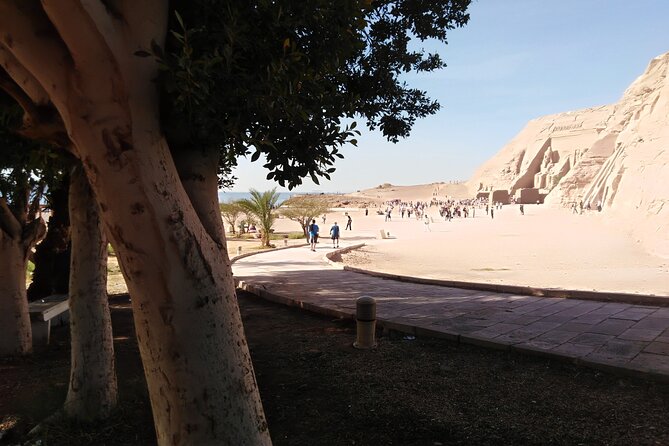
The early departure also does not guarantee an empty site. Depending on the day and arrival time, you may reach the temples during a busy period. If avoiding crowds is important, ask the operator which departure time is available and how long it allows on site.
Who should book this Abu Simbel trip?
I would choose this tour if you are staying in Aswan, want the lowest practical price, and can accept a very early morning and a fixed schedule. It suits people who are comfortable exploring a major monument independently after a short explanation.
It is also a good fit if you need a dependable return to Aswan by early afternoon. The timing can work well with an onward train, flight, or another planned activity, but confirm any special drop-off rather than relying on a promise made casually on the morning.
I would hesitate if you dislike long road journeys, need generous sightseeing time, or expect a guide to remain beside you inside both temples. Families with young children may also find the 4 a.m. start and long return tiring, though the activity information says most people can participate.
Free cancellation is available up to 24 hours before departure. Changes made inside that window are not accepted, and poor weather or failure to reach the minimum group size can lead to a new date or a refund.
Should you book it?
Book it for efficient, low-cost access to Abu Simbel, not for a relaxed guided day. The transport is the strongest part: pickup is often punctual, the route is direct, and the price is hard to beat.
Before paying, confirm your pickup location, especially if you are on Elephantine Island. Ask exactly how much time you will have inside the complex, what the entry fee is on your date, and whether the Egyptologist will provide a short outside briefing or a longer guided service.
If you prepare a little before leaving Aswan, bring breakfast, carry Egyptian pounds, and protect your temple time, this trip can deliver the essential Abu Simbel experience at a very fair price. If you want comfort and freedom, pay more for a private arrangement.
FAQ
What time does the Abu Simbel tour start?
Pickup is usually around 4 a.m., with some pickups reported at 3:45 a.m. The exact time depends on your accommodation and the shared route.
How long is the drive from Aswan to Abu Simbel?
The drive is about three hours each way. The stated distance is roughly 275 to 295 kilometers south of Aswan.
How long do I have at Abu Simbel?
The planned visit is about two hours, but some departures allow closer to 90 minutes because of pickup delays, security stops, or the shared schedule.
Which temples are included?
You visit the temple of Ramses II and the temple of Queen Nefertari at the Abu Simbel complex.
Are entrance tickets included?
No. Entry tickets are not included in the tour price. Any additional guide or site-related fee should be clarified before entering.
Is hotel pickup available?
Yes. Pickup is offered from accommodations in Aswan, but special arrangements may apply for people staying on Elephantine Island. Confirm the meeting point in advance.
New on the Aswan list
- 4-Day-3 Night Nile Cruise Aswan & Luxor + Abu Simbel, Air Balloon★ 5.0 · 26 reviews
- 4-Days Nile Cruise sails Aswan to Luxor &Abu Simbel. Air Balloon★ 5.0 · 26 reviews
- Abusimbel Aswan to Luxor 4 days Nile cruise★ 5.0 · 27 reviews
- 4-Day 3-Night Nile Cruise from Aswan to Luxor – Luxury Tour★ 4.5 · 27 reviews
- Tour to Abu Simbel Temple with a small group and a Professional tour guide★ 4.5 · 27 reviews
- 4 Days 3 Nights from Aswan to Luxor Nile cruise+Abu simbel temple★ 5.0 · 27 reviews
- 4 Days Nile Cruise from Aswan to Luxor★ 5.0 · 28 reviews
- Nile Cruise 4 Days 3 Nights from Aswan to Luxor★ 4.5 · 29 reviews
Aswan Tours, compared.
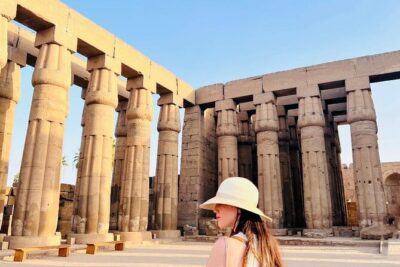
4-Days Nile Cruise From Aswan To Luxor including Abu Simbel and Hot Air Balloon
Read our review →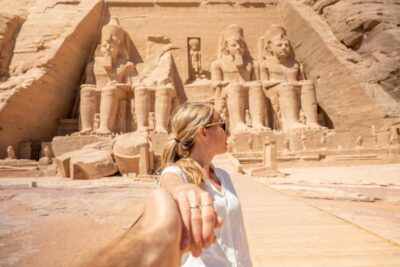
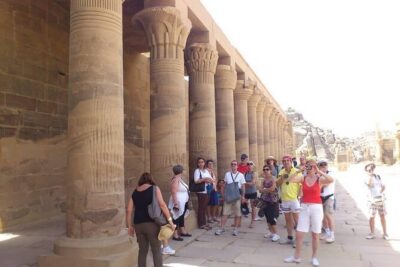
4-Day 3-Night Nile Cruise from Aswan to Luxor including Abu Simbel, Air Balloon
Read our review →
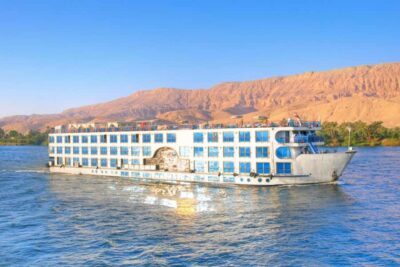
4-Day Nile Cruise from Aswan to Luxor with Guide
Read our review →4-Days Nile Cruise From Aswan To Luxor including Abu Simbel and Hot Air Balloon
Read our review →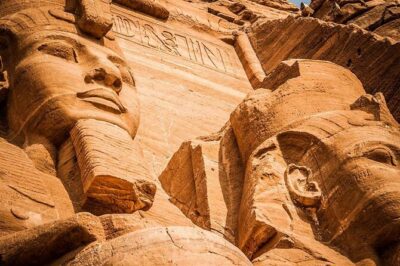
Private Day Tour to Abu Simbel Temples from Aswan
Read our review →
High Dam, Unfinished Obelisk, & Philae Private Tour
Read our review →Browse the lists this tour appears in