
Reviewed · ABU SIMBEL TOURS
3-Day Luxor Aswan and Abu Simbel Historical Sites Private Tour
The big achievement here is fitting Luxor, Aswan, and Abu Simbel into three busy days without leaving you to bargain for every car or puzzle over Egyptian train tickets. I like the private format, which lets your own group move at a sensible pace, and I like the practical mix of first-class train travel, private road transport, and the short boat ride to Philae. The guide names most often associated with this company include Khaled and Khalid, while Mohamed handles trip arrangements for many bookings.
The trade-off is clear: this is a fast historical tour, not a slow Nile holiday. Admission fees, meals, drinks, and accommodation are extra, and Day 3 includes a long road journey to Abu Simbel and back. You will see major sights, but you will need decent stamina and an early-start mindset.
Key points to know before booking
- Three major destinations in three days: Cover Luxor’s ancient temples, Aswan’s monuments, and Abu Simbel without arranging separate transfers.
- A private guide and vehicle: Only your party takes part, with an Egyptologist guide and an air-conditioned vehicle.
- First-class rail between Luxor and Aswan: The train ticket is included, saving you one of the more awkward transport arrangements.
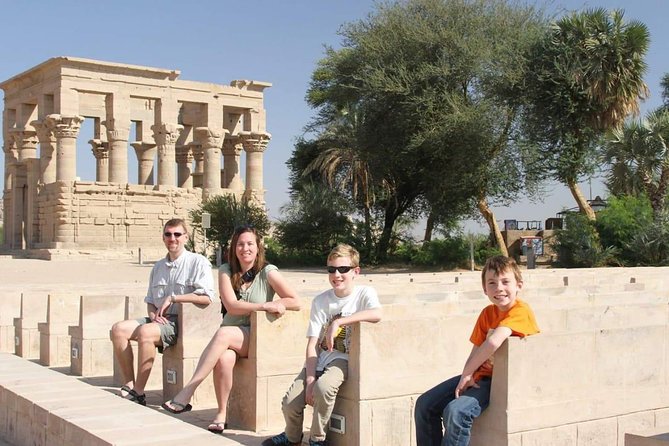
- Philae includes a boat ride: Reach the island temple by motorboat, then explore with your guide and enjoy free time.
- Abu Simbel is an all-day road trip: Allow about eight hours for the vehicle excursion from Aswan.
- The advertised price is $251.29 per person: It can be good value for a small group, but site tickets, food, and lodging are not part of that price.
Why this three-day route works
Egypt’s southern monuments are spread along the Nile, and transport can eat up a great deal of your holiday. This tour puts the pieces in a logical order: Luxor on the first day, Aswan on the second, then Abu Simbel on the third.
I like that you get both private driving and first-class rail. The train breaks up the road travel between Luxor and Aswan, while the private vehicle handles the West Bank of Luxor, Aswan’s outlying sights, and the long trip to Abu Simbel.
You also avoid one common nuisance: negotiating separately with taxi drivers at every stop. Pickup and drop-off at your hotel are included, though you should confirm the exact pickup point when booking, especially if you are arriving through an airport or beginning the tour in Aswan rather than Luxor.
The pace is the main thing to consider. Each day is built around famous sites rather than long stretches of free time. That suits you if your priority is seeing the key monuments in a short visit. If you want leisurely museum visits, extended meals, or time on the Nile, three days will feel tight.
A few other Luxor days to weigh up
- Luxor: Abu Simbel Temple Private Guided Day Trip with Lunch
★ 4.6 · 546 reviews - 4 Days Aswan and Luxor Nile cruise&Abu Simbel by plane from Cairo
★ 5.0 · 155 reviews - 4 Nights Luxor to Aswan Nile cruise with Abu Simbel&Air Balloon
★ 5.0 · 155 reviews
Day 1: tombs and temples across Luxor
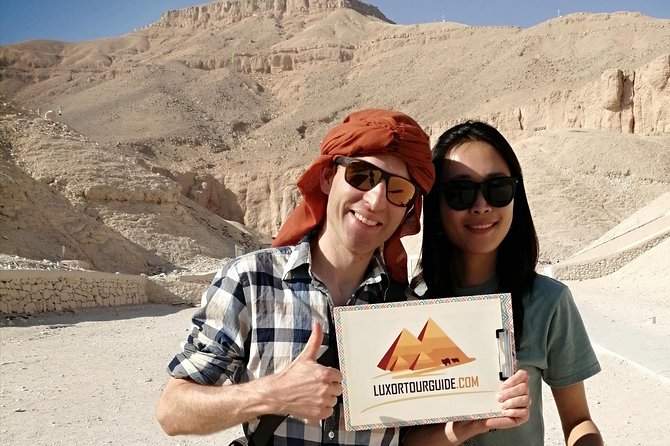
The first day begins on Luxor’s West Bank at the Valley of the Kings. This dry valley served as the burial place of the kings of ancient Thebes, and the setting helps explain why royal tombs were placed here rather than in visible pyramids.
You receive a short introduction at the visitor center, then enter the tombs included with your admission. Guides are not permitted inside the tomb chambers, so your Egyptologist explains the decoration and points out what to watch for before you go in. That advance briefing matters, since the tombs can look like a rush of painted walls if you do not know what the scenes represent.
Admission to the Valley of the Kings is not included. The tomb of Tutankhamun requires an additional direct payment, so decide in advance if seeing it matters to you. The tour gives you roughly an hour and a half here, enough for a focused visit but not an exhaustive survey of every open tomb.
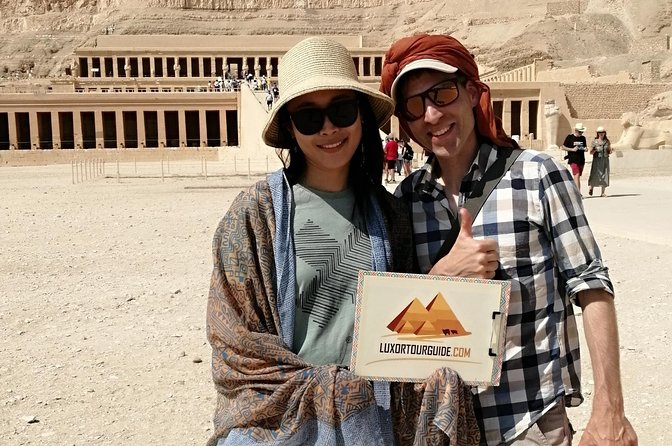
Next comes the Temple of Hatshepsut, built into the cliffs and dedicated to one of Egypt’s most unusual rulers. Hatshepsut presented herself in the traditional male form of kingship, and your guide explains how that choice helped her hold power.
The temple’s broad courtyards and terraces are easy to explore at your own pace. Take time to inspect the carved scenes and the temple’s strong geometric design. The admission fee is extra, and the open setting can feel exposed in strong sun, so bring water and a hat.
A short stop at the Colossi of Memnon follows. These two huge statues are the remaining pieces of the funerary temple of Amenhotep III. You have about 20 minutes, which is enough for photographs and a quick explanation. This is a useful pause between larger sites, but do not expect a full temple visit because little of the original complex survives above ground.
Karnak and Luxor Temple after the West Bank
The route then crosses to the East Bank for Karnak, the enormous temple complex that grew over more than 3,000 years. It was not built as one neat monument. Different pharaohs added courts, pylons, columns, sanctuaries, and inscriptions, leaving you with a site that feels more like a city of temples than a single building.
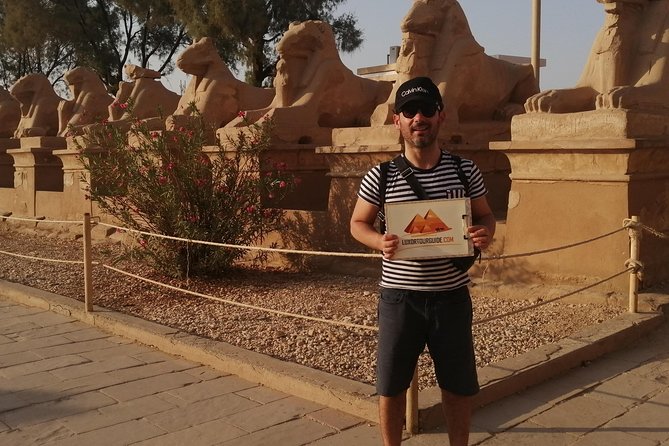
The Avenue of Sphinxes leads toward the entrance, and your guide explains how the great facade took shape. Inside, the Great Court and the Great Hypostyle Hall provide the visual high point. The hall’s 134 columns rise like a stone forest, and the scale is hard to grasp until you walk among them.
Look for the sacred lake toward the back of the complex. Your guide can explain its religious purpose and how priests used water in temple rituals. After the guided portion, you have additional time to explore, which is valuable here because Karnak rewards slow looking.
The schedule data gives an unusually short listed duration for Karnak, but the site description also allows free time after the guided visit. Confirm the exact timing with the operator before you go, since a rushed visit would undersell one of Luxor’s most important monuments.
Luxor Temple is the final major stop of the day. Once connected to Karnak by a long Avenue of Sphinxes, it was used for royal and religious ceremonies. Ramses II’s statues dominate the entrance, while the inner rooms carry layers of carved decoration from different periods.
Your guide helps you read the hieroglyphic scenes and explains how Alexander the Great inserted himself into the temple’s story. Look for the surviving obelisk at the entrance. Its pair now sits in Paris’s Place de la Concorde, an unexpected reminder of how Egyptian monuments were scattered far beyond the Nile.
Luxor Temple is especially effective later in the day, when its columns and statues take on a warmer tone. The entrance fee is not included, and you should expect plenty of walking across uneven stone at both Luxor and Karnak.
Day 2: Philae, granite, and the High Dam
Day 2 shifts to Aswan and begins at Philae Temple. The temple once occupied a different island, but construction of the High Dam raised the surrounding water. An international preservation effort moved the complex roughly 500 meters to its present location.
You reach the island by motorboat, and that short ride is part of the appeal. Philae is dedicated mainly to Isis and includes shrines connected with the story of Isis and Osiris. The island setting gives the visit a calmer character than the huge temple grounds in Luxor, although the admission ticket is extra.
Your guide leads a two-hour visit, then gives you time to look around on your own. Pay attention to the reliefs and the variety of smaller sanctuaries around the main temple. Ask your guide to point out the signs of later religious use and the practical work involved in moving the site.
The included boat ride is a real advantage. You do not have to arrange a separate transfer to the dock or negotiate for a boat after arriving. The ticket to enter Philae, however, remains your responsibility.
The next stop is the Unfinished Obelisk, located in Aswan’s granite quarries. The monument still lies in the rock where workers abandoned it after a crack appeared during carving. Your guide explains how the ancient craftsmen shaped hard granite and why one flaw could end the entire project.
This stop makes an important point about ancient construction. Obelisks were not simply transported from a ready-made quarry block. They had to be cut, checked, polished, and moved, with a single structural problem capable of wasting enormous labor.
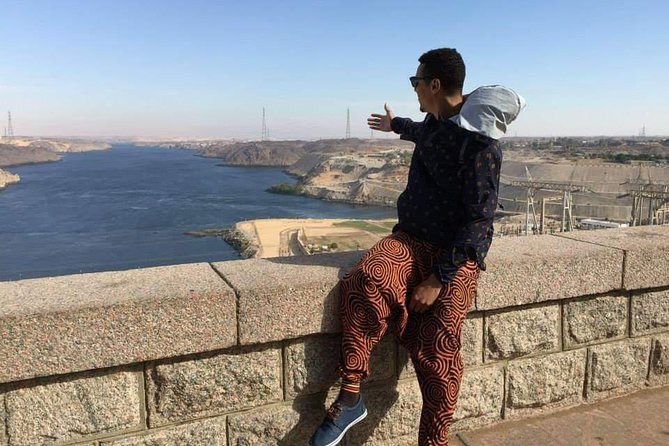
The tour then visits the Aswan High Dam, built from 1960 to 1970. From here, you can see Lake Nasser, described in the tour material as the second-largest artificial lake in the world, along with the Friendship emblem. The dam is a modern engineering site rather than an ancient monument, but it helps explain the changes to the Nile and the relocation of Philae.
This day offers a good balance: an island temple, an ancient worksite, and a modern Egyptian achievement. The drawback is that each stop has its own entrance charge, so your final cost will be higher than the advertised tour price.
Same base, a completely different day out:
- Hurghada: Luxor Valley of the Kings & Tutankhamun Tomb Trip
★ 4.7 · 13,208 reviews - Luxor Day Trip from Hurghada Small Group & Tutankhamun Tomb
★ 4.8 · 5,366 reviews - Hot Air Balloon Ride in Luxor Egypt with Transfers Included
★ 5.0 · 4,319 reviews - Luxor: Shared Full-Day Tour to Luxor West and East Banks
★ 4.5 · 1,812 reviews
Day 3: the long road to Abu Simbel
Abu Simbel is the tour’s biggest time commitment and, for many people, its most dramatic stop. The vehicle journey from Aswan takes most of the day, with the stated duration around eight hours. You should treat this as a dedicated excursion rather than a quick add-on.
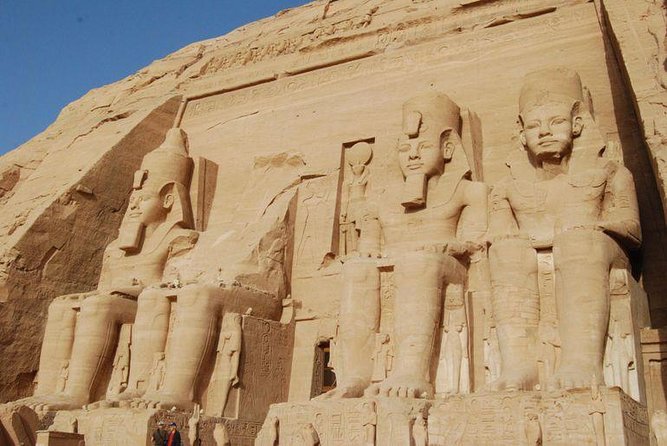
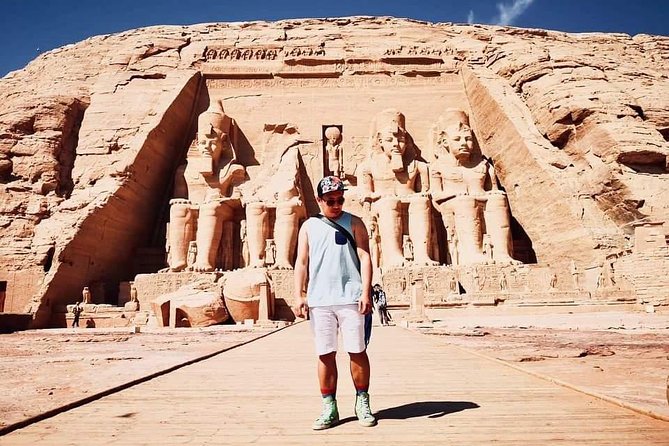
The Great Temple is fronted by four enormous rock-cut figures of Ramses II. The smaller Temple of Hathor stands nearby, and together the two monuments form one of Egypt’s most memorable ancient sites.
Before you enter, your guide explains how the temples were discovered by accident in 1813 and how an international preservation project moved the entire cliff face to higher ground. That relocation is not a minor footnote. It is central to understanding why the temples are where they are today.
As at the Valley of the Kings, guides are not allowed inside the temple interiors. Your Egyptologist uses photographs and illustrations to explain the rooms, carvings, and layout before or after you enter. This arrangement is less convenient than having the guide beside you, but the briefing gives you a useful framework for reading the interior walls yourself.
The private format helps here. You are not tied to a large group’s questions or pace, and you can ask for clarification about Ramses II, Hathor, the relocation, or the temple decoration. Still, the overall excursion remains demanding because of the road distance and the heat that can build up around the site.
If Abu Simbel is high on your Egypt wish list, the long drive is usually the price of admission in practical terms. If you dislike long vehicle days, consider that carefully before booking. The tour provides transport in an air-conditioned vehicle, but no food or drinks are included, so plan your own refreshments within the operator’s stated arrangements.
What the private format adds
A private tour does not guarantee a leisurely schedule, but it gives you room to shape the experience. You can ask the guide to spend more time on a favorite tomb, slow down at a relief, or keep explanations brief when you are ready to explore independently.
The guide is also useful for deciding how to use limited time. At the Valley of the Kings, for example, you may want advice on which available tombs best match your interests. At Karnak, a guide can help you focus on the Great Hypostyle Hall, sacred lake, and major additions rather than wandering without a plan.
Khaled and Khalid are names associated with positive feedback about this company’s Egypt guides. Descriptions of their work emphasize clear explanations, humor, patience, and a willingness to adjust the pace. Because guide assignment can vary, ask at booking if a specific guide is important to you.
Mohamed is also identified with trip coordination, and the booking process may involve him when you need to discuss timing or transport details. Mahmoud is named as a driver in one account, but you should not assume a particular driver will be assigned.
Price, exclusions, and real value
At $251.29 per person, the tour can make financial sense if you are in a small private group and want transport arranged from end to end. The price covers the Egyptologist guide, hotel pickup and drop-off, air-conditioned vehicle transport, first-class train seating from Luxor to Aswan, the Philae boat ride, fuel, parking, driver costs, service charges, and taxes.
That is a useful bundle. First-class rail tickets and several private transfers would take time and planning to arrange independently, especially if you are unfamiliar with local transport. The private vehicle is also valuable for Abu Simbel, where the road distance makes a casual taxi arrangement a poor plan.
The price does not include entrance fees at the archaeological sites. It also excludes food, drinks, accommodation, personal expenses, and gratuities. Tutankhamun’s tomb costs extra as well.
For a solo participant, the per-person price is less compelling because there is no group to share the private vehicle and guide cost. For two or more people, the convenience improves the value. You should add up the entrance tickets and lodging before comparing this package with a cruise, a train-based independent trip, or separate day tours.
Who will get the most from this tour
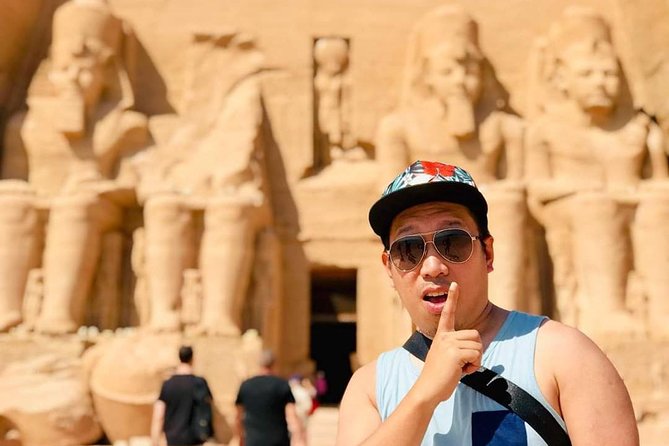
I would choose this for you if your Egypt trip is short and your main goal is to see the famous southern monuments efficiently. It suits first-time visitors who want historical context at each site and prefer not to arrange each taxi, train, and boat separately.
It also works well for friends or family who value privacy. You can keep questions focused on your interests, take photographs without holding up a large group, and ask for changes in emphasis when time allows.
I would be more cautious if you need a gentle pace, have limited mobility, or dislike long road journeys. The tour requires a moderate level of physical fitness, includes substantial walking at ancient sites, and reserves a full day for Abu Simbel. Accommodation is available by request, but it is not included in the stated price.
Confirmation is provided at booking, and free cancellation is available up to 24 hours before the local start time. Changes or cancellations made inside that 24-hour window are not accepted for a refund.
Should you book it?
Book this tour if you want maximum coverage in minimum time and are comfortable paying site fees separately. Its best features are the private guide, first-class Luxor to Aswan train ticket, included Philae boat ride, and organized Abu Simbel transport.
Skip it if you want a relaxed Nile schedule or plan to spend long hours at fewer monuments. For everyone else, especially a small group with only three days for Luxor and Aswan, this is a sensible, well-packed way to reach the sites that are hardest to arrange on your own.
FAQ
How long is the tour?
The experience lasts approximately three days.
Is the tour private?
Yes. Only your party participates in the activity.
Is hotel pickup included?
Yes. Hotel pickup and drop-off are included, but you should confirm the exact pickup details when booking.
Is an Egyptologist guide included?
Yes. A qualified Egyptologist guide is included. Guides named in the supplied information include Khaled and Khalid.
Are train tickets included?
Yes. First-class seating on the train from Luxor to Aswan is included.
Is the boat to Philae Temple included?
Yes. The boat journey to Philae Temple is included. The entrance fee to the temple is not included.
Are entrance fees included?
No. Entrance fees for the listed sites are paid separately. Tutankhamun’s tomb also requires an additional direct payment.
Is accommodation included?
No. Accommodation is not included, though it can be arranged by request.
Can I cancel for a full refund?
Yes, if you cancel at least 24 hours before the experience start time. Cancellations or changes made less than 24 hours before the local start time are not accepted for a refund.
More Historic Sites in Luxor
- Sunrise Hot Air Balloon Over the Historical sites in Luxor
★ 5.0 · 697 reviews - From Cairo: Private Full-Day Tour of Historical Alexandria
★ 4.1 · 1,155 reviews - Old Cairo Guided Walk Tour: History, Culture & Street Bites
★ 4.6 · 633 reviews - From Cairo: Historical Alexandria Shared Day Tour with Lunch
★ 4.4 · 260 reviews
New on the Luxor list
- Full-Day East and West Luxor Private Tour★ 4.5 · 26 reviews
- Marsa Alam: Snorkeling with Sea Turtles Marsa Mubarak★ 4.9 · 26 reviews
- Private Full day East and West Bank, Luxor★ 5.0 · 26 reviews
- Day Trip to Edfu & Kom Ombo temples from Luxor and drop off in Aswan or Luxor★ 5.0 · 26 reviews
- Luxor Day Tour: Kings Valley & Karnak & Luxor & Hatshepsut Temple★ 5.0 · 26 reviews
- Luxury Hot Air Balloon Experience in Luxor with Pick-up★ 5.0 · 27 reviews
- Full-Day Luxor Tour – Discover the East and West Banks of the Nile★ 5.0 · 27 reviews
- 5 Days 4 Nights Nile Cruise Tour★ 5.0 · 27 reviews
Abu Simbel Tours, compared.
4-Days Nile Cruise From Aswan To Luxor including Abu Simbel and Hot Air Balloon
Read our review →
4-Day 3-Night Nile Cruise from Aswan to Luxor including Abu Simbel, Air Balloon
Read our review →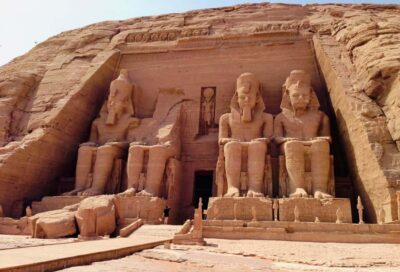
Abu Simbel Temple Private Guided Day Trip with Lunch
Read our review →4-Days Nile Cruise From Aswan To Luxor including Abu Simbel and Hot Air Balloon
Read our review →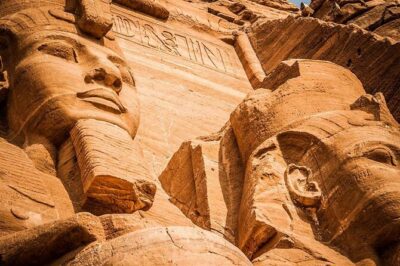
Private Day Tour to Abu Simbel Temples from Aswan
Read our review →4 Days Nile Cruise from Aswan to Luxor including Abu Simbel and Hot Air Balloon
Read our review →
Browse the lists this tour appears in