Reviewed · HURGHADA TOURS
Private Day Tour to Luxor from Hurghada
Luxor packs some of Egypt’s greatest monuments into one long day. From Hurghada, this private tour takes you across the desert to the Valley of the Kings, Hatshepsut’s temple, the Colossi of Memnon, Karnak, and Luxor Temple, with your own Egyptologist to connect the stones to the pharaohs who built them.
I like the private door-to-door transport, since you avoid gathering a busload of strangers and can travel in an air-conditioned vehicle with your own group. I also like having a guide who can explain the Valley of the Kings before you enter, where guides are not allowed inside the tombs.
The drawback is the day’s sheer length: 15 to 17 hours is a serious outing, especially with the early departure and several hours on the road each way. Entrance tickets are not included, so plan for about 600 Egyptian pounds in local cash, plus a possible extra charge for Tutankhamun’s tomb.
Key points
- Sunrise departure from Hurghada: A pickup around 5:30 a.m. is possible, giving you an early start toward Luxor.
- Five major sights: The route covers the Valley of the Kings, Hatshepsut’s temple, Memnon’s Colossi, Karnak Temple, and Luxor Temple.
- Private Egyptologist guide: Your guide can adjust explanations to your group and prepare you for the tombs before you enter.
- Air-conditioned private vehicle: The long desert transfer is easier with hotel pickup, parking, fuel, and driver costs included.
- Lunch is included: Other food and drinks are not included unless specifically stated.
- Extra entrance costs: Site tickets are paid locally, with about 600 Egyptian pounds recommended for the main admissions.
A very long day that reaches ancient Luxor
This is the practical answer for seeing Luxor from a Hurghada beach base when you do not want to change hotels. You leave early, cross the desert, spend the day moving between the East and West Banks, then return to Hurghada late.
The timing matters. A reported pickup at 5:30 a.m. allowed the group to travel during sunrise, when the desert road could be especially pleasant to watch from the car. You should expect a long ride, but the private format makes the transit less tiring than a large shared coach. You can travel with only your own group, stop as arranged, and avoid waiting for people from several hotels.
The vehicle is air-conditioned, and the price includes the driver, fuel surcharge, parking, service charges, and taxes. Those details may sound minor, but they help keep the final cost clearer on a day with substantial road time.
At $140 per person, the value depends on your group size and priorities. You are paying for a private vehicle, hotel transfers, lunch, a dedicated Egyptologist, and access to five major Luxor sights in one day. You still pay admission fees yourself, and the estimated 600 Egyptian pounds is an important addition to your budget.
For a solo participant or a couple, the price is not the cheapest way to reach Luxor. For a small group, group discounts may improve the deal, and the comfort and flexibility of a private trip become easier to justify. You also save the cost and time of arranging separate transport from Hurghada.
A few other Hurghada days to weigh up
- Private Transfer from Hurghada Airport to anywhere in Hurghada
★ 5.0 · 970 reviews - Hurghada: Private or Shared City Tour with Guide & Shopping
★ 4.5 · 753 reviews - Hurghada: Private Speedboat Adventure with Snacks & Pick-up
★ 4.8 · 582 reviews
The Valley of the Kings, tombs below the Theban hills
The first major stop is the Valley of the Kings, the burial ground of the kings of ancient Thebes, now Luxor. You begin with a short visit to the visitor center, then your guide explains the setting and the tombs before you go inside.
This preparation is useful because guides cannot enter the tombs with you. Your Egyptologist can point out what to watch for in the painted rooms, explain how the burial chambers were used, and give you enough context to make sense of the decorations on your own.
The allotted time is about 1 hour and 30 minutes. That sounds generous, but the valley contains more tombs than you can reasonably see in one visit, and admission usually covers a selected number rather than every tomb. The exact choice of open tombs can vary, so ask your guide which ones are included in the regular ticket and which are worth the time.
Tutankhamun’s tomb costs extra. It is a small chamber compared with some royal tombs, and the famous pharaoh’s burial goods are not all displayed there, but the name alone makes it a major draw. If you want to enter, bring additional money beyond the estimated main admission total.
The valley is one of the tour’s strongest stops, but it is not a relaxed stroll. You will walk between the visitor area and tomb entrances, and the desert setting offers little shade. Wear practical shoes, carry water, and keep your schedule in mind, since Hatshepsut’s temple follows soon after.
Hatshepsut’s temple and a queen who changed the rules
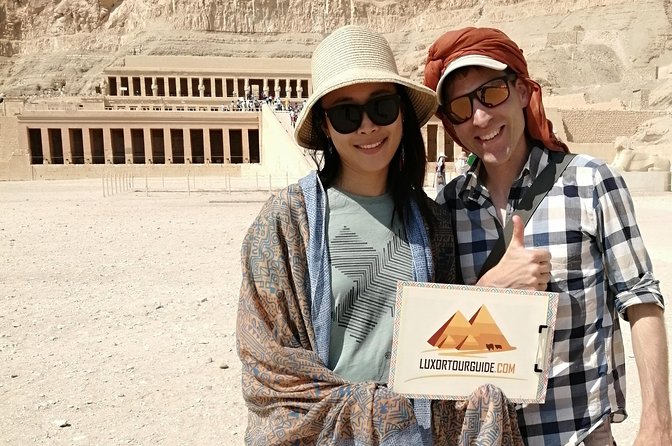
The Temple of Hatshepsut at Deir el Bahari is a sharp change from the underground tombs. Its broad terraces rise against the cliffs, with long approaches, open courtyards, and decorated walls that make the site easy to read from a distance.
Your guide introduces Hatshepsut, the female ruler who presented herself as a male king to secure her position on the throne. That detail gives the visit a human thread. You are not simply looking at columns and reliefs, but at a ruler using images, titles, and ritual to claim authority in a world dominated by male pharaohs.
The stop lasts about 45 minutes, with time to explore independently. I would use the guide’s explanation first, then spend the remaining minutes looking closely at the hieroglyphs and the relationship between the terraces and the cliffs behind them.
The short visit is also a limitation. Hatshepsut’s temple rewards slow looking, and 45 minutes can pass quickly once you factor in walking and photo stops. Still, the private arrangement helps because you are not following a large group through every courtyard at the same pace.
Expect strong sun and open ground. The site’s scale is easy to appreciate, but there is no reason to rush from one corner to another. Listen carefully at the start, then choose a few areas to inspect rather than trying to cover every detail.
The Colossi of Memnon, a quick stop with a big view
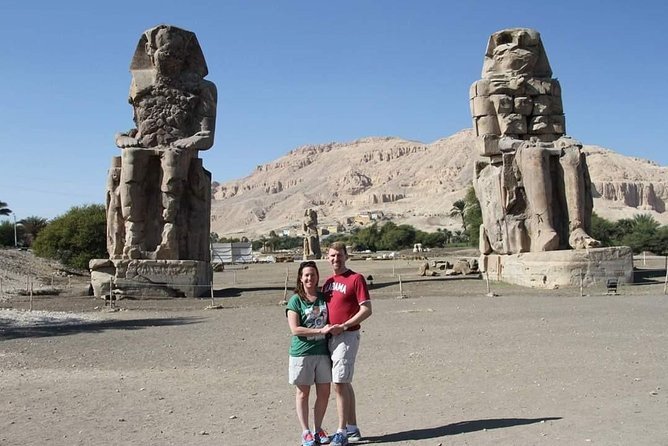
The Colossi of Memnon receive about 15 minutes, making this the briefest stop. These two huge statues once marked the entrance to the funerary temple of Amenhotep III. The temple itself is gone, leaving the seated figures as the clearest reminder of the complex.
This is a photo stop, but it is not meaningless filler. The statues give you a sense of ancient scale, and they help explain how much of Luxor has disappeared over time. What you see today is only a small remnant of a much larger royal project.
Admission is free, so this stop does not add to your ticket budget. The short time is enough for a close look and photographs, though you will not have an extended archaeological visit here.
Same base, a completely different day out:
- From Hurghada: Cairo and Giza Highlights Full-Day Tour
★ 4.5 · 6,014 reviews - Hurghada: Luxury Cruise Trip to Orange Bay with Lunch
★ 4.9 · 5,451 reviews - Hurghada: Orange Bay Island Boat Trip w/ Breakfast and Lunch
★ 4.9 · 5,345 reviews - Hurghada: Royal Seascope Submarine Cruise with Snorkel Stop
★ 4.4 · 4,637 reviews
Karnak, where the scale becomes hard to grasp
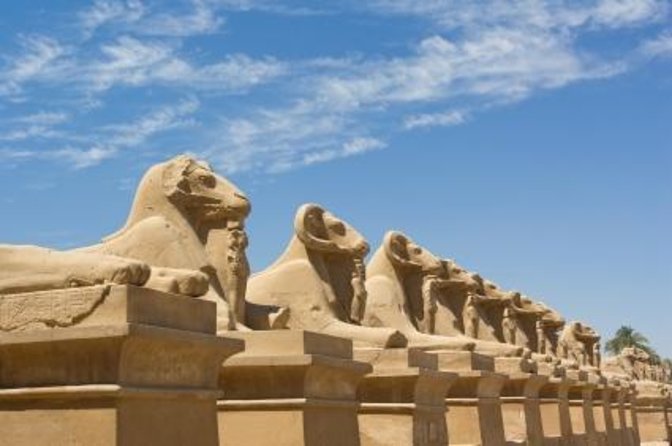
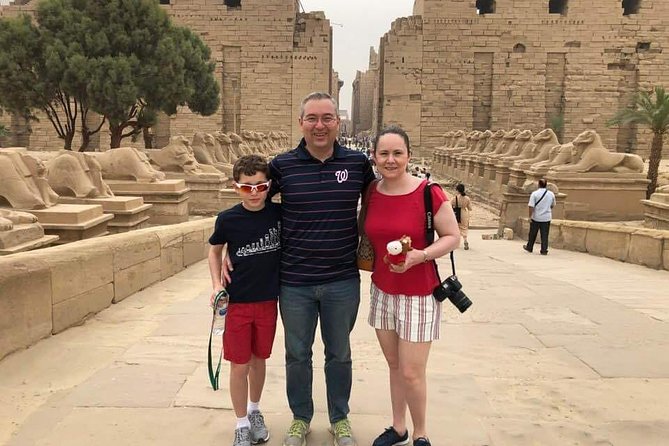
Karnak is the day’s largest and most demanding monument, with about two hours set aside. The complex grew over many centuries as different pharaohs added temples, gateways, columns, statues, and religious spaces. Your guide begins along the Avenue of Sphinx, then helps you read the layers as you move inward.
The deeper you go, the farther back in time the oldest parts reach, with ruins dating back more than 3,000 years. That progression is one reason a guide adds real value here. Without context, Karnak can look like a vast collection of stones. With a clear explanation, you begin to see how successive rulers added their own marks to an already sacred place.
The Great Court leads toward the Great Hypostyle Hall, the visual high point for many people. Its 134 columns rise overhead in dense rows, creating the impression of an ancient stone forest. Give yourself time to look up, but also look at the carved surfaces around you. Names and scenes cut into the walls show how kings used the complex to link themselves with the gods.
Farther inside, the sacred lake marks another important part of the site. It was connected with ritual purification and offerings. Your guide can explain its role before you have free time to explore at your own pace.
Two hours is a useful amount of time, though Karnak can easily fill a whole morning. The complex is spread out, and walking on uneven surfaces in the heat can wear you down after the West Bank sites. This is where comfortable shoes and water matter most.
The tour includes free time after the guided portion. Use it to return to a column group or courtyard that caught your eye, rather than trying to race through every remaining section. The private format is especially helpful here, since your guide can focus on the features your group finds most interesting.
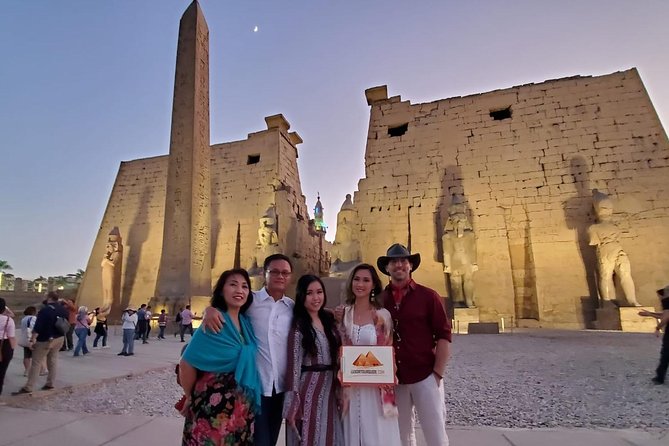
Luxor Temple completes the East Bank visit

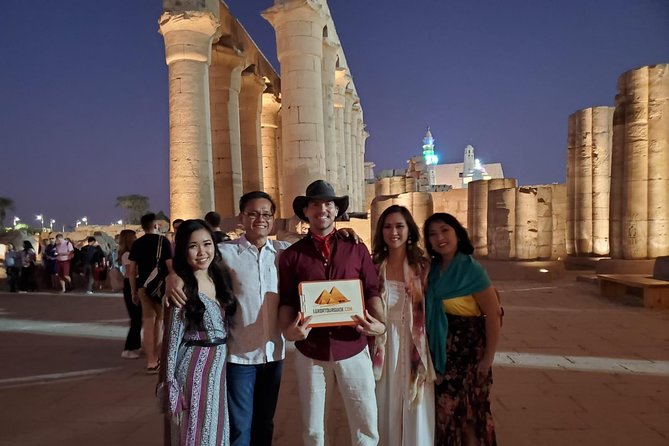
Luxor Temple is included as the fifth major sight, alongside Karnak. The supplied schedule gives detailed touring time for Karnak but does not specify a separate duration or full description for Luxor Temple, so you should confirm the exact order and time allocation with the operator before departure.
That point is worth checking because Luxor Temple deserves more than a rushed glimpse. Its inclusion gives the day a useful contrast: Karnak is a huge religious complex that grew over centuries, while Luxor Temple presents another major royal and sacred setting on the East Bank.
Ask whether the visit takes place before or after Karnak and how much free time you will have. The answer may affect your expectations, particularly after the long West Bank schedule. The tour summary clearly includes both temples, but the detailed stop information does not spell out the separate timing for Luxor Temple.
What the private guide changes
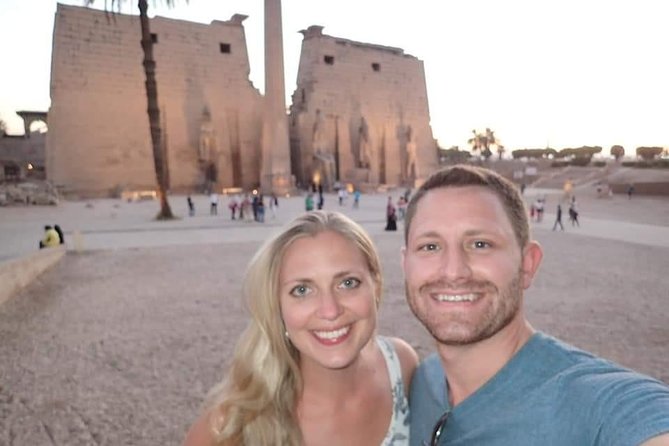
A private Egyptologist is more than a voice repeating dates. The strongest use of the guide comes before and after the moments when guiding is restricted. At the Valley of the Kings, your guide cannot enter the tombs, so the briefing beforehand becomes essential.
The supplied feedback names driver Mohamed and guide Tamer. A punctual 5:30 a.m. pickup, a comfortable air-conditioned car, and clear coordination between driver and guide were important parts of that experience. Names and staffing can change, so treat them as useful examples rather than a guarantee of who will lead your trip.
A private guide also lets you ask basic questions without feeling you are holding up a coach group. If your group wants more time on Hatshepsut’s reliefs or less time on a particular section of Karnak, you can discuss that directly.
The guide cannot remove every limit. You still have a fixed day, entrance rules, long drives, and site restrictions. But a good guide helps you spend your limited hours on the details that make the monuments understandable.
Lunch, tickets, and the real cost
Lunch is included, which is helpful on a full-day outing. The inclusion list also covers transport, parking, fuel, driver costs, taxes, and service charges. Food and drinks beyond the specified lunch are not included, so carry money for anything extra.
Site admission fees are paid separately. The tour estimates about 600 Egyptian pounds in local cash for admissions, but that figure should be treated as a planning guide rather than a guaranteed final total. Tutankhamun’s tomb requires an additional payment if you choose to enter.
Gratuities are recommended but not included. You can decide what feels appropriate based on the service you receive from the driver and guide.
The $140 price is strongest when you value convenience and privacy. You get hotel pickup and drop-off from Hurghada, a private air-conditioned vehicle, lunch, and a professional guide. If you split the cost among several people, the private setup may offer a fair balance between comfort and sightseeing time.
Who should book this Luxor day trip
I would recommend this tour to you if Luxor is high on your list but your holiday is based in Hurghada. It is also a good fit if you want one dedicated guide, dislike large groups, or prefer having transport arranged from your hotel.
It suits adults and families who can handle an early start, a long road day, walking around major archaeological sites, and hot open-air conditions. The activity information says most people can participate, but it does not provide specific accessibility details, so ask the operator directly if your group has mobility needs.
You may want a different plan if you prefer slow museum-style sightseeing, dislike pre-dawn departures, or want to spend several days in Luxor. Five major sights in one day gives you impressive coverage, but it cannot provide an unhurried visit to every monument.
The free cancellation policy allows a full refund when you cancel at least 24 hours before the local start time. Changes or cancellations inside that window are not accepted for a refund, and poor weather may lead to a new date or a full refund.
Should you book it?
Book this tour if you want the most important Luxor sights in one ambitious day without arranging the transport yourself. The private vehicle, lunch, hotel pickup, and Egyptologist guide make the $140 starting price easier to understand, especially for a small group sharing the cost.
Before booking, confirm the pickup time, the exact plan for Luxor Temple, the current admission total, and whether you want to pay extra for Tutankhamun’s tomb. If you can accept the long day and budget for tickets, this is a practical way to trade beach time in Hurghada for a memorable look at ancient Egypt.
FAQ
How long does the tour from Hurghada to Luxor last?
The experience lasts approximately 15 to 17 hours, including the journey from Hurghada, sightseeing in Luxor, and the return transfer.
Is hotel pickup included?
Yes. Hotel pickup and drop-off in Hurghada are included.
Is this a private tour?
Yes. Only your own group participates in the activity.
Which Luxor sites are included?
The tour includes the Valley of the Kings, the Temple of Hatshepsut, the Colossi of Memnon, Karnak Temple, and Luxor Temple.
Is an Egyptologist guide included?
Yes. A qualified Egyptologist guide is included.
Are entrance tickets included in the price?
No. Admission tickets are paid separately. The estimated local cash needed is about 600 Egyptian pounds.
Does Tutankhamun’s tomb cost extra?
Yes. Entering the tomb of King Tutankhamun requires an additional payment made directly at the site.
Is lunch included?
Yes. Lunch is included, but other food and drinks are not included unless specifically stated.
Can I cancel for a full refund?
Yes, if you cancel at least 24 hours before the experience start time. Cancellations or changes made less than 24 hours in advance are not refundable, and poor weather may result in another date or a full refund.
New on the Hurghada list
- Full-Day Small-Group Luxor Tour from Hurghada with Lunch & Entrance Fees★ 4.5 · 25 reviews
- From Hurghada: El Gouna Quad and MX Bike Safari Tour★ 4.5 · 25 reviews
- Cairo Over Day Egyptian Musuem & Pyramids with Transfer -Hurghada★ 5.0 · 26 reviews
- Makadi Bay: Luxor Private Tour Kings Valley and Hatshepsut★ 4.4 · 26 reviews
- Orange Bay Island By Speedboat★ 5.0 · 26 reviews
- Private Speedboat Tour From Hurghada★ 5.0 · 26 reviews
- Orange Bay Island Boat Trip and Parasailing with Lunch – Hurghada★ 5.0 · 26 reviews
- Private Tour: shopping Tour In Hurghada★ 5.0 · 26 reviews
Hurghada Tours, compared.



Orange Bay Island Boat Trip w/ Breakfast and Lunch
Read our review →
Royal Seascope Submarine Cruise with Snorkel Stop
Read our review →
3 Islands, Dolphins & Snorkel Yacht Trip w/ Lunch
Read our review →
Hurghada or Makadi: Discover the Magic of Dolphin House
Read our review →
Sindbad Submarines – Hurghada (Egypt) – 2 Hours
Read our review →