Reviewed · GIZA PYRAMIDS & SPHINX TOURS
Private Day Tour Giza Pyramids, Sphinx, Memphis, and Saqqara
The best part of this private Cairo day is the sweep of it. In one outing, you move from the famous Giza Pyramids and Sphinx to the quieter tombs of Saqqara, then finish among the remains of Memphis, Egypt’s first capital. That gives you both the postcard sights and the older, less polished places that explain how pyramid building developed.
I like the easy hotel pickup and the freedom of a private car. I also like having a guide who can point out good photo spots, explain the difference between the pyramids, and help you make sense of the tomb paintings. The main drawback is that some itineraries include perfume, papyrus, cotton, carpet, or other shopping stops, and some guides may push camel rides, buggy trips, or other paid extras.
Key points to know
- Three major archaeological areas in one day: Visit Giza, Saqqara, and Memphis without arranging separate transport.
- Private vehicle and private group: Your party travels in an air-conditioned car or van with hotel pickup and drop-off.
- Saqqara adds real depth: The Step Pyramid, Pyramid Texts, Old Kingdom tombs, and Mastaba of Ti make this more than a standard pyramid photo stop.
- Guide quality can shape the day: Strong guides such as Mona, Tonsi, Osama, Farah, and Hazem have been praised for clear explanations, flexibility, and photography help.
- Shopping stops need managing: Ask at the start for a monuments-first day if you do not want perfume, papyrus, cotton, or carpet demonstrations.
- Basic admission is included: Extra tickets for entering certain pyramids or special areas may cost more.
Why this route gives you more than the usual Cairo photo stop
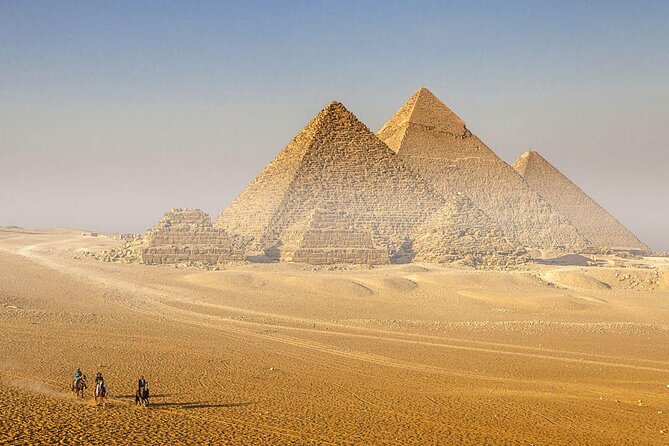
Many first-time Cairo visitors see the Great Pyramid, take a few pictures, and leave with only a vague idea of what they have seen. This route gives you a fuller day. You visit the three main royal pyramids at Giza, the Sphinx, the Step Pyramid at Saqqara, several Old Kingdom monuments, and Memphis.
That sequence matters. Giza is the grand spectacle, but Saqqara helps you understand the experiment that came before it. Memphis then connects the monuments to the wider story of early Egyptian government and kingship.
The experience lasts about eight hours, though the actual day can stretch if traffic, late pickups, lunch, or shopping stops take time. Cairo traffic is unpredictable, so do not schedule a tight evening flight or another fixed activity immediately afterward.
Because the tour is private, you are not tied to the pace of a large group. You can ask for more time at a tomb, spend less time at a shop, or tell your guide that you care more about archaeology than staged photographs. That flexibility is one of the strongest reasons to consider paying for this format.
A few other Cairo days to weigh up
- Cairo: Pyramids & Great Sphinx Private Tour with Camel Ride
★ 4.9 · 6,335 reviews - Tour to Giza Pyramids and The Egyptian Museum
★ 5.0 · 6,016 reviews - VIP All inclusive Best of the best Giza Pyramids,Sakkara,Memphis
★ 5.0 · 3,164 reviews
Hotel pickup makes the morning easier
Pickup is offered from hotels in Cairo or Giza. Your guide and driver collect you, and at the end of the day you return to the original pickup point.
That sounds basic, but it has real value in Cairo. You avoid arranging several taxi rides, bargaining over a driver waiting for you, and figuring out how to connect Giza with Saqqara and Memphis. The private air-conditioned vehicle also gives you a place to cool down between sites.
Bottled water is included. Bring more water if you can, along with sun protection and shoes suited to uneven ground. The monuments involve walking outdoors, and the heat can make the second half of the day feel longer than the first.
A useful first conversation with your guide is simple: state your priorities. If you want every minute at the ruins, say so clearly. If you want lunch, a camel ride, or time for shopping, say that too. Several strong days came from guides who adjusted the order and pace around the group’s wishes.
Giza Plateau: begin with Egypt’s biggest names
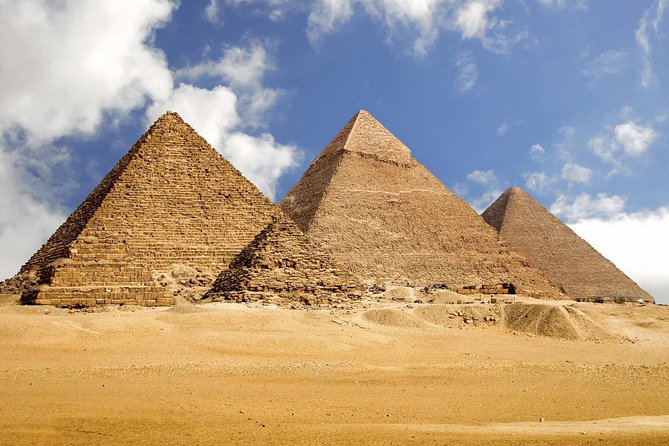
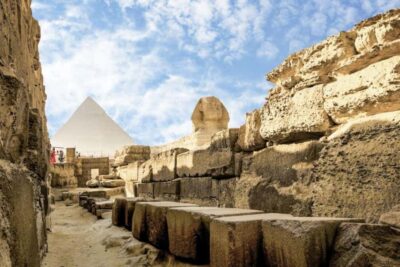
The Giza Plateau contains the Great Pyramid of Khufu, the Pyramid of Khafre, the Pyramid of Menkaure, their related temple areas, and the Great Sphinx. These monuments date from Egypt’s Fourth Dynasty, during the Old Kingdom.
The first view can feel almost unreal. The pyramids rise from the edge of the Western Desert, yet modern Cairo and Giza are close by. Your guide should help you read the site rather than simply point at the largest pyramid. Ask about the role of the valley temples, causeways, mortuary temples, and burial complexes surrounding each royal pyramid.
The Great Pyramid of Khufu is the largest of the three. The tour allows about 30 minutes at the pyramid itself, but the wider Giza visit is listed at about two hours. That distinction is important. You may see the exterior, hear the story of the complex, and take photographs without entering the pyramid.
Entry inside individual pyramids is not clearly covered by the basic admission. The itinerary specifically marks the tickets for Khufu, Khafre, and Menkaure as not included, while the main attraction admission is included. If going inside matters to you, confirm the extra cost before leaving the hotel.
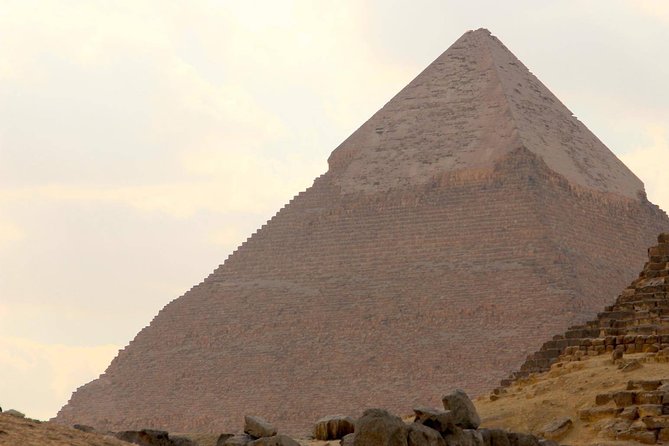
Khafre’s Pyramid often appears taller because it sits on higher ground and retains some of its smooth outer casing near the top. Its complex includes a valley temple, causeway, mortuary temple, and the Sphinx temple. Menkaure’s Pyramid is smaller, but its complex adds another useful point of comparison. The three pyramids were not simply copies of one another.
A good guide can also save you time at Giza by taking you to viewpoints where all three pyramids appear together. Guides named Tonsi, Usam, Farah, and Hazem have been praised for taking photographs and finding less crowded picture locations. Your assigned guide will vary, so treat that as a possibility rather than a guarantee.
The Sphinx and Khafre’s valley temple
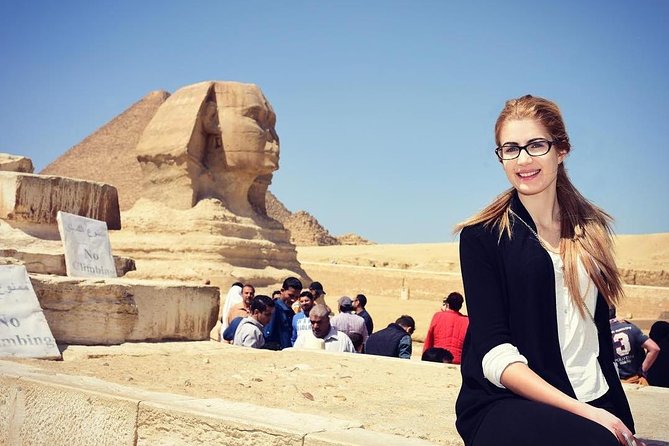
The Great Sphinx is close to Khafre’s complex. Cut from limestone bedrock, it has a lion’s body and a human head, traditionally linked to Pharaoh Khafre. The monument is about 73 meters long and 20 meters high, so its scale is easy to underestimate in photographs.
You have about 30 minutes here. That is enough for the main view, the temple area, and photographs, but not for a slow archaeological study. The Sphinx is one of the places where a guide adds value because the visible statue is only part of the story. Restoration blocks and the surrounding excavation area help explain how the monument has survived and changed.
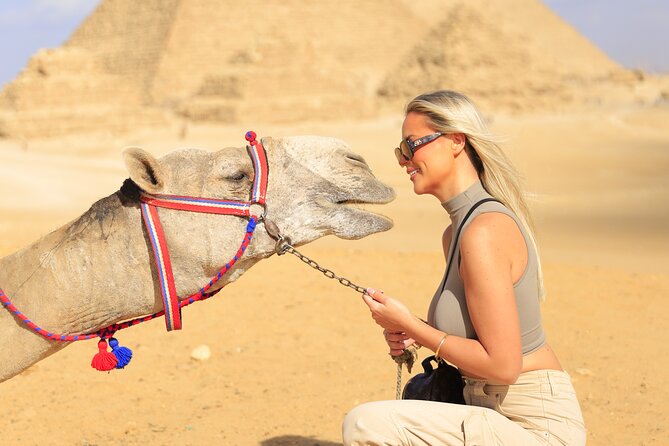
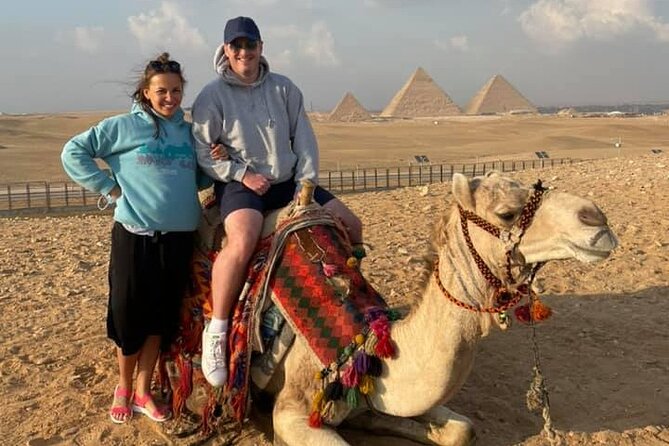
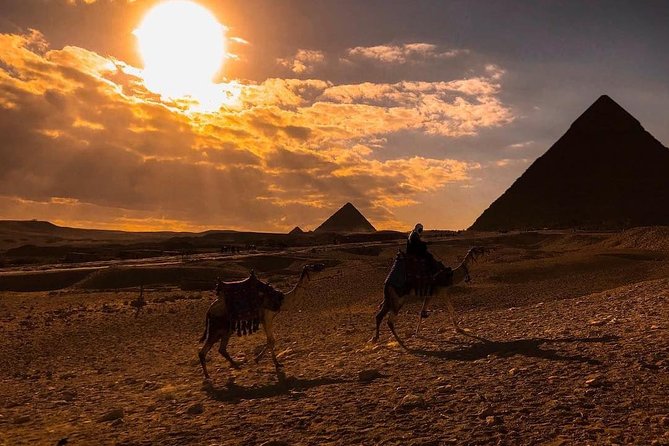
Expect persistent offers for camel rides or buggy trips around Giza. These are optional and cost extra. They can be fun if you want them, but they are not necessary to see the pyramids. If you prefer walking and monuments, say that before the tour begins.
One important warning comes from the shape of the day: a guide who spends too long arranging paid extras can shorten your time at the actual sites. Keep an eye on the clock. At a private tour, you have every right to ask how much time remains and which stop comes next.
Same base, a completely different day out:
- From Cairo: Pyramids of Giza, Sphinx, Saqqara & Memphis Tour
★ 4.7 · 3,110 reviews - Cairo 8 Hour Private Tour of Pyramids, Egyptian Museum and Bazaar
★ 5.0 · 2,931 reviews - From Cairo: Half-Day Tour to Pyramids of Giza and the Sphinx
★ 4.6 · 2,891 reviews - Cairo: Pyramids, Sakkara & Memphis Tour with Lunch
★ 4.6 · 2,493 reviews
Saqqara shows how pyramids developed
Saqqara lies about 27 kilometers southwest of Cairo. It is less immediately overwhelming than Giza, but I consider it the more rewarding part of the day for anyone interested in ancient Egypt beyond the famous monuments.
The Step Pyramid of Djoser was built as an important stage in pyramid design. It developed from the earlier mastaba form, a flat-roofed rectangular tomb, into a stacked structure that points toward the smooth-sided pyramids at Giza.
The listed visit gives Saqqara about an hour, while the description also refers to roughly two hours in the area. In practice, the time available may depend on traffic, opening hours, and how many extra stops are added. Tell your guide that the Step Pyramid and tombs are your priority.
The Pyramid of Unas is especially important because its underground chambers contain Pyramid Texts. These spells, carved into the walls for the first time in Unas’s pyramid, became part of a long tradition of funerary writing. Even if you are not an Egyptology student, the inscriptions make the visit feel more personal than an exterior pyramid photograph.
The Pyramid of Teti offers another Old Kingdom interior. The scheduled stop is short, about 15 minutes, so you may need to move briskly. The same is true of the Mastaba of Ti, listed at 15 minutes. Its wall scenes show daily activities and offer a glimpse of ordinary work, food production, craft, and social life in ancient Egypt.
That is why Saqqara can be worth protecting from sales stops. Giza gives you monumental scale. Saqqara gives you tomb decoration, religious texts, and the stages of architectural change. If your interest is ancient culture rather than shopping, make this clear from the start.
Memphis connects the monuments to a capital city
The final historical stop is Memphis, an ancient capital traditionally dated to about 3100 BCE. The site is more open and fragmentary than Giza or Saqqara, but the surviving pieces help place the pyramids within the larger story of Egyptian rule.
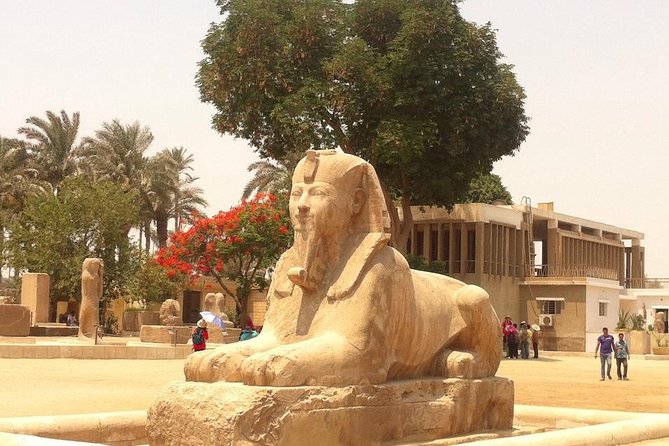
The main sights listed are the colossal statue of Ramses II and a large alabaster sphinx. The Ramses statue is displayed lying down because of its condition and size. It is a striking reminder that Memphis was not just a ceremonial name in a textbook, but a major center connected to royal power.
The Memphis stop is planned for about an hour, including travel and the visit. It works well at the end because you have already seen the royal tombs and can now think about the administration and religious system that supported them.
Do not expect a vast city preserved in full. Memphis is an archaeological site with major remains rather than a complete ancient capital. Its value comes from the pieces, the guide’s explanation, and the way it rounds out the day.
Shopping stops can change the character of the tour
The additional information for this experience includes 20-minute stops at a perfume palace, flower cotton store, papyrus center, and handmade carpet school. These are presented as places to learn about local products and buy government-approved souvenirs.
Some people enjoy this part. You might learn how oils are presented, see papyrus-making demonstrations, examine Egyptian cotton, or watch rugs being woven. If you want gifts, these stops can be convenient.
If you do not want to buy anything, they can feel like a hard interruption. The day already includes long drives and several large sites. A 20-minute stop can become longer when a demonstration turns into a sales presentation, and that time usually comes out of your visit to the monuments.
The clearest advice is to set expectations before the vehicle leaves. Say that you want to skip shopping, or ask for only one brief stop. Some guides, including Osama in one account, have avoided these places when told directly. Others have included perfume, papyrus, spice, or carpet visits despite the main archaeological focus.
The same rule applies to camel rides, buggy rides, scarves, and other add-ons. Ask for the full price before agreeing. Never assume that an activity offered by the guide is part of the $65 tour price.
What the $65 price really buys
At $65 per person, this is a strong value if you want a private vehicle, hotel transport, a guide, bottled water, and access to several major sites in one day. The price is especially attractive for a small private group because you are not sharing the vehicle or waiting for a bus to fill.
Admission is included, but the wording points to basic-area access. Entry tickets for the individual pyramids are marked separately as not included. Lunch at a local restaurant, described as optional, also costs extra, as do personal purchases, tips, camel rides, buggy rides, and shopping.
The value drops if shopping takes up much of the day or if you pay for extras without first agreeing to the price. It also drops if you want long, quiet visits at every site. There is simply a lot to cover in eight hours.
The experience is often booked well ahead, with an average booking lead time of 36 days. That suggests you should reserve early if your Cairo dates are fixed, then use the cancellation terms to protect your plans. Free cancellation is available up to 24 hours before the start time. Changes or cancellations inside that window are not accepted for a refund.
How to get the best guide-led day
Guide quality matters more here than the vehicle. The best version of the tour includes clear English, solid ancient Egyptian history, help with photographs, and a willingness to follow your priorities.
Names associated with especially strong bookings include Mona, Tonsi, Osama, Farah, Hazem, Ihab, Michael, Halawani, and Usam. You cannot select one of them from the information provided, but you can ask for a guide who explains the archaeology rather than simply escorting you from gate to gate.
A good guide may adjust the order, begin at Saqqara to avoid heavier crowds, or use the available time well after a late arrival. One particularly useful feature of a private tour is flexibility when a flight arrives late. The guide may be able to pack more into the remaining hours, although sites closing around 4 p.m. can limit what is possible.
For the best result, tell your guide:
- Which pyramids you want to enter, if any
- How much time you want at Saqqara
- If you want lunch
- If camel or buggy rides interest you
- That you do or do not want shopping stops
- If you want help taking photographs
This takes less than five minutes and can prevent a disappointing mismatch.
Who should book this private Cairo day
I would recommend it to a first-time Cairo visitor who wants the major pyramid sights plus Saqqara and Memphis without solving the transport puzzle alone. It is also a good fit for couples, families, and small groups who value a private car and the ability to adjust the pace.
It suits you particularly well if you want a guide to explain what you are seeing. Giza can be confusing without context, and Saqqara rewards someone who can explain mastabas, Pyramid Texts, and the development of pyramid architecture.
I would be cautious if you dislike sales stops, paid add-ons, or a tightly packed day. You can reduce those risks by stating your preferences firmly, but the possibility remains part of this experience. If you want only the pyramids and no extras, a simple private driver arrangement may feel less complicated, though you would give up the included guide.
Final call: a good route with one important condition
Book this tour if you want maximum historical coverage in one Cairo day and are prepared to manage the extras. Giza, the Sphinx, Saqqara, and Memphis make a satisfying route, and the private car, hotel pickup, and guide can save both time and hassle.
Before departure, confirm which admissions are included, ask about any extra pyramid tickets, and state that shopping is optional for you. With a guide who respects that plan, this can be an excellent introduction to ancient Egypt. Without that conversation, the day may contain too much selling and too little time among the stones.
FAQ
How long does the private tour last?
The experience lasts approximately eight hours, including pickup, transport between sites, sightseeing, and return to your hotel.
Where can pickup and drop-off take place?
Pickup and drop-off are offered at hotels in Cairo or Giza. You return to the original pickup location at the end of the tour.
Is this a private tour?
Yes. Only your own group participates, and transport is provided in a private air-conditioned vehicle.
Which attractions are included?
The route includes the Giza Plateau, the pyramids of Khufu, Khafre, and Menkaure, the Great Sphinx, Saqqara, the Pyramid of Unas, the Pyramid of Teti, the Mastaba of Ti, and Memphis.
Are all entrance fees included?
Basic admission is included. The itinerary marks tickets for entering the individual pyramids as not included, so confirm extra costs before the tour.
Is lunch included?
No. Lunch at a local restaurant is optional and costs extra.
Are camel rides and buggy rides included?
No. Camel rides and buggy rides are optional paid extras. Ask for the price before agreeing to one.
Can I cancel for a full refund?
You can cancel at least 24 hours before the start time for a full refund. Cancellations or changes made less than 24 hours before the experience are not accepted for a refund.
New on the Cairo list
- Private Tour Giza Pyramids Wonders All inclusive★ 5.0 · 26 reviews
- Private Half Day Tour to Giza Pyramids & Great Sphinx from Cairo★ 5.0 · 26 reviews
- Private Tour To Pyramids of Giza Memphis Saqqara With Lunch★ 5.0 · 26 reviews
- 2 days 1 night Luxor,Aswan & Abu simbel by flight from Cairo★ 4.5 · 26 reviews
- Private Day to Giza Pyramids, Egyptian Museum and camel sunset★ 5.0 · 26 reviews
- Siwa Oasis Tour 3 Day 2 Nights from Cairo★ 5.0 · 26 reviews
- VIP Cairo Day Trip Coptic Orthodox Church & Islamic Old Mosques★ 5.0 · 26 reviews
- Cairo sailing boat Tours on the Nile by felucca★ 4.0 · 26 reviews
Giza Pyramids & Sphinx Tours, compared.
Pyramids & Great Sphinx Private Tour with Camel Ride
Read our review →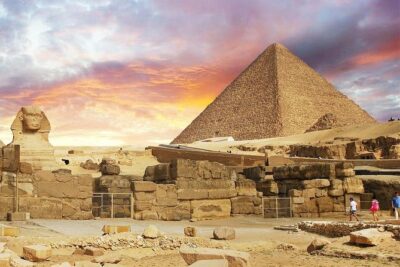
Tour to Giza Pyramids and The Egyptian Museum
Read our review →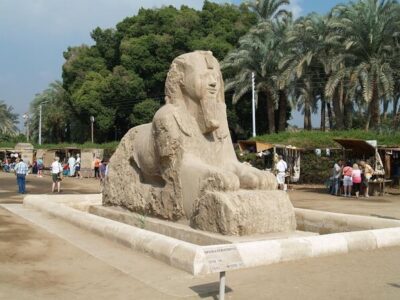
VIP All inclusive Best of the best Giza Pyramids,Sakkara,Memphis
Read our review →
Pyramids of Giza, Sphinx, Saqqara & Memphis Tour
Read our review →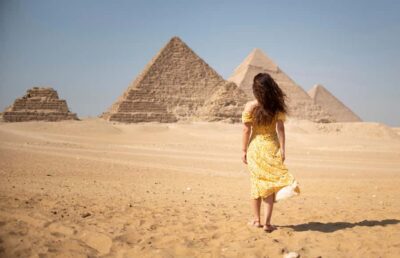
Half-Day Tour to Pyramids of Giza and the Sphinx
Read our review →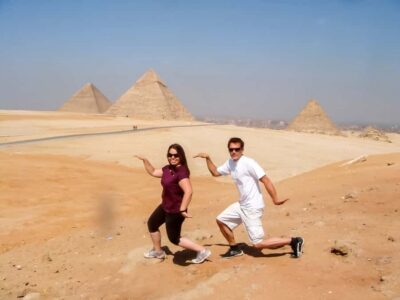
Private ViP all-inclusive Giza Pyramids,Sphinx,Inside Pyramid
Read our review →