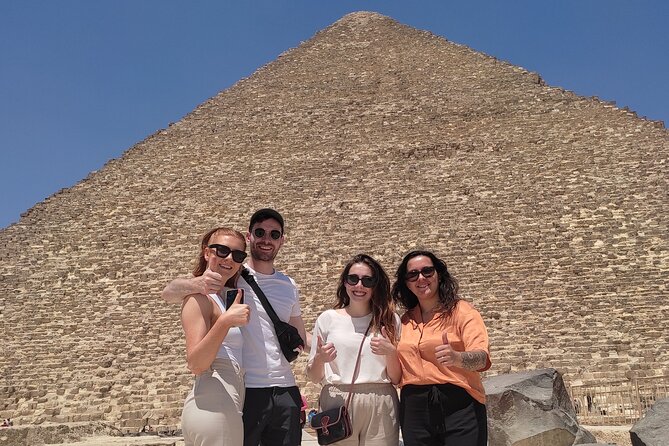
Reviewed · GIZA PYRAMIDS & SPHINX TOURS
Full Day Tour Giza Pyramids, Sphinx, Saqqara &Dahshur Pyramids
The big draw here is simple: in one long Cairo day, you see the famous Giza Pyramids and Sphinx, then continue to the older step pyramid at Saqqara and the unusual Bent and Red Pyramids at Dahshur. It gives you the clearest picture of how Egyptian pyramid building developed.
I like the private vehicle and hotel pickup, which remove much of Cairo’s transport stress. I also like the chance to ask questions and adjust the pace with guides such as Ahmed, Anan, or Wael. The main consideration is time. Ten major stops in 8 to 9 hours can feel brisk, and you may wish you had more time at Giza.
Key points at a glance
- Three major pyramid areas in one day: Visit Giza, Saqqara, and Dahshur without arranging separate transport.
- Private attention: Your group travels alone, giving you room to ask questions and request changes.
- Ancient engineering in sequence: See the mature pyramids at Giza, Djoser’s step pyramid, and Sneferu’s experimental designs.
- Optional interior visits: Entry inside some pyramids requires an extra ticket, while the Red Pyramid may be open for free entry.
- A useful panoramic stop: The Giza viewpoint gives you time for photos and camel riding if that option is selected.
- Good value at $60: The price is attractive for a full private day, but check exactly which add-ons are included.
Why this day covers Egypt’s pyramid story so well
Many Cairo pyramid outings stop at Giza. This one adds Saqqara and Dahshur, so you see more than the postcard version of ancient Egypt.
At Giza, you meet the finished ideal: smooth-sided pyramids built on an enormous scale. At Saqqara, you see the earlier step form linked to King Djoser and the architect Imhotep. At Dahshur, the Bent Pyramid shows a design problem in progress, while the Red Pyramid points toward the classic shape later used at Giza.
That sequence gives the day real purpose. You are not simply collecting monuments. You are watching ancient builders test shapes, materials, angles, and construction methods over several generations.
The tour lasts about 8 to 9 hours. That is enough time to cover the three areas, but not enough to linger everywhere. I would think of it as a strong first survey of the pyramid fields, not a slow archaeological study.
A few other Cairo days to weigh up
- Cairo: Pyramids & Great Sphinx Private Tour with Camel Ride
★ 4.9 · 6,335 reviews - Tour to Giza Pyramids and The Egyptian Museum
★ 5.0 · 6,016 reviews - VIP All inclusive Best of the best Giza Pyramids,Sakkara,Memphis
★ 5.0 · 3,164 reviews
Hotel pickup makes a long Cairo day easier
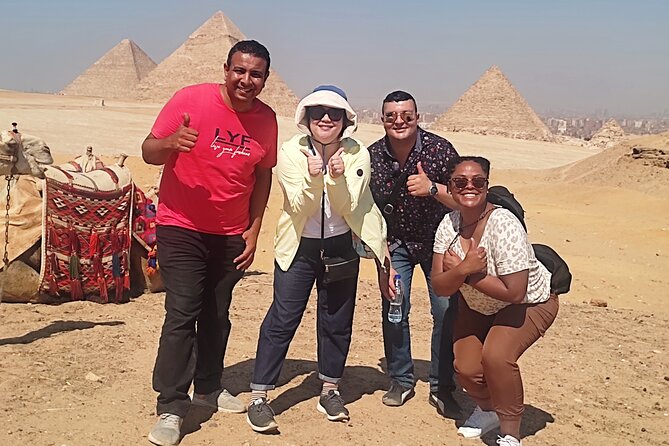
Pickup and drop-off are offered from accommodation in Cairo or Giza. You travel in a private air-conditioned vehicle, with bottled water included.
That matters more than it may sound. The sites are spread across different parts of the greater Cairo area, and the day includes several road transfers. Having one driver and one vehicle saves you from finding taxis, negotiating each ride, or trying to connect public transport between remote archaeological areas.
The private setup also gives you a little control. You can ask questions as they arise, request a short pause, or spend less time at a stop that does not interest you. Previous customers singled out both guides and drivers for being caring, respectful, informative, and safe, with Ahmed, Anan, Wael, and driver Omar receiving particular praise.
Pickup from the airport, Nasr City, October City, or Heliopolis costs an extra $15 per person. Pickup from the New Administrative Capital costs an extra $20 per person. Confirm your pickup location before booking so the low headline price does not surprise you later.
Giza begins with the three great pyramids
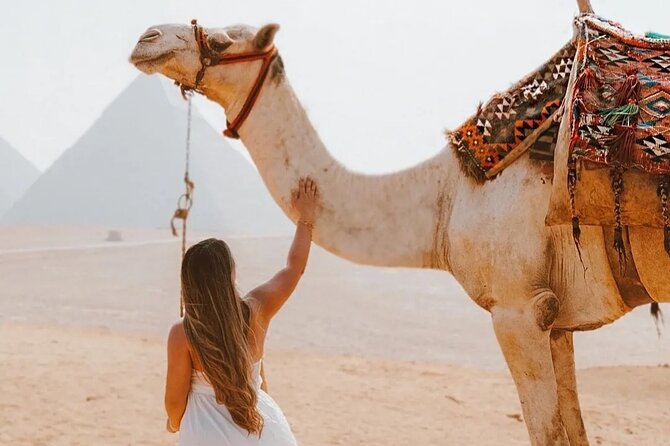
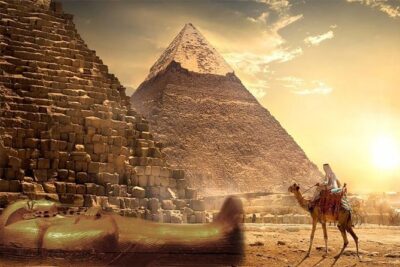
The first major section covers the Giza Plateau and its famous monuments. You see the pyramids of Khufu, Khafre, and Menkaure, followed by the Valley Temple, the panoramic viewpoint, and the Sphinx.
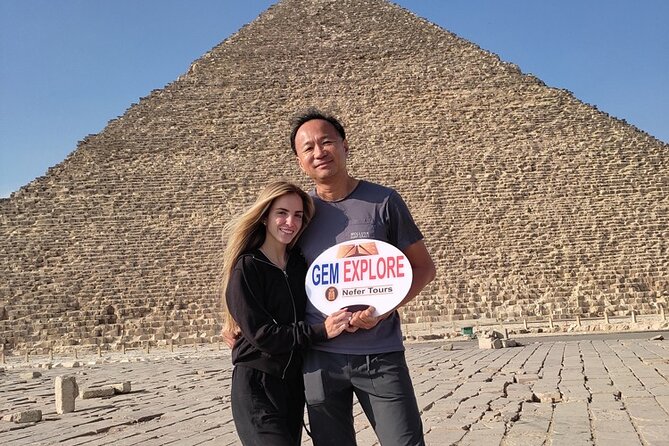
Khufu’s Great Pyramid is the oldest and largest of the three. It is also the only surviving structure from the ancient Seven Wonders. The original complex included a valley temple, causeway, mortuary temple, and other elements, though parts of the valley temple now lie beneath the modern village of Nazlet el-Samman.
Your guide can explain how the pyramid functioned as part of a wider royal complex rather than as an isolated triangular monument. That context helps you read the site properly. The pyramid itself is the headline, but the surrounding temples and processional route show how the royal burial program worked.
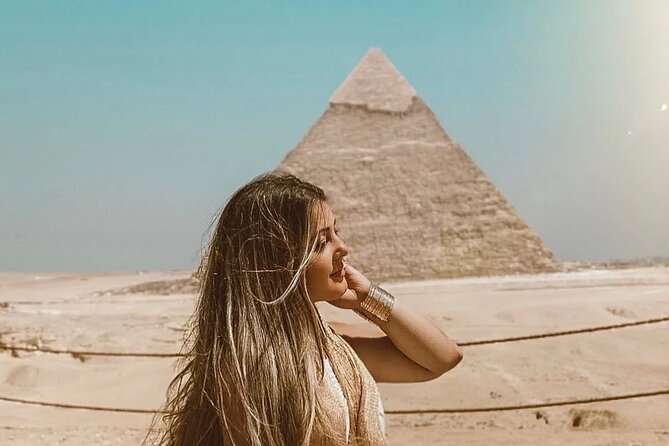
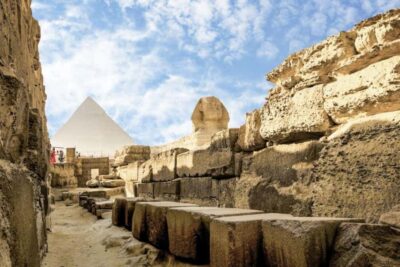
Khafre’s Pyramid is the second highest. Its upper casing stones are gone, but the remaining cap at the top makes it easy to understand how smooth and polished the pyramids originally looked. The nearby Valley Temple is especially important because it was used in the preparation and mummification process connected with Khafre.
Menkaure’s Pyramid is smaller, but it has its own appeal. Granite blocks remain on the lower section, and the stone came from Aswan, more than 1,000 kilometers away. I like this detail because it turns the monument into a logistics lesson. Moving such heavy material across Egypt required planning, labor, boats, and time.
The supplied schedule gives roughly an hour for the initial Giza area, another hour around Khufu, 30 minutes for Khafre, and additional time at Menkaure, the viewpoint, and the Sphinx. In practice, the exact rhythm may depend on traffic, entrance lines, heat, and how much you want to photograph.
The panoramic viewpoint is useful for photos and camels
The Giza viewpoint offers a broad view of six pyramids and the city of Giza. You have about 30 minutes there, which is enough for photographs and a look back across the plateau.
This is also the main place connected with camel rides. A camel ride is included only if you choose the package that includes it, so check the booking option carefully. If you want the ride, use the viewpoint as a chance to ask your guide about timing and cost details before agreeing to anything on site.
The stop is practical because the pyramids look different from a distance. Up close, their scale can be hard to judge. From the viewpoint, their relationship to one another becomes clearer, and you can take the classic group photograph without trying to fit an entire pyramid into a cramped frame.
Same base, a completely different day out:
- From Cairo: Pyramids of Giza, Sphinx, Saqqara & Memphis Tour
★ 4.7 · 3,110 reviews - Cairo 8 Hour Private Tour of Pyramids, Egyptian Museum and Bazaar
★ 5.0 · 2,931 reviews - From Cairo: Half-Day Tour to Pyramids of Giza and the Sphinx
★ 4.6 · 2,891 reviews - Cairo: Pyramids, Sakkara & Memphis Tour with Lunch
★ 4.6 · 2,493 reviews
The Sphinx rewards a close look
The Great Sphinx is visited with the same general entry to the pyramid area. You have about 30 minutes for a close view and photographs, with help from your guide.
The lion body and human head make the Sphinx instantly familiar, but its condition is best understood from nearby. Look at the worn surfaces, the missing nose, and the enormous paws. Your guide can also explain the traditional connection with King Khafre and the role of the Sphinx as a guardian figure.
Thirty minutes is a sensible amount of time for the basic visit, though you may want longer if photography matters to you. The Sphinx area can become one of the day’s slower points because everyone wants the same front-facing image. A private guide is useful here because you can ask for help with where to stand and how to organize the stop.
Pyramid interiors require planning
The standard area entry does not automatically mean you can enter every pyramid. Interior access to the Giza pyramids requires a special ticket, and the guide can assist with this purchase.
That distinction is important when comparing prices. The $60 per-person starting price covers a full private outing, but extra pyramid tickets may cost more. If entering Khufu or Khafre is a priority, say so before the day begins and ask which ticket is needed.
The interiors are not for everyone. Tight passages, steep sections, and limited space can make the experience physically demanding. The information provided specifically warns against entering the Bent Pyramid if you are claustrophobic or have health concerns. Take that warning seriously, and do not feel that you must go inside to have a worthwhile day.
Saqqara shows the first great step
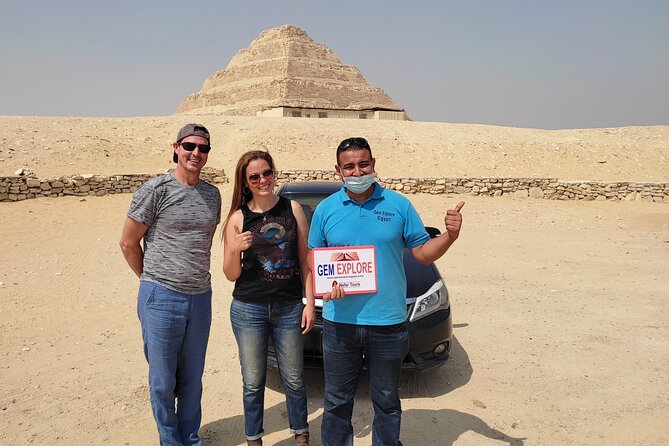
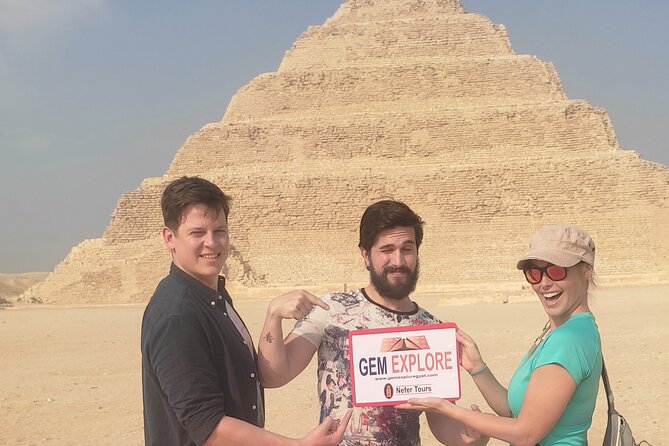
After Giza, the tour moves to Saqqara, home of King Djoser’s Step Pyramid. The site dates to about 2670 BC and is described as the oldest stone structure in the world.
Here, the key sight is not only the pyramid but the large complex around it. You can see the colonnaded entrance, enclosure wall, Sed Festival complex, north and south pavilions, the Southern Tomb, and nearby tombs. The setting helps you understand that Djoser’s monument was a carefully planned ceremonial center.
The Step Pyramid is made from stacked levels, unlike the smooth-sided pyramids at Giza. It represents a major stage in pyramid design, and the architect Imhotep is central to the story. A good guide can connect the structure’s design to the changing ambitions of Egyptian kings and the growing use of stone in monumental building.
The planned Saqqara visit includes about 30 minutes in the wider area and 1 hour 30 minutes at the Step Pyramid complex. That is one of the more generous portions of the day, and rightly so. Saqqara contains more layers and details than a quick photo stop can show.
Some pyramid interiors may be available without an extra charge, but entry to the Step Pyramid and the new Southern Tomb of King Djoser requires a special ticket. Ask about those tickets if you want to go inside. Otherwise, use the time to study the entrance, walls, columns, and surrounding tombs.
Dahshur puts pyramid design on display
After lunch, you head through Giza’s villages toward Dahshur. This is where the tour becomes especially useful for anyone interested in how pyramid construction changed.
The Bent Pyramid and Red Pyramid were built during the reign of Sneferu, between 2613 and 2589 BC. They are among Egypt’s oldest, largest, and best-preserved pyramids. Unlike the Step Pyramid, both move toward the smooth-sided form that later became standard.
The Bent Pyramid is the more unusual sight. Its lower section rises at a steep angle, then the upper section changes angle, creating the bent profile. The change reflects an early attempt to solve the engineering challenge of building higher with sloping sides.
The outer casing remains in unusually good condition, giving you a better idea of the polished appearance many pyramids once had. The pyramid is open inside, but reaching the interior is challenging. You must be fit, and the narrow route may be uncomfortable if you are claustrophobic or have a health problem.
The Red Pyramid is often easier to understand as the finished version of the experiment. Its reddish limestone gives it its name, and it is considered the first classic smooth-sided pyramid in Egyptian history. The stone came from the Tura Mountains near Cairo.
You may be able to enter the Red Pyramid for free, according to the supplied details. Still, access conditions can change, so ask your guide on the day. If you enter, expect a physically demanding passage rather than a polished museum-style interior.
Lunch and optional extras need a close check
Lunch is included only with the appropriate package option, as is the camel ride. Bottled water is included, while area entry fees are included if you select that option.
The price begins at $60 per person. For a private 8 to 9-hour day covering three archaeological areas, private transport, a guide, and hotel pickup, that is a strong starting value. The final cost depends on the package you choose and any special pyramid tickets you add.
Before confirming, check four points:
- Whether area entry fees are included in your selected option
- Whether lunch is included
- Whether the camel ride is included
- Which interior pyramid tickets cost extra
This is not nitpicking. A low advertised price can look different once airport transfers, special entrances, and optional activities are added. The tour remains good value if you choose the inclusions that matter to you and skip the rest.
The private format is the main advantage
A private tour changes the feel of a busy sightseeing day. You are not waiting for a large group to finish every photograph or follow a fixed pace that suits nobody.
The guide can spend more time on the subjects you care about. You might focus on construction methods, royal burial customs, architecture, or the stories of Djoser and Sneferu. If you are traveling with family, one person can take photographs while another asks questions without holding up a bus group.
The private driver is just as important. Giza, Saqqara, and Dahshur are separate areas, and the vehicle handles the connections between them. The air conditioning is a practical comfort in Egypt’s heat, especially during a full day outdoors.
The tradeoff is that the tour still has a lot packed into it. Private does not mean slow. If you want a quiet, unhurried visit to Giza alone, book a shorter tour. If you want to compare several pyramid sites in one day, this schedule makes sense.
Who should book this pyramid tour
I would choose this tour if you have one full day in Cairo and want more than the standard Giza visit. It suits first-time visitors who want the main sights explained without having to arrange transport between distant sites.
It also suits anyone curious about pyramid design. Seeing Djoser’s steps, Sneferu’s Bent Pyramid, the Red Pyramid, and the Giza group in one day gives you a useful progression that separate Giza-only outings cannot provide.
Families and small groups should benefit from the private format, especially if they want flexibility. The tour is also a good match for people who prefer a guide who can answer questions directly rather than listening to a fixed group presentation.
I would hesitate if you dislike long sightseeing days, have mobility limits that make steep or narrow pyramid passages difficult, or want extended time inside the monuments. You can skip the interiors, but the distance between sites and the number of stops still make this an active day.
Free cancellation is available when you cancel at least 24 hours before the start time. Changes or cancellations inside that window are not accepted for a refund.
Should you book the $60 private day?
Book it if you want the broadest pyramid overview in a single Cairo outing. The strongest reasons are the private transport, hotel pickup, direct guide attention, and the rare chance to compare Giza, Saqqara, and Dahshur without solving the transport puzzle yourself.
Ask for the inclusions that match your plans before you pay. If you want pyramid interiors, lunch, a camel ride, or airport pickup, confirm each item and its additional cost.
For a packed but worthwhile day, this is a sensible choice. Just protect your energy for the final stops, keep an open mind about skipping a difficult interior, and allow more time at Giza on another visit if the Great Pyramid deserves your full attention.
FAQ
How long does the tour last?
The tour lasts approximately 8 to 9 hours.
Is hotel pickup included?
Pickup and drop-off are offered from accommodation in Cairo or Giza. Pickup from the airport, Nasr City, October City, or Heliopolis costs an extra $15 per person. Pickup from the New Administrative Capital costs an extra $20 per person.
Is this a private tour?
Yes. Only your group participates, and transport is provided in a private air-conditioned vehicle.
Are pyramid interior tickets included?
Entering the Giza pyramids requires a special ticket. Entry to the Step Pyramid and the new Southern Tomb of King Djoser also requires an extra ticket. The guide can assist with these purchases.
Are lunch and the camel ride included?
Lunch and the camel ride are included only if you select the option that includes them. Check the chosen package before booking.
Can I cancel for a full refund?
Yes, if you cancel at least 24 hours before the experience start time. Cancellations or changes made less than 24 hours before the start time are not accepted for a refund.
New on the Cairo list
- Private Tour Giza Pyramids Wonders All inclusive★ 5.0 · 26 reviews
- Private Half Day Tour to Giza Pyramids & Great Sphinx from Cairo★ 5.0 · 26 reviews
- Private Tour To Pyramids of Giza Memphis Saqqara With Lunch★ 5.0 · 26 reviews
- 2 days 1 night Luxor,Aswan & Abu simbel by flight from Cairo★ 4.5 · 26 reviews
- Private Day to Giza Pyramids, Egyptian Museum and camel sunset★ 5.0 · 26 reviews
- Siwa Oasis Tour 3 Day 2 Nights from Cairo★ 5.0 · 26 reviews
- VIP Cairo Day Trip Coptic Orthodox Church & Islamic Old Mosques★ 5.0 · 26 reviews
- Cairo sailing boat Tours on the Nile by felucca★ 4.0 · 26 reviews
Giza Pyramids & Sphinx Tours, compared.
Pyramids & Great Sphinx Private Tour with Camel Ride
Read our review →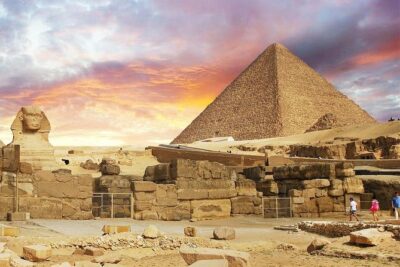
Tour to Giza Pyramids and The Egyptian Museum
Read our review →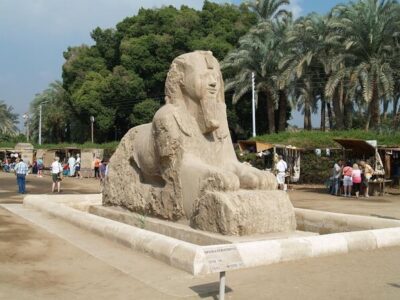
VIP All inclusive Best of the best Giza Pyramids,Sakkara,Memphis
Read our review →
Pyramids of Giza, Sphinx, Saqqara & Memphis Tour
Read our review →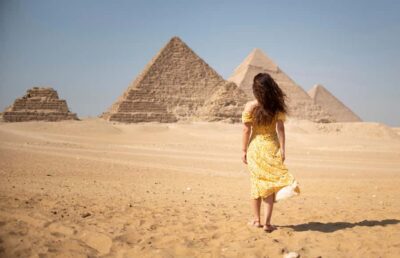
Half-Day Tour to Pyramids of Giza and the Sphinx
Read our review →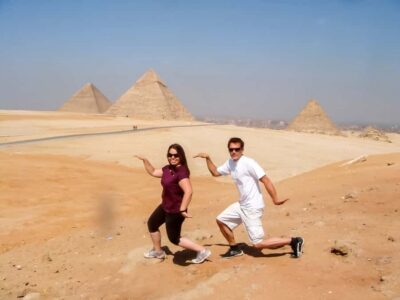
Private ViP all-inclusive Giza Pyramids,Sphinx,Inside Pyramid
Read our review →