Reviewed · GIZA PYRAMIDS & SPHINX TOURS
Giza Pyramids, Sphinx & inside the Great Pyramid of Khufu
The best reason to choose this Giza tour is simple: it includes entry inside the Great Pyramid of Khufu, not just an outside look at its huge limestone face. You also visit the Pyramids of the Queens, Khafre’s Mummification Temple, the Sphinx, and a panoramic viewpoint, so the outing covers far more than a quick photo stop.
I like the private format, since your group can have time for photos and questions without being tied to strangers. I also like the clear all-inclusive plan, which can include lunch, drinks, a camel ride, and the Great Pyramid ticket. The main point to check before booking is which price option you are selecting, since several inclusions apply only to the all-inclusive package.
Key points at a glance
- Inside Khufu’s Great Pyramid: Spend about an hour at the pyramid connected with Pharaoh Khufu, with admission included when the all-inclusive option is selected.
- All three major pyramids: See Khufu, Khafre, and Menkaure, each with a different shape, setting, and story.
- Sphinx and Mummification Temple: Visit the famous lion-bodied statue and the nearby remains linked with Khafre’s burial rites.
- Private hotel pickup: Your own group receives pickup and drop-off, which takes much of the guesswork out of reaching the Giza Plateau.
- Camel ride, lunch, and drinks: These are part of the all-inclusive package, along with bottled water and soft drinks on board.
- About four to six hours: The advertised length gives you a half-day visit, though the exact pace can vary with pickup and time at each site.
Why going inside Khufu changes the visit
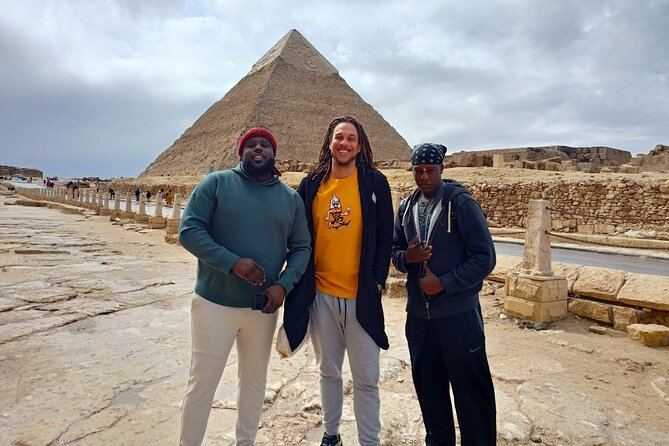
From the outside, Khufu’s pyramid is almost too large to grasp. Walking into it gives you a more physical sense of the monument. You are no longer only looking at a royal tomb from a distance. You are entering its narrow interior passages and seeing how the building works from within.
The Great Pyramid was built around 2560 BC for Pharaoh Khufu. It originally reached about 146.6 meters, or 481 feet, and now measures about 138.8 meters, or 455 feet. More than two million limestone blocks went into the structure. For more than 3,800 years, it was the tallest human-made structure in the world.
The interior ticket is important because access inside the Great Pyramid is often treated as an extra on Giza visits. Here, it is included only when you select the all-inclusive price option, so read the booking choice with care. The time allocated is about one hour, enough to make the visit a central part of your day rather than a rushed add-on.
You should also know what kind of experience this is. The attraction is the ancient structure itself, not a furnished royal tomb. The inside visit is about stone, corridors, scale, and the effort of reaching the inner chambers. If you dislike tight spaces or physical exertion, this may be the part you find most demanding.
A few other Giza days to weigh up
- Private guided tour to Giza Pyramids, and Great Sphinx
★ 5.0 · 1,755 reviews - VIP Giza Pyramids,Sphinx,ATV bike,CamelRide,Shopping&DinnerCruise
★ 5.0 · 704 reviews - Private Tour to explore Giza Pyramids – Saqqara -Memphis
★ 5.0 · 294 reviews
A half-day route across the Giza Plateau
The tour lasts about four to six hours and begins with pickup at your hotel. Your guide and driver handle the movement between sites, while you focus on the monuments. Since this is a private activity, only your group participates.
The advertised route gives you roughly three hours at the main Giza complex, one hour at Khufu’s pyramid, and about thirty minutes each at Khafre’s pyramid, Menkaure’s pyramid, the panoramic viewpoint, and the Sphinx. Those times are approximate, but they show the balance of the day: the pyramids receive the most attention, with time left for photographs and the key supporting monuments.
A guide can also help you understand the site in the right order. The three pyramids are not simply three similar buildings lined up in the desert. They belong to different pharaohs and periods within Egypt’s Fourth Dynasty, and their positions affect how large they appear.
Khufu, Khafre, and Menkaure
Khufu’s Great Pyramid is the largest and the main event. Its vast size can make the other two seem smaller, but each has its own character.
Khafre’s pyramid is the middle-sized pyramid and was built for Pharaoh Khafre around 2520 BC. It appears taller than Khufu’s because it sits on higher ground. Look closely at the top, where some of the original smooth limestone casing remains. That small surviving section helps you picture how all three pyramids once looked, before their outer surfaces were removed or worn away.
The Great Sphinx is associated with Khafre and sits near his pyramid. Its human head and lion’s body were carved from one piece of limestone. At about 73 meters long and 20 meters high, it is much larger than photographs suggest.
Menkaure’s pyramid is the smallest of the three, originally about 65 meters high. That does not make it a throwaway stop. Its complex includes a mortuary temple and three smaller pyramids linked with queens. Much of the original casing has disappeared, while large limestone and granite blocks still show the scale of the work.
I like this three-pyramid sequence because it keeps the visit from becoming one repeated sight. Khufu gives you size and the inside visit. Khafre gives you the surviving casing and the connection with the Sphinx. Menkaure gives you a closer look at a smaller royal complex and the queen’s pyramids.
The Pyramids of the Queens and Khafre’s temple
The tour includes entry to the Pyramids of the Queens, a useful addition for anyone who wants more than the standard pyramid photographs. These smaller structures help you see that the Giza site was a complete funerary complex, not just three isolated tombs.
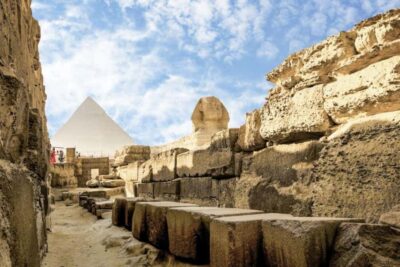
Khafre’s Mummification Temple is another valuable stop. This was where the pharaoh’s body was prepared before burial. The remaining ruins include large pillars and sections of the original temple, giving you a clearer idea of the ceremonies and buildings connected with a pyramid.
This stop also adds context to the Sphinx and pyramid. Ancient Egyptian royal burials involved a series of stages, and the temple was part of that process. I would pay attention here to the relationship between the spaces, rather than treating the temple as another pile of old stone.
Same base, a completely different day out:
- From Hurghada: Pyramids and Egyptian Museum Tour & Boat Ride
★ 4.4 · 381 reviews - Egyptian Museum in Cairo: Private Guided Tour
★ 5.0 · 316 reviews - Cairo: Grand Egyptian Museum QR Ticket
★ 4.7 · 243 reviews - Sharm El-Sheikh: Full-Day Tour of Cairo and Pyramids by Bus
★ 4.8 · 237 reviews
The panoramic viewpoint and the best photo pause
The panoramic area offers a broad view of Khufu, Khafre, and Menkaure together. It is one of the most useful points in the tour because you can see the scale, spacing, and alignment of the group at once.
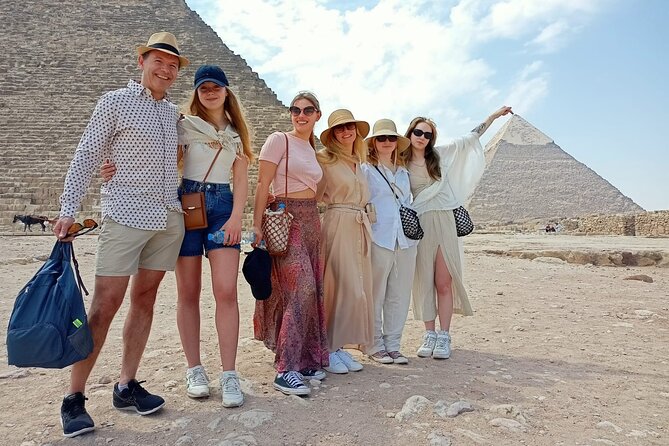
This is the place for wide photographs, including the three pyramids against the desert. Your guide can also take photos for you, an especially handy service when you want more than selfies. One of the strongest parts of the experience is the balance between guided explanation and time to explore on your own.
Do not rush this stop. The pyramids can look deceptively close together from certain angles, yet the viewpoint helps you understand the size of the plateau and the difference in their positions. It is also a natural pause after the more focused visits to the pyramid interiors and temples.
The Sphinx and the Mummification Temple
The Great Sphinx is a short but essential stop. Its damaged face and enormous body invite the usual questions about age, purpose, and identity. The statue is believed to represent Khafre, and its location near his pyramid is an important clue to the wider design of the complex.
The nearby Mummification Temple reveals a less familiar side of the site. The pyramids were royal tombs, but the temples supported the rituals that made the burial possible. Large pillars and surviving sections of masonry give the guide material to explain how the pharaoh’s body was prepared and moved toward burial.
You receive about thirty minutes for this part of the visit. That is enough to see the main features, hear the explanation, and take photographs, though anyone who enjoys close archaeological study may wish for longer. The overall tour is designed as a strong half-day introduction, not a full archaeological research visit.
What the all-inclusive price means
The listed price is $30 per person, and the tour offers group discounts. That sounds like good value for a private half-day outing, but the exact value depends on the package you choose.
The all-inclusive option covers:
- Site entrance fees
- Entry to the Great Pyramid of Khufu
- A qualified Egyptologist guide
- Hotel pickup and drop-off
- Lunch and drinks
- Bottled water and soft drinks on board
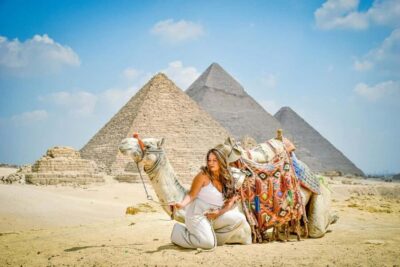
- A 20-minute camel ride
- Skip-the-line tickets
The wording matters. The Great Pyramid ticket, lunch, drinks, camel ride, and site fees are specifically tied to the all-inclusive option. Do not assume every $30 booking includes the same items until you have checked the selected package.
If you want the inside visit, this package can be a sound buy because the ticket is already arranged. The camel ride also adds a classic Giza activity without forcing you to negotiate for one at the site. One particularly useful detail is that the camel ride is listed as 20 minutes, though the guide may be able to adjust the experience. Mahmoud, one of the guides associated with this tour, arranged a longer camel ride for no extra cost for one group.
Lunch and drinks matter more than they might seem in the Giza heat. Having food and bottled water included means fewer interruptions and less need to search for a place to eat during a tightly timed visit. Still, I would confirm exactly what the selected package contains before payment.
The guide can make the difference
The monuments are impressive without help, but the guide shapes how much you take away. This experience includes a qualified Egyptologist guide, and the strongest part of the service is the practical handling of the day as much as the historical explanation.
Mahmoud is specifically associated with arranging the route, the Great Pyramid entry, photographs, and a longer camel ride. Andrew is another guide connected with the experience. Since guide assignment can vary, you should not assume one particular person will lead your group, but these names give you an idea of the personal service offered.
A good rhythm for this site is short explanations followed by time alone. That is how the tour is designed. You receive background on the pharaohs, construction, burial customs, and the individual monuments, then have room to take photographs and look around.
This format suits you if you want help with the history but do not want every minute filled with a lecture. It also works well for first-time visitors who might otherwise spend the day trying to work out ticket access, routes, and transport.
Transport, pace, and practical comfort
Hotel pickup and drop-off are major advantages in Giza. The site is close to Cairo, but reaching the right entrance and moving between major points can be confusing if you are handling everything alone. Having a driver also keeps the day focused on the plateau rather than on arranging taxis.
The tour is private, so your group does not have to wait for a large coach party. That can help with photographs and small timing changes. It does not mean every part of the visit will be quiet or uncrowded, since the pyramids and Sphinx are major attractions, but it gives you more control than a standard group outing.
Most people can participate, and the location is near public transportation. The Great Pyramid interior deserves special thought. The experience may involve narrow passages and physical effort, so consider your comfort before treating the included ticket as an automatic must-do.
You can expect confirmation when you book, and mobile tickets make the arrangement easier to manage. Free cancellation is available if you cancel at least 24 hours before the start time. Inside that 24-hour window, the amount paid is not refunded, and changes are not accepted.
Who should book this Giza experience
I would choose this tour if you want the main Giza sights in one organized half-day and you care about entering Khufu’s pyramid. It is especially suited to first-time visitors, couples, families, and small groups who value hotel transport and a private guide.
It also suits you if you want a few extras built into the day. Lunch, drinks, and a camel ride can save time and avoid small negotiations at the site. The skip-the-line arrangement is useful when you would rather spend your limited Cairo time looking at ancient monuments than waiting at a ticket counter.
I would hesitate if you want a slow, highly specialized archaeology tour. The itinerary covers a lot in four to six hours, and each supporting stop receives about thirty minutes. You may also prefer another plan if you do not want a camel ride, lunch, or other package features included in the price.
The 31-day average advance booking suggests that planning ahead is sensible. That is particularly true if you want the all-inclusive option and a private pickup on a specific day.
Should you book it?
Book this Giza tour if you want a well-organized first encounter with the plateau, inside access to Khufu, and the convenience of having transport, tickets, food, drinks, and a camel ride handled together. The private format and time for your own photographs add real value.
Before booking, confirm that you have selected the all-inclusive option and that the Great Pyramid ticket is included. If you are comfortable with the interior conditions and prefer a guided half-day over independent planning, this is a strong choice at the stated price. If you want long, unhurried time at each pyramid, choose a slower itinerary instead.
FAQ
How long does the Giza Pyramids tour last?
The experience lasts about four to six hours, depending on the day’s timing and transport.
Is hotel pickup and drop-off included?
Yes. Hotel pickup and drop-off are included.
Does the tour include entry inside the Great Pyramid of Khufu?
Yes, but the Great Pyramid ticket is included when you select the all-inclusive price option.
Does the tour include a camel ride?
A 20-minute camel ride is included with the all-inclusive option.
Are lunch, drinks, and bottled water included?
Lunch and drinks are included with the all-inclusive option. Bottled water and soft drinks are also listed for the vehicle.
Can I cancel for a full refund?
Yes. You can cancel at least 24 hours before the experience start time for a full refund. Cancellations or changes made less than 24 hours before the start time are not accepted for a refund.
New on the Giza list
- Private Tour Giza Pyramids Wonders All inclusive★ 5.0 · 26 reviews
- Private Day to Giza Pyramids, Egyptian Museum and camel sunset★ 5.0 · 26 reviews
- Sakkara, Memphis & Dahshur Tour★ 5.0 · 26 reviews
- Half Day Giza Pyramids and Sphinx★ 5.0 · 26 reviews
- Pyramid Duo Rooftop Capturing Elegance from the Rooftop★ 5.0 · 26 reviews
- Comfort experience To Saladin castle, bazaar, old Cairo & museum★ 5.0 · 27 reviews
- Half Day private guided tour Giza Pyramids,Sphinx,lunch,camel rid★ 5.0 · 27 reviews
- Cairo: Giza Pyramids & Museum of Egyptian Civilization Tour★ 4.4 · 27 reviews
Giza Pyramids & Sphinx Tours, compared.
Pyramids & Great Sphinx Private Tour with Camel Ride
Read our review →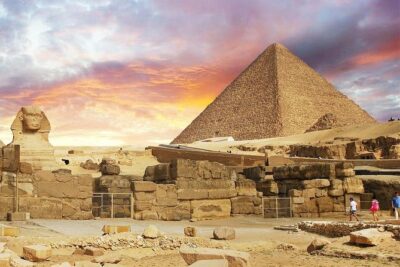
Tour to Giza Pyramids and The Egyptian Museum
Read our review →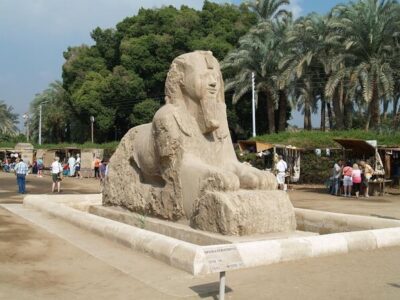
VIP All inclusive Best of the best Giza Pyramids,Sakkara,Memphis
Read our review →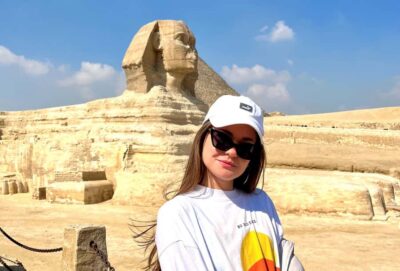
Pyramids of Giza, Sphinx, Saqqara & Memphis Tour
Read our review →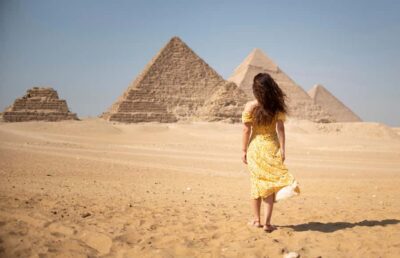
Half-Day Tour to Pyramids of Giza and the Sphinx
Read our review →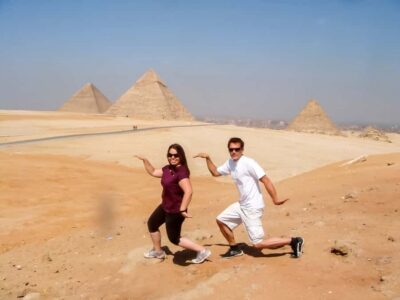
Private ViP all-inclusive Giza Pyramids,Sphinx,Inside Pyramid
Read our review →