
Reviewed · CAIRO TOURS
2 Days 1 Night Travel Package To Aswan & Luxor From Cairo
The most striking thing about this two-day Egypt tour is the distance it covers. You leave Cairo before dawn, fly to Aswan, visit Philae and the High Dam, make the long road trip to Abu Simbel, then continue to Luxor for a full day of temples and tombs before flying home. I like the included domestic flights and the chance to see Abu Simbel without arranging several separate bookings.
I also like the private-tour format, since your group can move at its own pace and ask questions without following a large crowd. Guides such as Samir have earned strong praise for clear explanations and for arranging food and souvenir stops. The main caution is simple: this is an intense schedule, and unclear flight details, meals, or hotel arrangements can cause real trouble if you do not confirm them in writing.
Key points to know before booking
- Abu Simbel is the headline stop: You make the long drive from Aswan to the enormous temples of Ramesses II and Nefertari.
- The schedule begins at 3:00 am: Your Cairo pickup and airport transfer start very early, so plan for a demanding first day.
- Two domestic flights save time: Cairo to Aswan and Luxor to Cairo are included, along with transfers in all three cities.
- The private guide matters: A guide such as Samir can add useful context at sites that otherwise feel like a parade of stone walls and names.
- Hotel and meals need checking: Accommodation is optional, lunch and dinner are not included, and breakfast is not promised.
- This is a packed tour, not a leisurely Nile trip: You see a remarkable amount in two days, but you spend long hours in vehicles and airports.
Why this Cairo to Aswan and Luxor plan is appealing
Southern Egypt holds some of the country’s most important ancient sites, but getting there from Cairo takes planning. This package handles the broad structure: airport transfers, domestic flights, local transportation, a private guide, and admission fees. That makes it useful if you have only two days and do not want to coordinate several local operators.
The route also has a good historical sweep. In Aswan, you see a temple rescued from rising water. At Abu Simbel, you meet the grand political style of Ramesses II. In Luxor, the focus shifts to royal burial, religious power, and the temples of ancient Thebes.
At $500 per person, the value depends on what your chosen option actually includes. Round-trip domestic flights, private transfers, guides, and entrance fees can make the price reasonable for a short trip. But the headline price should not be treated as an all-in total until you confirm the hotel, meals, flight schedule, and any site supplements.
The accommodation wording deserves special attention. A hotel night can be added, or you may arrange your own accommodation. One booking involved a room setup that did not suit two friends, while another traveler booked a hotel independently in Aswan and was collected the next morning. If you are sharing a room with someone who needs separate beds, settle that point before payment.
A few other Cairo days to weigh up
- White & Black Desert tour 2 Days 1 night camping from Cairo.
★ 5.0 · 649 reviews - Cairo: 2-Day Bahariya Oasis Camp and Desert Tour
★ 4.9 · 616 reviews - White & Black desert camping tour 2 Days 1 night From Cairo
★ 5.0 · 467 reviews
Day one: Philae, the High Dam, and Abu Simbel
Your day begins with a hotel pickup in Cairo at about 3:00 am. A representative takes you to Cairo International Airport for the flight to Aswan. This early start is not a minor detail. You need energy for a day that includes airport time, several ancient sites, and roughly 300 kilometers of driving to Abu Simbel and back by road.
Once in Aswan, you head to Philae Temple. The original temple complex sat near the First Cataract of the Nile, but repeated flooding from the Aswan Low Dam and later the High Dam threatened it. During the international Nubia rescue campaign, the temples were dismantled and rebuilt on nearby Agilkia Island.
That setting gives Philae an extra layer of interest. You are not simply looking at an ancient monument. You are seeing a modern rescue project that saved an ancient monument from the river. The temple’s reliefs and columns honor Isis, and the island approach helps explain why the site feels separate from the modern city.
The planned visit lasts about three hours, including admission. You should use your guide here. Philae contains layers of Egyptian, Greek, and Roman work, and the carved scenes can look similar if you do not know what to look for. Ask your guide to point out the changes in style and the effects of the relocation.
The next stop is the Aswan High Dam, usually about 30 minutes. The dam controls the Nile’s annual floods, supports a large share of Egypt’s electricity supply, and keeps river navigation more consistent. It also created Lake Nasser and caused the relocation of major Nubian monuments, including Abu Simbel.
I find this stop valuable because it connects modern Egypt with the ancient sites you are visiting. The dam brought major benefits, but it also permanently changed the river and forced the movement of temples. Your guide can help turn what might otherwise be a quick photo stop into a useful piece of context.
Abu Simbel: the long road to Ramesses II
Abu Simbel is the day’s major prize, but reaching it takes commitment. The temples lie about 230 kilometers southwest of Aswan, with the road journey listed at roughly 300 kilometers. The visit itself is planned for about three hours, but the full outing takes much longer once driving and stops are included.
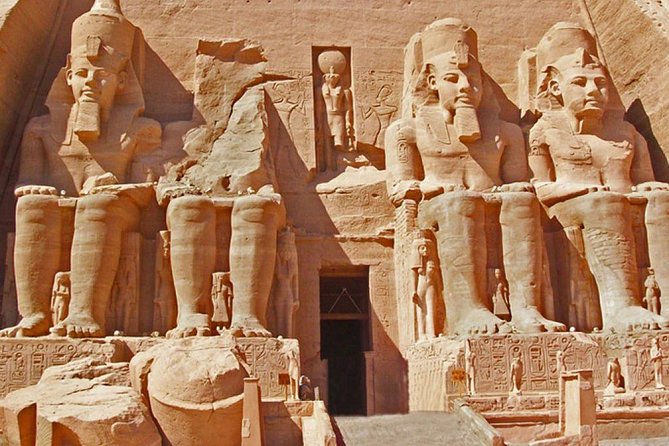
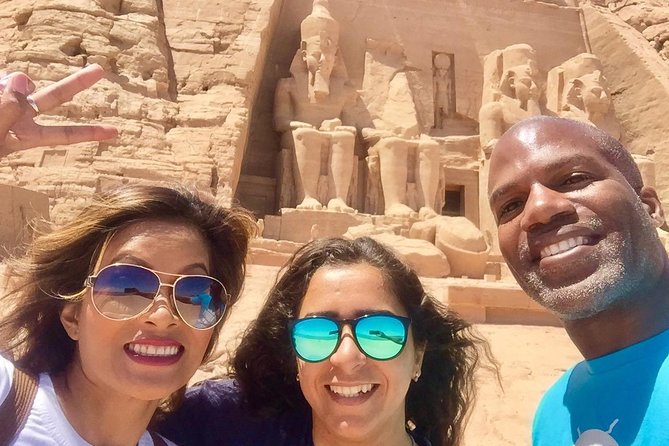
The larger temple is dedicated to Ramesses II. Four huge seated figures cut into the mountainside greet you at the entrance, and their scale gives the site its famous force. The smaller temple honors Queen Nefertari and is also linked to the goddess Hathor. Together, the temples celebrate royal power, religion, and Ramesses II’s victory claim at the Battle of Kadesh.
Do not rush the interiors. The outside statues are the obvious attraction, but the chambers contain carved scenes and inscriptions that explain how the king wanted to be remembered. With a private guide, you can ask for a focused explanation instead of trying to absorb every wall at once.
The return drive is the hard part. You will have already flown from Cairo, visited two Aswan sites, and spent hours on the road. A review of the experience praised Abu Simbel and Aswan but also warned about the long hours in the car. That is a fair trade-off: Abu Simbel is difficult to reach, and this tour gives you a practical way to see it, but the route is not easy.
Food is another concern. Lunch and dinner are not included, and one person arrived in Aswan hungry because no breakfast or lunch had been provided. Carrying food is wise, but the tour information does not promise that meals can be brought or arranged. Ask the operator exactly where meal stops occur and who pays.
The overnight question: Aswan, Luxor, and room arrangements
The package is described as two days and one night, with accommodation available as an option. The supplied details do not make the hotel standard fully clear, so ask four direct questions before booking:
- Is the hotel included in the $500 price or added separately?
- Is the night in Aswan or Luxor?
- Is the room private, and can you request twin beds?
- Does the rate include breakfast only, as the bed-and-breakfast wording suggests?
These questions matter because the schedule depends on an early pickup the next morning. If you arrange your own hotel, give the property details to the operator and get written confirmation of the pickup time and location.
The hotel can also affect the real value of the tour. A basic room may be fine if you only need a few hours of sleep, while a more comfortable property costs more but may be welcome after Abu Simbel. The package gives you a choice, which is useful, but choice also means you must make sure the final price matches your needs.
Same base, a completely different day out:
- Cairo: Pyramids & Great Sphinx Private Tour with Camel Ride
★ 4.9 · 6,335 reviews - Tour to Giza Pyramids and The Egyptian Museum
★ 5.0 · 6,016 reviews - VIP All inclusive Best of the best Giza Pyramids,Sakkara,Memphis
★ 5.0 · 3,164 reviews - From Cairo: Pyramids of Giza, Sphinx, Saqqara & Memphis Tour
★ 4.7 · 3,110 reviews
Day two: royal tombs on Luxor’s west bank
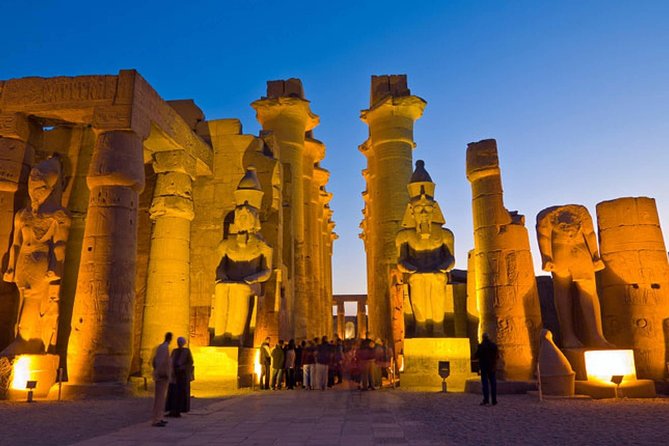
The second day focuses first on Luxor’s west bank, the ancient Theban Necropolis. The Valley of the Kings contains rock-cut tombs made over nearly 500 years, from the 16th to the 11th century BC. Pharaohs and high-ranking nobles of the New Kingdom were buried here, and more than 60 tombs and chambers are known.
The basic admission fee is included according to the tour details, but optional visits can cost extra. The clearest example is the tomb of King Tutankhamun. You should ask before entering which tombs are covered by your ticket and what supplement applies to Tutankhamun’s tomb.
The valley is best approached with realistic expectations. You are not visiting one grand building. You are moving through a dry valley filled with separate tomb entrances, each with its own condition and decoration. Some chambers are small and plain, while others preserve striking painted scenes.
The planned visit lasts about three hours. That gives you time to see the main area, but the heat and walking can add up, especially after the previous day. Wear sensible shoes and keep water close. The provided details do not specify the exact number of tombs entered, so ask your guide which ones are open that day.
Hatshepsut’s temple and the Colossi of Memnon
The Temple of Hatshepsut at Deir el-Bahari is one of Luxor’s most distinctive monuments. Its terraces rise against the cliffs, creating a strong contrast with the separate tombs of the Valley of the Kings. The temple was built for Hatshepsut and dedicated to Amun.
Hatshepsut ruled as pharaoh during Egypt’s Eighteenth Dynasty, and the monument reflects her need to present royal authority in a very public way. The temple’s three levels and broad approach make it easy to understand as a ceremonial building, not simply a place of burial.
The visit is planned for about two hours. Restoration has continued over many years, so some areas may look more complete than others. Take time to examine the surviving reliefs rather than treating the site as a quick viewpoint.
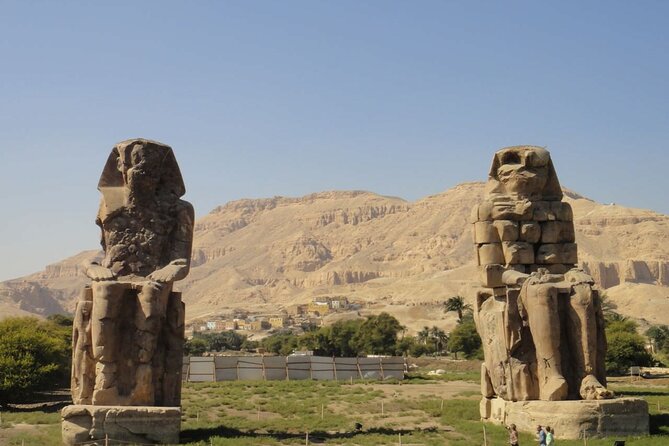
The Colossi of Memnon are a shorter stop, about 30 minutes. These two massive statues portray Amenhotep III and have watched over the Theban Necropolis since about 1350 BC. They once formed part of a larger mortuary temple, much of which no longer survives.
This is mainly a photo and orientation stop, but it helps you picture the scale of the royal monuments that once lined Luxor’s west bank. Your guide can explain what remains and what has disappeared.
Luxor Temple and Karnak: the grand east bank finish
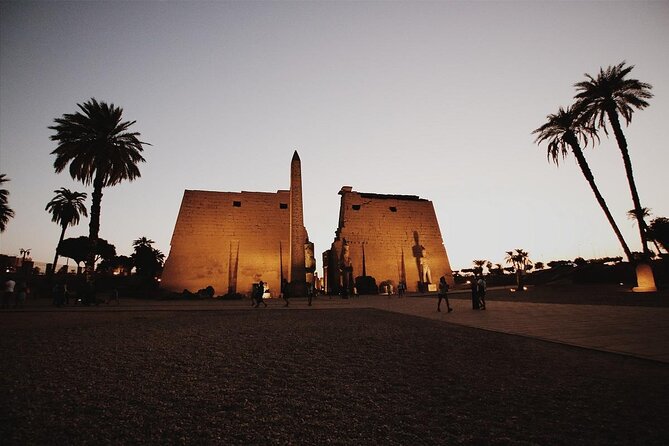
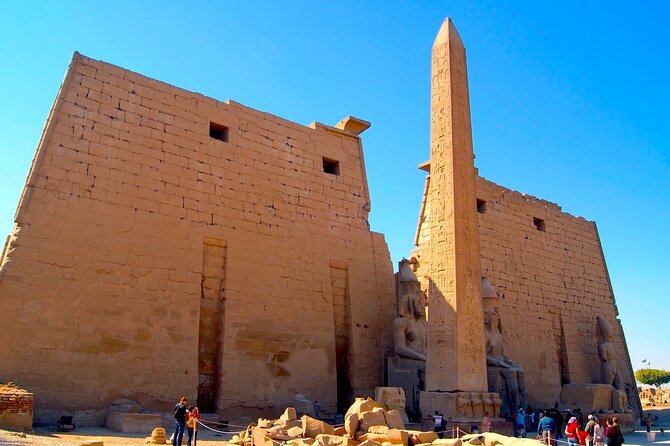
Luxor Temple sits in the modern city on the east bank of the Nile. Built around 1400 BC, it was known in ancient Egyptian as the southern sanctuary. Unlike many temples in Thebes, it was not dedicated to a single cult god or deified ruler in the same way as a mortuary temple.
The planned visit lasts about two hours. Look for the mix of construction from different rulers and the way the temple relates to the ancient city around it. Luxor Temple is especially useful after the west bank sites because it shows the public and religious side of ancient Thebes, rather than focusing only on royal death.
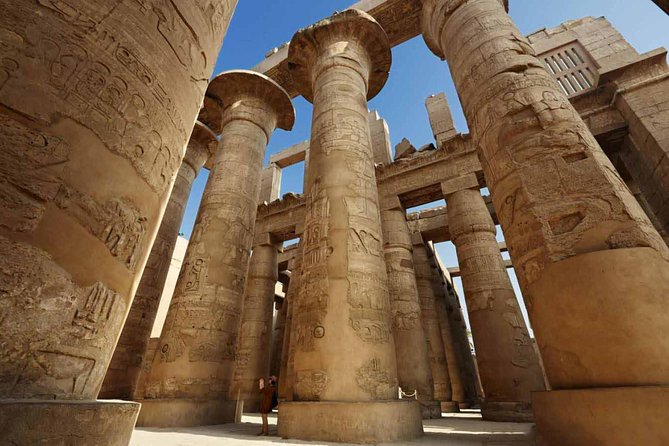
Karnak takes another two hours and is the largest site on this itinerary. The complex includes temples, chapels, pylons, and other structures built over many centuries, from the Middle Kingdom into the Ptolemaic period. Most of what you see dates from the New Kingdom, when Thebes held major religious and political power.
Give yourself room to slow down in the Great Hypostyle Hall, where enormous columns crowd the space. Karnak is not a single temple with one clear route. It is a sprawling religious complex, so a guide is particularly useful for explaining which rulers added which sections.
The itinerary places Karnak near the end of the day, followed by a transfer to Luxor Airport and the flight back to Cairo. That makes for an efficient finish, but also a tiring one. Delays at any earlier stop could put pressure on the airport transfer, so confirm the planned departure time and the name of the person meeting you in Luxor.
Guides, vehicles, and private-tour advantages
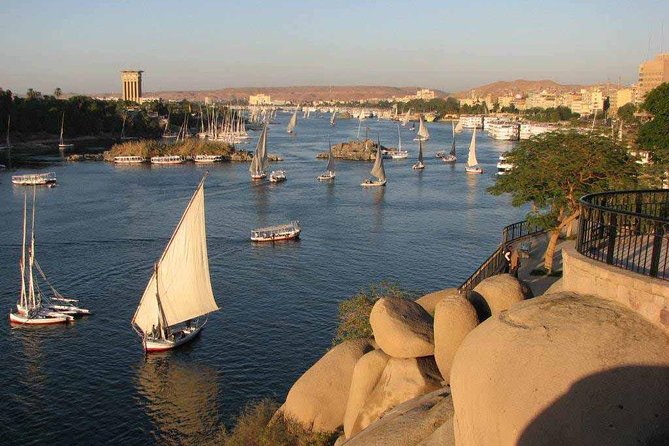
The package includes a private tour, meaning only your own group participates. That can be a major advantage during a schedule this tight. You can ask to spend more time at Abu Simbel or less time at a stop that interests you less, though the flight and airport times will limit how much flexibility is possible.
One guide named Samir received especially warm praise for his explanations and for building in food and souvenir stops. Another person found the guide’s repeated requests to tip friends uncomfortable and disliked the smoking. These details point to an important practical matter: tipping is not included, and you should decide your own tipping budget rather than feeling pressured during the day.
The package includes a tour guide, but the supplied information does not guarantee that the same guide accompanies you on both days. It also does not provide vehicle models, drive times between every stop, or a detailed hour-by-hour schedule. Ask for the full plan before departure.
Flight information needs special care. One booking had no flight details supplied in advance, and the airport pickup information appeared incorrect at first. Another booking had a problem when the driver did not arrive for the Luxor airport transfer. These are not small errors when you are traveling on a fixed two-day schedule, so confirm both flights and every airport pickup in writing.
What the $500 price really covers
At $500 per person, the package is best judged as a time-saving arrangement rather than a cheap sightseeing day. Included services are round-trip flights from Cairo to Aswan and Luxor to Cairo, transfers in Cairo, Aswan, and Luxor, a private guide, and entrance fees.
The phrase entrance fees can depend on the tour option selected. Optional visits, including King Tutankhamun’s tomb, are excluded. Tipping, lunch, dinner, and the optional hotel night are also outside the basic inclusions unless your chosen package says otherwise.
I would compare the price against the cost of booking two flights, several private transfers, a long Aswan to Abu Simbel road trip, a Luxor guide, and admissions separately. The package may be good value if you want one company responsible for the whole route. It is less attractive if you already have a hotel, can arrange flights cheaply, and prefer to set your own pace.
Confirmation is promised within 48 hours, subject to availability. You must provide a passport photo during booking, so have that ready. The cancellation terms are strict close to departure: a full refund requires cancellation at least six full days ahead, with a 50 percent refund available two to six days before the start time. Cancellation less than two days before departure receives no refund.
Who should book this fast southern Egypt tour?
I would choose this package if you have limited time in Egypt and want the major Aswan and Luxor sights without planning every transfer yourself. It suits an independent couple, family, or small group that values a private guide and can handle early starts, long drives, and a tightly packed route.
It is also a good fit if Abu Simbel is high on your list. Reaching it independently takes extra planning, while this itinerary places the temple at the center of day one.
I would hesitate if you want relaxed meals, long afternoons, or plenty of unplanned time. The schedule leaves little room for delays. I would also avoid booking until the operator confirms the hotel setup, meal plan, flight numbers, and airport contacts.
Should you book it?
Book it if your priority is seeing Philae, Abu Simbel, the Valley of the Kings, Hatshepsut’s temple, Luxor Temple, and Karnak in only two days. The private format, included flights, and guide support make an ambitious route possible.
Do not book it on price alone. Confirm every moving part, especially accommodation, food, flight information, and the Luxor airport pickup. If those details are clear and you accept the long hours, this can deliver a powerful snapshot of southern Egypt. If you want comfort and breathing room, spend more nights in Aswan and Luxor and visit these sites at a slower pace.
FAQ
How long does the tour last?
The experience lasts approximately two days and includes one overnight stay if you select the accommodation option or arrange a hotel yourself.
What time does the tour start?
The stated start time is 3:00 am, when you are picked up from your Cairo hotel for the transfer to Cairo International Airport.
Are flights included?
Yes. Round-trip domestic flights from Cairo to Aswan and from Luxor to Cairo are included.
Is Abu Simbel included?
Yes. The Abu Simbel Temple Complex is part of the Aswan day, and admission is included according to the selected tour option.
Is accommodation included?
Accommodation is listed as optional. You can add a hotel or arrange your own, so confirm the final package price and room details before booking.
Are meals included?
Lunch and dinner are not included. The accommodation option is described on a bed-and-breakfast basis, but you should confirm exactly what breakfast is provided.
Is the tour private?
Yes. Only your group participates in the private tour.
Are entrance fees included?
Entry fees are included, but the exact inclusions depend on the tour option selected. Optional visits, such as entering King Tutankhamun’s tomb, are not included.
What documents are needed to book?
You need to provide a photo or copy of your passport during the booking process.
New on the Cairo list
- Private Half Day Tour to Giza Pyramids & Great Sphinx from Cairo★ 5.0 · 26 reviews
- Private Tour Giza Pyramids Wonders All inclusive★ 5.0 · 26 reviews
- Private Tour To Pyramids of Giza Memphis Saqqara With Lunch★ 5.0 · 26 reviews
- 2 days 1 night Luxor,Aswan & Abu simbel by flight from Cairo★ 4.5 · 26 reviews
- Private Day to Giza Pyramids, Egyptian Museum and camel sunset★ 5.0 · 26 reviews
- Siwa Oasis Tour 3 Day 2 Nights from Cairo★ 5.0 · 26 reviews
- VIP Cairo Day Trip Coptic Orthodox Church & Islamic Old Mosques★ 5.0 · 26 reviews
- Cairo sailing boat Tours on the Nile by felucca★ 4.0 · 26 reviews
Cairo Tours, compared.
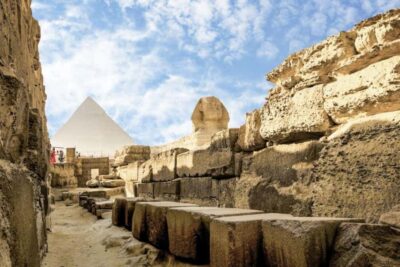
Pyramids & Great Sphinx Private Tour with Camel Ride
Read our review →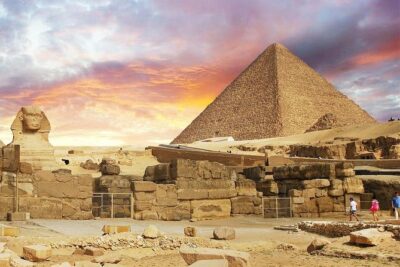
Tour to Giza Pyramids and The Egyptian Museum
Read our review →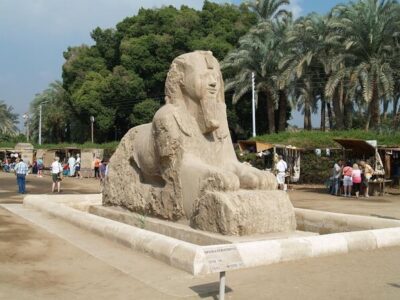
VIP All inclusive Best of the best Giza Pyramids,Sakkara,Memphis
Read our review →
Pyramids of Giza, Sphinx, Saqqara & Memphis Tour
Read our review →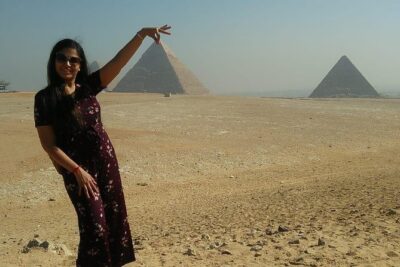
Cairo 8 Hour Private Tour of Pyramids, Egyptian Museum and Bazaar
Read our review →
Half-Day Tour to Pyramids of Giza and the Sphinx
Read our review →
Private ViP all-inclusive Giza Pyramids,Sphinx,Inside Pyramid
Read our review →Browse the lists this tour appears in